
Sketchy Analogies of Leading Change
I must confess some hesitation to share this post on my blog, as my attempt at a digital visual represents an analogy that seemed way cooler inside my head! I was aiming for a retro, chalk-style graphic, and it amuses me that it turned out like the quality that I could have created by hand. However, staying true to my roots as a storyteller, I invite you inside my evidently very sketchy mind to imagine several analogies of leading change, starting with the one represented visually below, and ending with stories of spring growth in the following text.
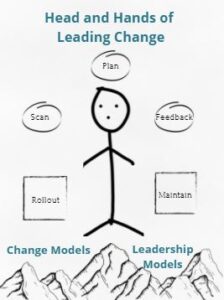
Successful change within an organization is impacted by many complex factors and is depicted in three components in my model above. Starting with the base, the change process should be established on strong theoretical foundations. Moving to the top for the first stage, it requires extensive front-loaded effort, including a thorough context scan, development of a strong plan, and throughout the entire change process, strong communication and feedback. Much of this stage involves research, thought, and communication, thus represented in this graphic at the “head” level. The secondary stage of implementing change is the active rollout and maintenance, represented at the “hand” level due to its hands-on nature. Note that communication and feedback loops should continue throughout and trigger iterative evaluation and refinement in both the head and hands stages, but I could not find a functional way to represent this graphically. I believe that consideration of all of these steps, stages, and foundational information will increase success rates in change initiatives.
There is great value in knowing some of the foundational theory and models for leadership and change in digital learning environments. My greatest affinity in leadership models thus far is something akin to servant leadership with many characteristics of Aboriginal leadership as described by Wright & Zinni (2010). These include aspects that may support leading change, such as a global perspective of the community and context, connections and relationships, values-based decisions and action, and collaboration. In consultation with B. Breitkreutz (personal communication, February 14, 2022), he suggested that transformational leadership may also be an effective model for situations that require change as his perception of it includes clear vision, relationship-, motivation-, and inspiration-building skills. He also noted that there are many models or frameworks that can help structure processes for successful change. One example is the broad process of design thinking that would enable a leader to work through the steps of empathize, define, ideate, prototype, test in order to achieve change (Baker III & Moukhliss, 2020). Another pseudo-change model he suggested was Tony Bates’ (2015) SECTIONS framework for selecting technology to use in digital learning environments. Both design thinking and the SECTIONS framework emphasize early research, including a thorough context scan, detailed plan, and gathering input and feedback. I envision integration of these theories as standing on the shoulders of giants, or on the rock-solid and lofty heights of knowledge accumulated by those who have gone before us as we venture into leading change. From this foundation, we can enter into what I depict as the “head” stage of the process and then finally to the “hands” stage.
In my experience, the first action in leading change should be relatively inactive, with a focus on research, information gathering, and communication through a thorough scan of the context that prepares the organization for successful rollout and maintenance in the second and final stage. Stage one should include learning about culture, values, history, people, resources, and more. Some early change models incorporate three general stages, such as Lewin, 1947; Backhand & Harris, 1977; and Beer, 1980. Later models such as Evans and Schaefer’s 10 Tasks and the CHANGE model articulate early steps that include context and planning in more detail (Biech, 2007). Consultation with a colleague supported the integrity of early planning, as he identified key strategies such as “creating hype for the change, planning contingencies for bumps and support for change, really good communication, reassessing and refining, and consideration of safety factors” (B. Breitkreutz, personal conversation, February 14, 2022). The depth of thought and effort in this “head” stage of leading change will pave the way for success when the rubber hits the road in the final “hands” stage. Active implementation of change is more likely to be successful if embedded between foundational theory and thorough early planning.
As I consider what I believe to be the three broad components of leading change, other analogies come to mind. Imagine a garden with a firm foundation of rock (theory), a thick layer of rich organic soil (pre-planning), and flourishing plants actively growing and being tended (rollout and maintenance of changes). The simple analogy of a single plant with rich theoretical soil, strong roots of pre-planning, and the plant itself as the change also fits. Without the theory and pre-planning, implementation will fail. Perhaps it’s just the joy of spring that sparks my imagination in these directions, but it is notable that these analogies also represent the perhaps immeasurable complexity of systems contextualized and embodied in components that must be considered when leading change.
References
Baker III, F. W., & Moukhliss, S. (2020). Concretising Design Thinking: A Content Analysis of Systematic and Extended Literature Reviews on Design Thinking and Human‐Centred Design. Review of Education, 8(1), 305-333.
Bates, T. (2019). Teaching in the Digital Age—Second Edition (2nd Edition). Tony Bates Associates Ltd. https://pressbooks.bccampus.ca/teachinginadigitalagev2/
Biech, E. (2007). Thriving Through Change: A Leader’s Practical Guide to Change Mastery. Association for Talent Development. https://royalroads.skillport.com/skillportfe/main.action?path=summary/BOOKS/22651#summary/BOOKS/RW$1544:_ss_book:22651
Julien, M., Wright, B., & Zinni, D. M. (2010). Stories from the circle: Leadership lessons learned from aboriginal leaders. The Leadership Quarterly, 21(1), 114–126. https://doi.org/10.1016/J.LEAQUA.2009.10.009
Alisha,
I agree wholeheartedly that the first stage should include learning about culture, values, history, people, resources, and more. This is aspect I have seen forgotten when working in a large organization in Japan and a large organization in Canada. Sometimes new leaders can be unaware of the work culture or the culture of the community and this can result in some very unpredictable results. I also appreciated your visual and your title. I am glad you shared.
Sam