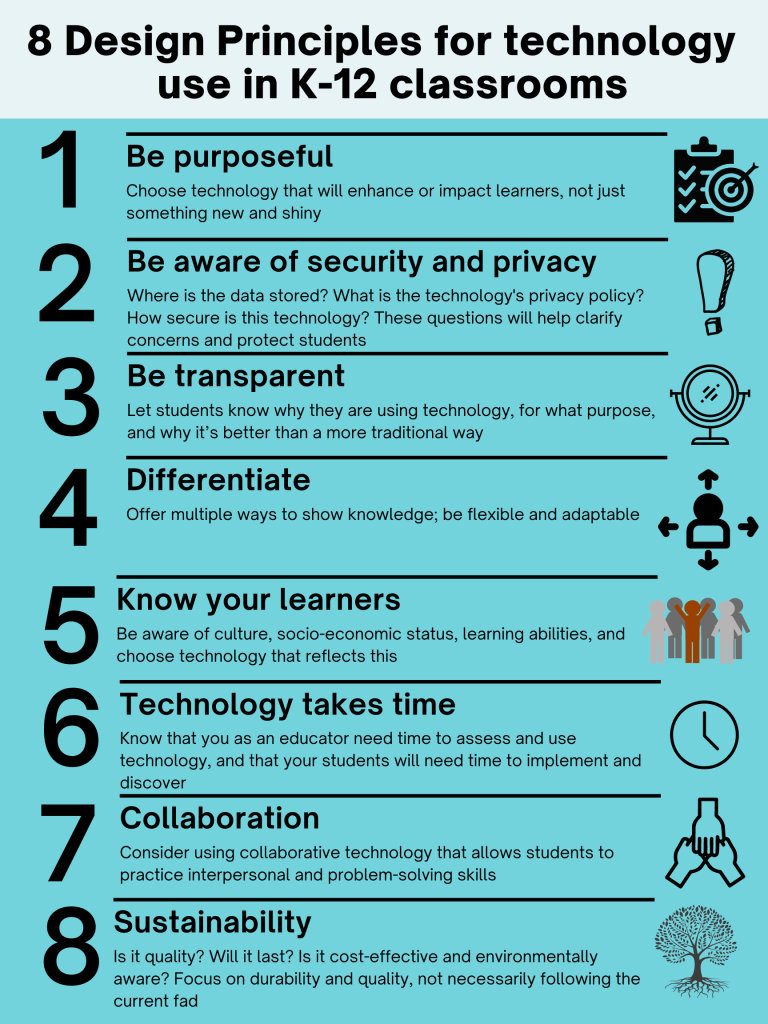
Choosing the technology to implement in a K-12 classroom can be overwhelming. Morris (2018) states in his article about critical digital pedagogy that educational technology offers many benefits but that participation in these tools requires a complex understanding of multi-literacies. That complex understanding takes time to assess, research, and implement, but teachers are notoriously short on time when effectively implementing technology (Delaney, 2011). The following design principles are meant to address significant steps to ensure that teachers choose the right technology for the right reasons and keep student safety and success at the forefront.
Firstly, choosing technology with purpose goes beyond simply using it but instead focuses on the reasoning behind this technology; this can be more impactful for your teaching and students’ learning (Morris, 2018).
Being aware of security and privacy allows you and your students to protect personal and sensitive information (Kimmons, 2020). Some questions to consider before choosing technology are: has your school district approved the tool? What personal information does the tool require from users? Where is this data stored, and who effectively owns it? The answers to these questions will aid in choosing technology that prioritizes student safety.
Clarity and transparency are essential when it comes to technology tools. Being explicit with your intentions allows for more meaningful learning, increased motivation, and even an increased sense of belonging and confidence (Kirkpatrick, 2020).
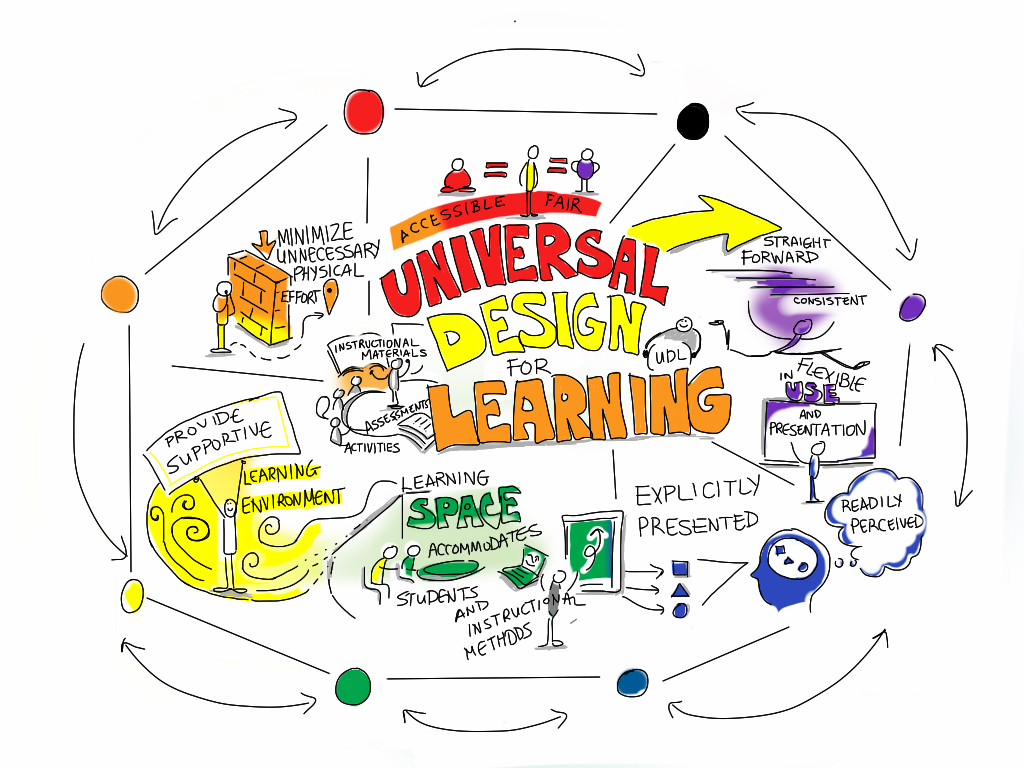
Differentiation is a key principle in teaching and learning and can also be applied to technology. By offering multiple ways to show understanding, differentiation allows all types of learners to be successful and included (Takacs et al., 2021). Universal Design for Learning (UDL) is a great framework to help plan for differentiation.
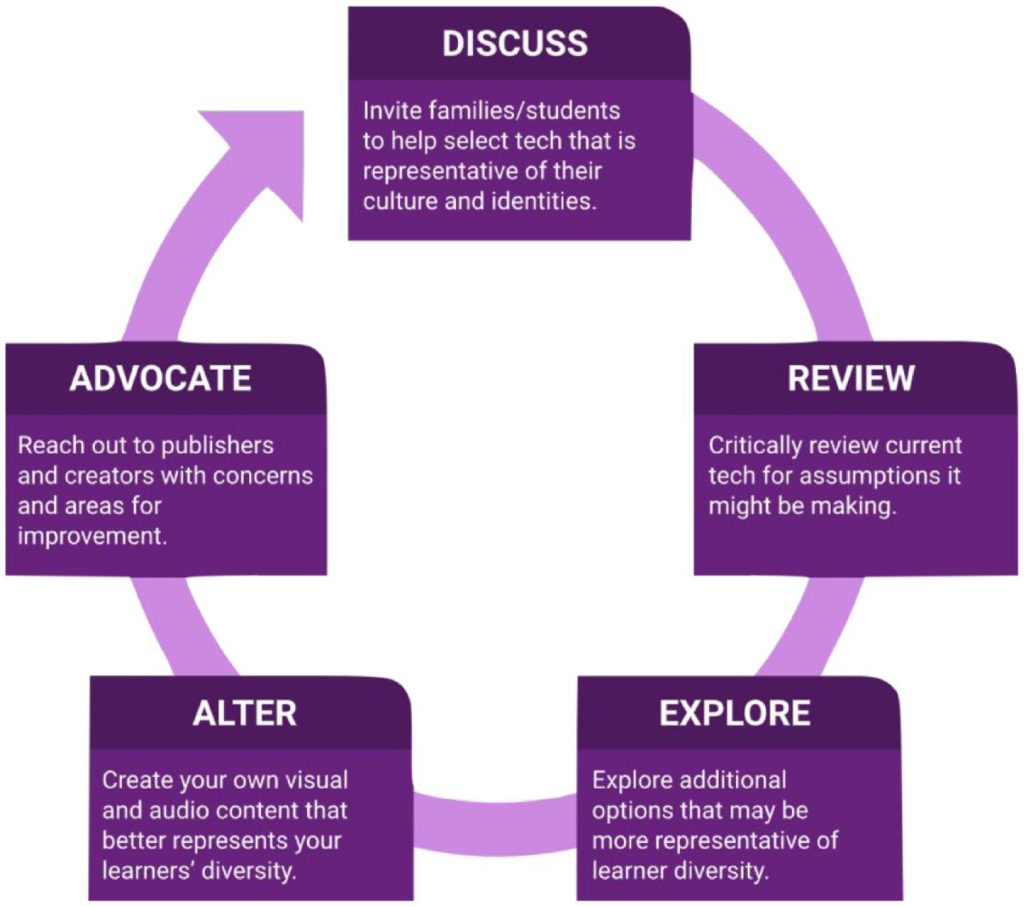
Awareness of your students’ diverse backgrounds allows you to be inclusive and understanding of the variation in your classroom and can help plan for and address “learner jaggedness” (Takacs et al., 2021, p.17). Technology can help but also hinder when it comes to diverse learners. Using a cycle like the one proposed in Kaczorowski et al.’s (2021) article, Designing an Inclusive Future, illustrates the importance of choosing technology that reflects classroom diversity.
When implementing new technology, educators must remember that it takes time, not just for the teachers to learn but also for the students to adjust and learn (Delaney, 2011). Educators often need more time to effectively learn new technology; it is helpful for educators to plan for this extra time as they incorporate new technology (Delaney, 2011).
From “Designing an Inclusive Future: Including Diversity and Equity With Innovations in Special Education Technology”, by T. Kaczorowski, D. MacMahon, and A. Hollingshead, 2022, TEACHING Exceptional Children, 0(0), (https://doi.org/10.1177/00400599221090506).
When implementing new technology, educators must remember that it takes time, not just for the teachers to learn but also for the students to adjust and learn (Delaney, 2011). Educators often need more time to effectively learn new technology; it is helpful for educators to plan for this extra time as they incorporate new technology (Delaney, 2011).
With technology and technology tools, consider incorporating collaborative resources. Using technology that promotes collaboration can foster problem-solving and interpersonal skills, while allowing more of a facilitator approach to teaching (Amplified by Design, 2018).
Finally, being aware of the effects of technology on our environment can help educators make smart and environmentally conscious decisions. By choosing refurbished technology and focusing on durability and quality, teachers can alleviate the strain of “limitless technology” and potentially create less e-waste, not to mention saving precious and limited funds (Selwyn, 2021) (Selwyn et al., 2020).
By using these eight design principles when implementing technology into the classroom, educators can effectively implement resources that are reflective of diversity and inclusivity and have students’ best interests in mind.
References
Amplified by Design, (2018, August 17). Five principles of EdTech Design: Designing educational technology that makes an impact. Medium. https://medium.com/@amplifiedbydesign/five-principles-of-edtech-design-d3d6b11fe678
Delaney, M. (2011, November 1). Training teachers to implement technology. EdTech Magazine. https://edtechmagazine.com/k12/article/2011/11/training-teachers-integrate-technology
Kaczorowski, T., McMahon, D., Gardiner-Walsh, S., & Hollingshead, A. (2022). Designing an Inclusive Future: Including Diversity and Equity With Innovations in Special Education Technology. TEACHING Exceptional Children, 0(0), https://doi.org/10.1177/00400599221090506
Kimmons, R. (2020). Online safety. In A. Ottenbreit-Leftwich & R. Kimmons, The K-12 educational technology handbook (1st ed). EdTech Books. https://edtechbooks.org/k12handbook/online_safety
Kirkpatrick, M., (2020). Transparency in the classroom. Teaching toolbox: Center for faculty innovation. https://www.jmu.edu/cfi/_files/t-t_19-20/02.27.20-transparency-in-the-classroom.pdf
Morris, M., (2018). Critical instructional design. In M. Morris & J. Sommel, An urgency of teachers: The Work of critical digital pedagogy. Hybrid Pedagogy, Inc. https://pressbooks.pub/criticaldigitalpedagogy/chapter/critical-pedagogy-and-learning-online/
Selwyn, N., Hillman, T., Eynon, R., Ferreira, G., Knox, J., Macgilchrist, F., & Sanch-Gil, J.M.(2020). What’s next for Ed-Tech? Critical hopes and concerns for the 2020s. Learning, Media and Technology 45 (1), https://doi.org/10.1080/17439884.2020.1694945
Selwyn, N. (2021). Ed-Tech Within Limits: Anticipating educational technology in times of environmental crisis. E-Learning and Digital Media, 18 (5), https://doi.org/10.1177/20427530211022951
Takacs, S, Zhang, J., Lee, H., Truong, L., & Smulders, D. (2021) A comprehensive guide to applying Universal Design for Learning. BC Campus. https://pressbooks.bccampus.ca/jibcudl/