We have just begun our fourth class in our Master’s program journey. This class (Innovation, Design, and Learning Environments) has asked us to reflect on design decisions in learning and technology.
I found some key tenets of both LD and ID helpful in my readings. First, each design is unique and different, meaning that there is no ‘one’ design that is made to ‘fit’ all projects (Dousay, 2017). Because of this, many models are available for designers to use as a basis for their design.
When looking at several of these models, there seemed to be some commonality in their principles. For example, Dousay (2017) states that the ADDIE process (analyze, design, develop, implement, evaluate) is at the heart of most design models, but how it is used differs with each model, allowing designers to customize their designs according to the context and learner needs.
After reading Dousay’s (2017) introduction to Instructional Design Models, I had a better grasp on the structure of design. At the end of this chapter, Dousay (2017) asks industry designers for tips for ID; the tip that resonated most for me was from Brent Wilson, University of Colorado: “… do not forget to meet the needs of learners, especially those at the margins.” (Wilson, n.d., in Dousay, 2017).
There are several reasons why this particular tip resonates with me. Firstly, I am a K-12 educator with a specialty in Special Education, essentially the teaching of those learners ‘in the margins’. Everyone has the right to learn and be included, which means that ID and LD need to reflect this principle, yet it seems like many past models may not. Heaster-Ekholm (2020) looks critically at ID models of the past and concludes that many models neglect to address the inherent biases of designers and their lack of cultural diversity in the design process.
In my culminating paper from our last course, I wrote about the future of education being based on the theory of respectful design (Grandoit-Sutka, n.d.). Kaczorowski et al. (2022) pointed out that technology use in the classroom was not reflective of classroom abilities or culture, therefore creating barriers to learning for many students. As Heaster-Ekholm (2020) suggests, if designers are aware of their biases and aim to understand the culture and context of the learners, they can select a model that will best reflect the learning environment.
Finally, realizing the importance of design to include all learners helps with effectiveness and practicality. Although ID and LD have some differences, they both aim to improve opportunities for learning (Parchoma et al., 2020).
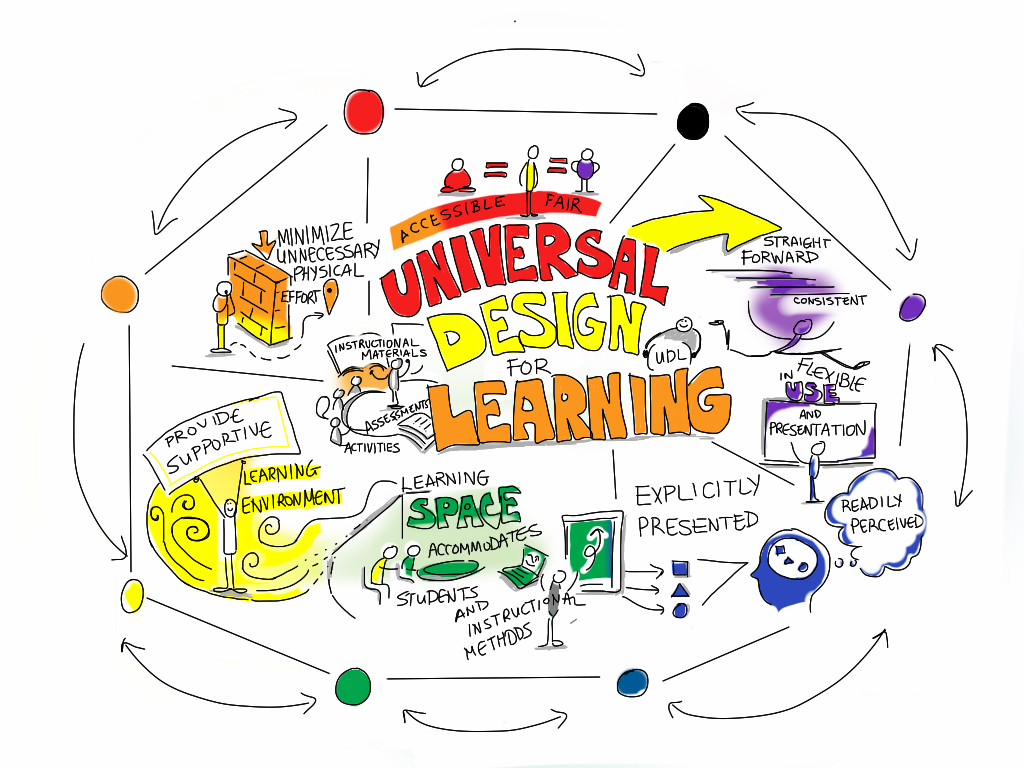
One model that attempts to accommodate varied learners and cultures is Universal Design for Learning (UDL). UDL asks designers and educators to question their beliefs, assumptions, and biases to plan and prepare for differences in learners (Takacs et al., 2021).
Image: Universal Design for Learning, by Giulia Forsythe, 2013, Flickr. CC0 1.0 Universal (CC0 1.0)
Shelly Moore, (n.d.), a special education advocate and teacher, discusses UDL through a special education lesson lens and provides short, relatable, easy-to-understand videos of how UDL works in the classroom. In one of these videos, she describes a more ‘traditional’ model of learning that emphasizes a need to “fix” students who do not fit into the model (Moore, 2021). The traditional approach uses many resources (Educational Assistants, specialized equipment, etc.) for a handful of students. Instead, Moore (2021) asks us to design with all learners in mind, making those limited resources available to all, not just those in need. By removing barriers and asking ourselves, “What is limiting learner success?” we can create a more effective and practical design for learning (Moore, 2021). This idea of design being cognizant of context is seen in Dousay’s (2017) chapter regarding ID models and Heaster-Ekholm’s (2020) literature and can lead to improved opportunities for learning.
As I continue with my career in K-12, I will search for design models based on the concept of respectful design and be cognizant of those learners in the margins.
References
Dousay. T. A. (2017). Instructional Design Models. In R. West (Ed.), Foundations of Learning and Instructional Design Technology (1st ed.). https://edtechbooks.org/lidtfoundations/instructional_design_models
Grandoit-Sutka, A., (n.d.). Elizabeth (Dori) Tunstall on designing for respect. deem journal. https://www.deemjournal.com/stories/dori-tunstall
Heaster-Ekholm, K. L. (2020). Popular Instructional Design Models: Their Theoretical Roots and Cultural Considerations. International Journal of Education and Development Using Information and Communication Technology, 16(3), 50–65. https://files.eric.ed.gov/fulltext/EJ1275582.pdf
Kaczorowski, T., McMahon, D., Gardiner-Walsh, S., & Hollingshead, A. (2022). Designing an Inclusive Future: Including Diversity and Equity With Innovations in Special Education Technology. TEACHING Exceptional Children, 0(0), https://doi.org/10.1177/00400599221090506
Moore, S. (2021, October 7). Removing the barriers: Planning for all! [Video]. YouTube. https://www.youtube.com/watch?v=MzL8yMBKM7k
Moore, S. (n.d.). 5 Moore minutes. https://fivemooreminutes.com/about/
Parchoma, G., Koole, M., Morrison, D., Nelson, D., & Dreaver-Charles, K. (2020). Designing for learning in the Yellow House: A comparison of instructional and learning design origins and practices. Higher Education Research & Development, 39(5), 997–1012. https://doi.org/10.1080/07294360.2019.1704693
Takacs, S, Zhang, J., Lee, H., Truong, L., & Smulders, D. (2021) A comprehensive guide to applying Universal Design for Learning. https://pressbooks.bccampus.ca/jibcudl/
Hi Terry,
UDL is pretty exciting to me. I’m curious what it would look like from an educator’s point of view, especially a K-12 educator. Do you use UDL currently? Do you think you will?
Wishing you a lovely Saturday,
Sarah
Hi Sarah,
Thanks for your query! I do try to use UDL when planning lessons in my classroom. It requires some forward thinking and planning, but in the long has proven extremely helpful with regards to including all levels of students. There are several UDL frameworks which have been really helpful with my planning, as well as the Shelley Moore videos I included in my post.
Your last paper sounds very interesting! I appreciate that you see some consistent underlying principles of design models – in this case do you think we need so many? I am also wondering if you think UDL has limitations ( you used the word “attempts” to address needs of varied learners), in particular as it relates to delivery models or culture for example? What other design challenges are present in the K12 sector that ID models could support you with?
Thanks for your thoughts Leeann,
I have been pondering your question, ‘do you think we need so many [design models]?’ for the past few days. As a novice, I find it overwhelming to see so many models. Personally, I think a ‘less-is-more’ approach may be better, but I am certainly no expert in this area!
As for your comment regarding UDL, I struggle with the assessment piece. For example, if my goal is to have students write a paragraph, does the student who uses completed sentences and rearranges them correctly receive the same grade as the student who creates their own sentences?
I also think UDL has an area for improvement concerning culture. There is no real discussion regarding methods to reflect a class culture that I have come across, but again, I am no expert.
I would like to explore more design models that focus on Indigenous ways of knowing and also models that reflect a worldly perspective, not a Western Culture based model. It would be interesting to see what other cultures value and emphasize, and the potential to include all learners would certainly be greater.