Reflections on digital leadership and change

Photo by ThisisEngineering RAEng on Unsplash

Reflecting on what we have learned from this course, my ideas regarding leadership have changed. In one of my initial posts about leadership, I viewed leadership as more managerial (Kent, 2023). After one of our first group discussions and readings, I connected with Sarder’s (2015) comment that leaders are about passion and encouragement rather than managing people and operations. 

Beyond leadership, I have also recognized the importance of planning for change. Al-Haddad & Kotnour’s (2015) article thoroughly overviews many well-used theories and frameworks for change management; this will continue to be a significant resource for me as I move forward in my career. 

If I look to the future, I envision myself as a digital leader; I want our schools to reflect our society, engage staff and students in a technological world, and prepare our young adults with the skills needed to be digital citizens. As Sheninger (2022) states, a digital leader “…establish[es] direction, influenc[es] others, and initiat[es] sustainable change…”. This is what I am passionate about, and this course has given me the tools to start my journey. In fact, I already have an idea for my first change plan; reintroducing a forgotten tool. 

My final project for this course is an implementation plan for Google Read and Write (GRW) in high school classrooms. I chose this topic as this tool is being used in schools but sparingly and often ineffectively. My goal is to rekindle the use of GRW as an easy-to-use, readily available assistive technology. The knowledge I have gained in project management, leadership, and change management will be valuable assets in reintroducing this helpful tool. Using a framework like Lewin’s change model can help prepare the staff for change, support them with training, and sustain GRW for years to come (Tang, 2019). 

Yet another essential aspect of leading digital change is data analysis. Evidence-based decisions for using technology in schools is a powerful tool (Sclater et al., 2016). Data-driven decision-making (DDDM) can be used to illustrate the benefits of GRW, how often it is being used, which functions are most used, and to help guide decisions around additional support for those that need it (Marsh et al., 2006; Sclater et al., 2016). 

Realistically, reintroducing GRW, or any technology, in classrooms will be challenging. Not only will I have to gain support and momentum from staff and administration, but addressing and planning for all the complexities of change will require time, persistence, and support. Being prepared with a change and project management plan, with data for evidence-based support, will hopefully help build momentum and inspiration for implementing digital tools in my district. 


References

Al-Haddad, S., & Kotnour, T. (2015). Integrating the organizational change literature: A model for successful change. Journal of Organizational Change Management, 28(2), 234–262. https://doi.org/10.1108/jocm-11-2013-0215

Kent, T. (2023, February 4). Reflections on leadership. https://malat-webspace.royalroads.ca/rru0263/reflections-on-leadership/ 

Marsh, J., Pane, J., & Hamilton, L. (2006). Making sense of data-driven decision making in Education: Evidence from recent RAND research. RAND corporation. https://doi.org/10.7249/OP170 

Sarder, R. (Producer). (2015, June 4). What makes a great leader?  by Peter Senge, author of the Fifth Discipline [Video]. Youtube. https://youtu.be/1aYaj2-GZqk 

Sclater, N., Peasgood, A, & Mullan, J. (2016). Learning analytics in higher education: A review of UK and international practice. Jisc. https://www.jisc.ac.uk/sites/default/files/learning-analytics-in-he-v3.pdf 

Sheninger, E. (2022, August 31). 7 Pillars of digital leadership in education. HMH. https://www.hmhco.com/blog/pillars-of-digital-leadership-in-education 

Tang, K.N. (2019). Change management. In (Ed.), Leadership and change management (pp. 47–55). Springer Singapore. https://doi.org/10.1007/978-981-13-8902-3_5

Being a part of change

Photo by Ross Findon on Unsplash

For several years, K-12 education has been attempting to integrate technology into the classroom effectively. British Columbia’s education system has also been working hard at centering curriculum around Core Competencies and trialling new assessment measures, which focused on several aspects, including flexible communication with parents and increasing transparency (British Columbia Ministry of Education, n.d.-a) (British Columbia Ministry of Education, n.d.-b). 

One recent project I was involved in was implementing e-portfolios that would allow parents to see what students were working on in classrooms and allow students to choose, reflect, and share what they deemed their best or most significant work. Not only did this address the transparency concern, but it also allowed students to practice identifying and reflecting on Core Competencies. 

As far as communication goes, the objectives were clear and well articulated. As Watt (2014) states in his book regarding project management, it is critical to have the project manager (in this case, our administration team) lay out clear goals. Watt (2014) also states that project managers should choose people with expertise as part of their plan. Although this was more informal, my administration team had two or three people on staff as contacts for support if teachers had any questions.  

As a teacher, I was not privy to any project plan, but I knew there were clear objectives and a timeline to follow. There were several training sessions in the form of staff meetings and professional development days to allow teachers to practice using the tool and ask questions. 

One of the main barriers to change was organizational readiness. Rafferty et al. (2003, as cited in Al-Haddad & Kotnour, 2015) suggest that an optimistic attitude and commitment to change can enable effective and successful change plans. Some staff members were hesitant to use e-portfolios or were lacking or unsure of their skills regarding the technology. Furthermore, staff illustrated some confusion around the purpose of e-portfolios, mainly in their use of them as assessment tools. 

To address these barriers, the use of data could be helpful. Issuing surveys for staff regarding abilities and comfort level could help provide targeted interventions and extra support; data could be used to make decisions based on tangible evidence rather than assumptions or anecdotes (KelloggInsight, 2015). To further support organizational readiness, Weiner (2009) states that cultivating and supporting confidence among staff leads to higher change efficacy. To help boost confidence, the administration could provide additional training sessions through video tutorials, lunchtime, or after-school sessions for those that need them.

As for the challenges around the usage of e-portfolios, increased clarity and communication would have been beneficial. Watt (2014) comments on the importance of continual communication. I found communication was strong to start but soon dwindled once the tool was implemented. Regular meetings or check-ins regarding the tool throughout the year could have identified and addressed concerns such as the questions surrounding assessment.  

Being a part of this change has allowed me to reflect on what aspects of change and project management I value most. If I were to implement change in my school, I would first examine if a change was needed (using data to substantiate this) and assess and promote organizational readiness. As for project management, I would create clear objectives, communicate them continuously with my team, and focus on time and resources (Watt, 2014).


References

Al-Haddad, S., & Kotnour, T. (2015). Integrating the organizational change literature: a model for successful change. Journal of Organizational Change Management, 28(2), 234-262.  https://doi.org/10.1108/JOCM-11-2013-0215 

British Columbia Ministry of Education, (n.d.-a). Core competencies. https://curriculum.gov.bc.ca/competencies

British Columbia Ministry of Education, (n.d.-b). Student reporting policy pilot. https://curriculum.gov.bc.ca/classroom-assessment/student-reporting-policy-pilot 

KelloggInsight. (2015, May 1). A Leader’s Guide to Data Analysis: A working knowledge of data science can help you lead with confidence. KelloggInsight. https://insight.kellogg.northwestern.edu/article/a-leaders-guide-to-data-analytics/ 

Watt,  A. (2014). Project Management (2nd ed.). BCcampus. https://opentextbc.ca/projectmanagement/

Weiner, B. J. (2009). A theory of organizational readiness for change. Implementation Science, 4(67), 1-9. https://doi.org/10.1186/1748-5908-4-67 

Digital leaders and implementing change

Leadership is a multi-layered term with qualities that are challenging to define. Generally, it can be agreed upon that leadership involves people who are passionate about change and will inspire and unite those around them to accomplish personal and organizational goals (Workman & Cleveland-Innes, 2012). 

Change is also a complex yet necessary aspect of leadership in most organizations. As Al-Haddad & Kotnour (2015) state, companies have realized that change must be involved to maintain or acquire success. This constant change also requires strong leadership. As Sheninger (2014) highlights in his article regarding digital leadership, digital leaders need to realize the potential of technology to establish a creative direction and initiate sustainable change. 

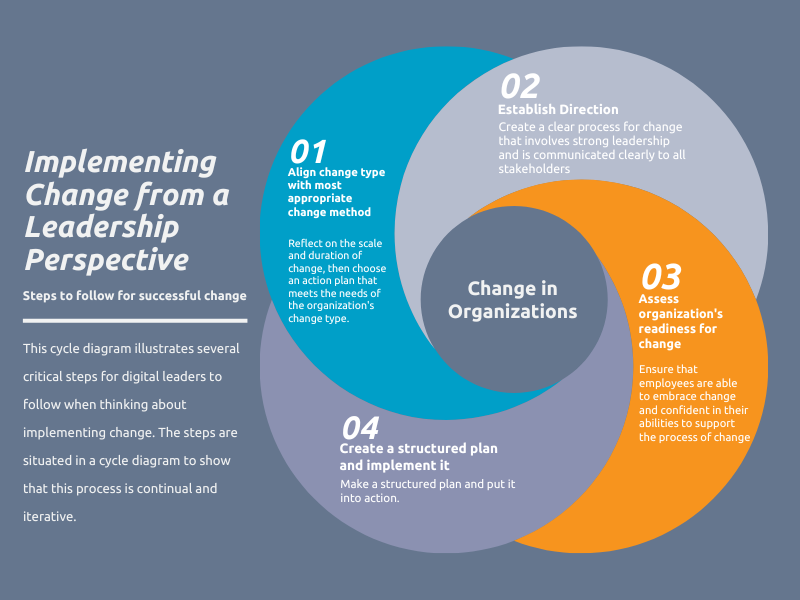
A digital leader then needs to instigate and implement change in the organization effectively. Several steps should be taken to promote organizational change and encourage desired outcomes. One of the first steps is to have a clear process for change. Al-Haddad & Kotnour (2015) propose that for change to be successful, organizations need strong leadership that can provide a structure for change, decrease barriers and foresee consequences, but also realize that businesses are diverse; finding a process that fits all businesses is unlikely. Therefore, Al-Haddad & Kotnour (2015) propose a framework for organizations that aligns a change type (aspects that describe forms of change, such as scale and duration) with a suitable change method (actions taken to cope with change, both systematically and with change management). Regardless of the chosen change direction, alignment with the scale and duration of change is key for success (Al-Haddad & Kotnour, 2015). 

As Al-Haddad & Kotnour (2015) state, many change methods exist. It can be helpful to look to organizations and their leaders to help gain an understanding of what method to choose. Mindy Holman, a teacher-librarian for a Vancouver Island high school, discussed her role as a digital leader during the pandemic when British Columbian schools were required to go online. She recalled that she was given clear direction on what needed to be accomplished (teachers creating online platforms for students), which helped her attain outcomes (M.Holman, personal communication, February 16, 2023). The significance of direction is also echoed in an interview with Sandra Norum, a support teacher for K-12 education in BC. When implementing Universal Design for Learning (UDL) principles, she states that clear directions and expectations are helpful for implementing change (Harrison, n.d.). Clearly, when implementing change, digital leaders should provide clear direction for change to promote success. 

Readiness for change is another aspect that digital leaders should be mindful of when planning. Mindy mentioned that a significant challenge in implementing a digital change in the K-12 education system was teachers who were entrenched in their non-digital ways; much time was spent encouraging, teaching, and persuading these educators to adopt this new technology (M.Holman, personal communication, February 16, 2023). Change readiness could have been more optimal; as Mindy discussed, several employees needed more preparation for this significant change. Wiener’s (2009) article discusses change management and organizational readiness; Wiener argues that organizational readiness (defined as members of the organization who are committed to change and confident in their abilities to do so) is key to successful change. One change method that addresses a part of change readiness is the Luecke method. Luecke developed a change process that highlighted change as an opportunity, not a barrier, and focused on encouraging employees to accept change (Al-Haddad & Kotnour, 2015). A digital leader can increase an organization’s readiness for change by encouraging all members to welcome it. Beich (2007) mentions Theory O, which also supports a notion of organizational readiness that focuses on employee participation and the bond with their organization, again focusing on employees who will welcome change, illustrating readiness. 

Once there is a clear direction and a readiness for change, digital leaders can work on a structured plan. As Beich (2007) suggests, leaders need to have a plan for successful change; not only do they need a plan, but they also need to implement it. Beich (2007) suggests the CHANGE model to help create an actionable plan, as it is generic enough to adapt to many different situations and needs. There are six steps in the CHANGE model, including acknowledging the need for change, aligning leadership with organizational needs, activating commitment and ensuring readiness, creating a design, guiding implementation, and evaluating change (Beich, 2007). It is a continual process, which Udas (2008) puts forward as a significant factor for success. 

For the best chance at successful change, digital leaders should consider several important factors, such as alignment of change type with a change method, clear direction, ensuring the organization is ready for change and creating and implementing a plan. Following these steps, digital leaders can take helpful steps to achieve their goals.  


References

Al-Haddad, S., & Kotnour, T. (2015). Integrating the organizational change literature: a model for successful change. Journal of Organizational Change Management, 28(2), 234-262.  https://doi.org/10.1108/JOCM-11-2013-0215 

Biech, E. (2007). Models for Change. In Thriving through change: A Leader’s practical guide to change mastery. Association for Talent Development.  [Retrieved from Skillsoft e-book database]. https://royalroads.skillport.com/skillportfe/main.action?path=summary/BOOKS/22651 

Harrison, M. (n.d.). Voices of Leadership – Sandra Norum, K-12. Royal Roads University – MALAT LRNT 525 Course Site. Retrieved February 17, 2023, from https://malat-coursesite.royalroads.ca/lrnt525/schedule/voices/

Sheninger, E. (2019, December 19). Pillars of digital leadership. International Centre for Leadership in Education. http://www.leadered.com/pdf/LeadingintheDigitalAge_11.14.pdf

Udas, K. (2008, June 30). Distributed learning environments and OER: The Change management challenge. eLiterate. https://moodle.royalroads.ca/moodle/pluginfile.php/1027690/mod_book/chapter/236387/Udas%2C%20K.%20%282008%2C%20June%2030%29.%20Distributed%20learning%20environments%20and%20OER.pdf 

Weiner, B. J. (2009). A theory of organizational readiness for change. Implementation Science, 4(67), 1-9. https://doi.org/10.1186/1748-5908-4-67 

Workman, T., & Cleveland-Innes, M. (2012). Leadership, personal transformation, and management. The International Review of Research in Open and Distributed Learning, 13(4), 313-323. https://doi.org/10.19173/irrodl.v13i4.1383

Reflections on leadership

Our first assignment for our most recent course asks us to reflect on our thoughts about leadership. At first, this was a fairly straightforward assignment, but after reflecting on our readings, I thought this was a more complex task than I initially thought. 

Leadership by Nick Youngson CC BY-SA 3.0 Pix4free

An excellent place to start this conversation is with a definition. To prove my point earlier, defining leadership is complicated. Workman and Cleveland-Innes (2012) allude to the plethora of definitions available. Fitzgerald (2003) discusses the problematic definition of educational leadership in neglecting gender, race, and socioeconomic status, and O’Toole (2008) bluntly states that values-based leadership is nearly impossible to define. The question remains, what is leadership?

For me, leadership is about leading people cumulatively towards a goal and achieving their personal best. Referring back to Workman and Cleveleand-Innes’ (2012) definition, leadership is inspiring, supporting, and guiding others to attain personal growth. To add to this definition, O’Toole (2008) also mentions that leaders unite people with differing agendas toward a common purpose; therefore, leaders foster personal growth and connect people towards a common goal. 

Despite the challenges of defining leadership, I found it much easier to list the qualities of a good leader. One of our initial tasks for this course was to rank a list of twenty leadership characteristics; my top five were supportive, competent, dependable, cooperative, and caring. However, after discussing our rankings as a team and engaging in our required readings, my characteristics regarding leaders changed.

Working as a group was enlightening as I could listen and discuss different perspectives on what these characteristics mean to each group member. Three of us work in the education field, and two of our members are in corporate settings. Our varied workplaces illustrated how leadership could be viewed and valued differently. 

Despite our varied backgrounds, we all found our leadership qualities challenged after the readings. Gill mentioned that she initially ranked the characteristics from more of a managerial perspective, then realized that leading is different than managing. As Sarder (2015) states, managing is more of an operations role, whereas leadership is about “spirit” and passion for change. 

With this new perspective on leadership, characteristics I had initially ranked in the top five (supportive, competent, dependable, and cooperative) seemed less about leading and more about managing. After careful reflection during our group discussions and readings, I rearranged leadership values to reflect my new understanding. 

Firstly, I realized that there is a certain amount of courage that is needed to be an effective leader, digital or otherwise. O’Toole (2008) alludes to this in his discussion about uniting people with different values; this can often lead to conflict and would take a certain amount of courage to address. In Huggins et al.’s (2017) article, the courage lies within leaders relinquishing control to support and promote others’ personal growth. It also takes courage to question traditional leadership definitions and practices to reflect a more diverse population, as Fitzgerald (2003) discusses in her article regarding indigenous women’s voices in educational leadership. 

More specifically, digital leadership requires a certain amount of courage. As Sheninger (2019) states that to promote a digital culture, schools must “Boldly move…forward…” (para. 6); to do this, leaders must relinquish control. Certainly, this will take courage. 

Two of my initial leadership characteristics remain the same. Competency is significant in digital leadership; leaders should be aware of how to leverage technology to create a supportive digital learning culture (Sheninger, 2019). Caring is also a key component. Sarder (2015) discusses that leaders should be passionate and caring about their causes. Digital leaders are no different; they should be passionate about technology and change to promote this mindset in their employees and workplaces (Sheninger, 2019). 

In my own experiences as a K-12 teacher, I also see much value in leaders being broad-minded. Being open to new and different ideas allows for creativity and innovation (Buchanan, 2018). It would seem that digital leaders would need to have a broad mindset in order to foster innovative ideas. Being broad-minded can also build trust and allow for open and honest communication, traits that Kouzes & Posner (2011) suggest build credibility and good leadership. 

The readings I have pursued regarding leadership have allowed me to reflect on what I truly value in a digital leader. If we use Sheninger’s (2019) definition of digital leadership as using technology to encourage and foster a digital culture within our learning and work environments, leaders should be courageous, competent, caring, and broad-minded. 


References

Buchanan, C. (2018, August 20). Leadership tip of the week: Being open-minded. The Ohio State Universityhttps://fisher.osu.edu/blogs/leadreadtoday/blog/leadership-tip-of-the-week-being-open-minded

Fitzgerald, T. (2003).  Changing the deafening silence of indigenous women’s voices in educational leadership. Journal of Educational Administration, 41(1), 9-23. https://doi.org/10.1108/09578230310457402

Huggins, K.S. (2017). Developing leadership capacity in others: An Examination of high school principals’ personal capacities for fostering leadership. International Journal of Education Policy and Leadership, 12(1). https://doi.org/10.22230/ijepl.2017v12n1a670 

Kouzes, J., & Posner, B. (2011). Credibility : How leaders gain and lose it, why people demand it (2nd ed.). Jossey-Bass. 

O’Toole, J. (2008). Notes toward a definition of values-based leadership. The Journal of Values-Based Leadership, 1(1). https://scholar.valpo.edu/jvbl/vol1/iss1/10 

Sarder, R. (Producer). (2015, June 4). What makes a great leader?  by Peter Senge, author of the Fifth Discipline [Video]. Youtube. https://youtu.be/1aYaj2-GZqk 

Sheninger, E. (2019, December 19). Pillars of digital leadership. International Centre for Leadership in Education. http://www.leadered.com/pdf/LeadingintheDigitalAge_11.14.pdf

Workman, T., & Cleveland-Innes, M. (2012). Leadership, personal transformation, and management. The International Review of Research in Open and Distributed Learning, 13(4), 313-323. https://doi.org/10.19173/irrodl.v13i4.1383