Leadership is a multi-layered term with qualities that are challenging to define. Generally, it can be agreed upon that leadership involves people who are passionate about change and will inspire and unite those around them to accomplish personal and organizational goals (Workman & Cleveland-Innes, 2012).
Change is also a complex yet necessary aspect of leadership in most organizations. As Al-Haddad & Kotnour (2015) state, companies have realized that change must be involved to maintain or acquire success. This constant change also requires strong leadership. As Sheninger (2014) highlights in his article regarding digital leadership, digital leaders need to realize the potential of technology to establish a creative direction and initiate sustainable change.
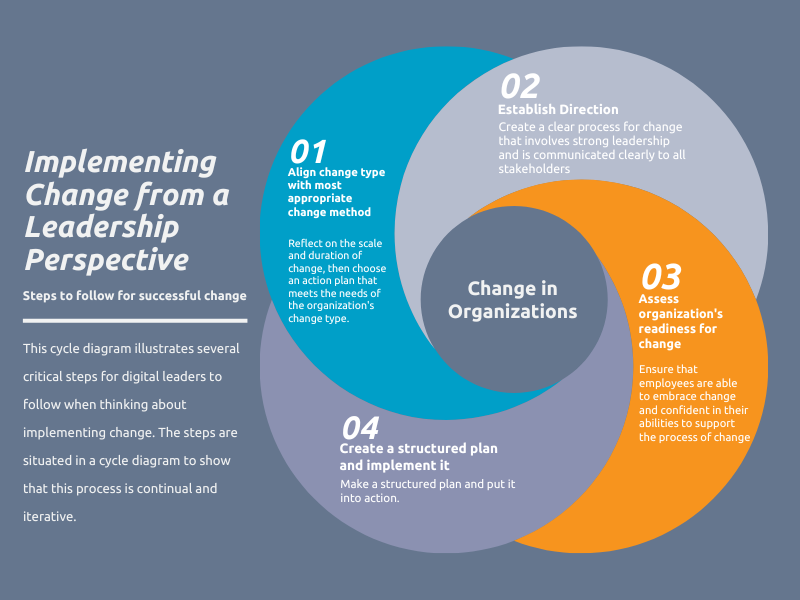
A digital leader then needs to instigate and implement change in the organization effectively. Several steps should be taken to promote organizational change and encourage desired outcomes. One of the first steps is to have a clear process for change. Al-Haddad & Kotnour (2015) propose that for change to be successful, organizations need strong leadership that can provide a structure for change, decrease barriers and foresee consequences, but also realize that businesses are diverse; finding a process that fits all businesses is unlikely. Therefore, Al-Haddad & Kotnour (2015) propose a framework for organizations that aligns a change type (aspects that describe forms of change, such as scale and duration) with a suitable change method (actions taken to cope with change, both systematically and with change management). Regardless of the chosen change direction, alignment with the scale and duration of change is key for success (Al-Haddad & Kotnour, 2015).
As Al-Haddad & Kotnour (2015) state, many change methods exist. It can be helpful to look to organizations and their leaders to help gain an understanding of what method to choose. Mindy Holman, a teacher-librarian for a Vancouver Island high school, discussed her role as a digital leader during the pandemic when British Columbian schools were required to go online. She recalled that she was given clear direction on what needed to be accomplished (teachers creating online platforms for students), which helped her attain outcomes (M.Holman, personal communication, February 16, 2023). The significance of direction is also echoed in an interview with Sandra Norum, a support teacher for K-12 education in BC. When implementing Universal Design for Learning (UDL) principles, she states that clear directions and expectations are helpful for implementing change (Harrison, n.d.). Clearly, when implementing change, digital leaders should provide clear direction for change to promote success.
Readiness for change is another aspect that digital leaders should be mindful of when planning. Mindy mentioned that a significant challenge in implementing a digital change in the K-12 education system was teachers who were entrenched in their non-digital ways; much time was spent encouraging, teaching, and persuading these educators to adopt this new technology (M.Holman, personal communication, February 16, 2023). Change readiness could have been more optimal; as Mindy discussed, several employees needed more preparation for this significant change. Wiener’s (2009) article discusses change management and organizational readiness; Wiener argues that organizational readiness (defined as members of the organization who are committed to change and confident in their abilities to do so) is key to successful change. One change method that addresses a part of change readiness is the Luecke method. Luecke developed a change process that highlighted change as an opportunity, not a barrier, and focused on encouraging employees to accept change (Al-Haddad & Kotnour, 2015). A digital leader can increase an organization’s readiness for change by encouraging all members to welcome it. Beich (2007) mentions Theory O, which also supports a notion of organizational readiness that focuses on employee participation and the bond with their organization, again focusing on employees who will welcome change, illustrating readiness.
Once there is a clear direction and a readiness for change, digital leaders can work on a structured plan. As Beich (2007) suggests, leaders need to have a plan for successful change; not only do they need a plan, but they also need to implement it. Beich (2007) suggests the CHANGE model to help create an actionable plan, as it is generic enough to adapt to many different situations and needs. There are six steps in the CHANGE model, including acknowledging the need for change, aligning leadership with organizational needs, activating commitment and ensuring readiness, creating a design, guiding implementation, and evaluating change (Beich, 2007). It is a continual process, which Udas (2008) puts forward as a significant factor for success.
For the best chance at successful change, digital leaders should consider several important factors, such as alignment of change type with a change method, clear direction, ensuring the organization is ready for change and creating and implementing a plan. Following these steps, digital leaders can take helpful steps to achieve their goals.
References
Al-Haddad, S., & Kotnour, T. (2015). Integrating the organizational change literature: a model for successful change. Journal of Organizational Change Management, 28(2), 234-262. https://doi.org/10.1108/JOCM-11-2013-0215
Biech, E. (2007). Models for Change. In Thriving through change: A Leader’s practical guide to change mastery. Association for Talent Development. [Retrieved from Skillsoft e-book database]. https://royalroads.skillport.com/skillportfe/main.action?path=summary/BOOKS/22651
Harrison, M. (n.d.). Voices of Leadership – Sandra Norum, K-12. Royal Roads University – MALAT LRNT 525 Course Site. Retrieved February 17, 2023, from https://malat-coursesite.royalroads.ca/lrnt525/schedule/voices/
Sheninger, E. (2019, December 19). Pillars of digital leadership. International Centre for Leadership in Education. http://www.leadered.com/pdf/LeadingintheDigitalAge_11.14.pdf
Udas, K. (2008, June 30). Distributed learning environments and OER: The Change management challenge. eLiterate. https://moodle.royalroads.ca/moodle/pluginfile.php/1027690/mod_book/chapter/236387/Udas%2C%20K.%20%282008%2C%20June%2030%29.%20Distributed%20learning%20environments%20and%20OER.pdf
Weiner, B. J. (2009). A theory of organizational readiness for change. Implementation Science, 4(67), 1-9. https://doi.org/10.1186/1748-5908-4-67
Workman, T., & Cleveland-Innes, M. (2012). Leadership, personal transformation, and management. The International Review of Research in Open and Distributed Learning, 13(4), 313-323. https://doi.org/10.19173/irrodl.v13i4.1383
Hi Terry,
I really liked your diagram. It was clear and provided enough info to understand each step. I agree with your insights on leadership through change. Can I ask, do you see much difference between how a leader in a digital environment would lead change compared to one in any other context? Do you feel a digital leader would need to posses different characteristics, than leaders in other settings, for success?
Good questions, Rebecca.
Digital leaders will share many of the same characteristics as other leaders; however, I believe certain qualities will be a higher priority for digital leaders, particularly courage, competency, and passion. My previous post about leadership goes into more detail about these capacities, but I will say that Sheninger’s (2019) article about digital leaders stresses passion and knowledge regarding technology is key. To me, being a digital leader also requires courage, as technology use could be viewed as a hindrance, not helpful.
Overall, digital leaders will need to have passion and knowledge of technology to help build a vision and buy-in for their organizations.
Sheninger, E. (2019, December 19). Pillars of digital leadership. International Centre for Leadership in Education. http://www.leadered.com/pdf/LeadingintheDigitalAge_11.14.pdf