For our newest course, we are beginning to focus on our final project. For me, this means reflecting back to the beginning of my journey and why I wanted to enroll in this Master’s program.
As a secondary school teacher, I see the importance of technology, but I am also privy to the setbacks, including inefficient practices, lack of training, lack of time, and challenges regarding availability.
Over the past year, I have discovered the potential of Open Educational Resources (OER) and Open Educational Practices (OEP) as ways to provide teachers with the skills and resources to aid in teaching and learning.
Ideally, I would like my research to reach secondary school teachers, which could be done in one of the following ways:
1- Holding a professional development (PD) day session
If I were to present my findings during a PD session, I could reach teachers at my local school district. In order to run a session, I would contact my school or district PD chairperson and ask to present a half-day session on my topic. Holding a PD session is a great way to meet and discuss my research with local teachers.
2- Create a website
This option would allow for a broader audience. To make a website, it is crucial for me to provide clear copyright information for the resources shared or created.
3- Create an OER, such as a digital toolkit
Creating an OER would directly illustrate the potential of this technology, showcasing its use to other educators. Providing clear copyright information, including a list of Creative Commons licensing options, would be needed to provide clarity regarding the sharing and adaptation of materials.
To reflect on my learning during this course, I have opted to use the same 3-2-1 format I used initially, as it illustrates a new outlook from my experiences.
3 Thoughts
*Digital facilitation is learner-centered.
Although I knew learning was about the learner, this sentiment did not translate into my thoughts of an online instructor. While working with my team on creating content, we always returned to what was best for our learners, including providing encouragement and support (like a cheerleader) and being a co-learner alongside them (Bull, 2013).
*Using frameworks and theory to substantiate decisions is key
Working with my team of co-facilitators illustrated the importance of using theory and design to frame our decisions concerning content and building our learning environment. Being cognizant of the Community of Inquiry (CoI) framework helped keep our team focused on providing a balanced approach to social presence, teaching presence, and cognitive presence. We incorporated such elements as creating opportunities for collaborative learning in our synchronous session (cognitive/social presence), as well as clearly stating outcomes, activities, and expectations (teaching presence) (Lalonde, 2021). We also incorporated various elements of Universal Design for Learning (UDL) to promote CoI and a learner-centred experience.
*Feedback is integral for effective digital learning.
This sentiment has remained unchanged, yet I am satisfied knowing this idea has been substantiated through my experiences. As our group was the last to present, I have not been able to view our learners’ insights, but I look forward to seeing what I can glean from their responses. If digital facilitation is, in fact, learner-centred, we must then seek feedback from our learners in order to provide them with what they need. As one of our resources from our facilitation week on inclusive learning states, an essential aspect of facilitating is to iterate and improve (Gamrat, 2020).
2 Questions
My initial question from the beginning of the course (how does a facilitator provide relevancy when information about their students is relatively unknown?) has been answered in a way. Using our knowledge of CoI, I know that spending time getting to know your learners at the beginning of the course (using technology surveys, encouraging informal activities for getting to know learners and asking for preferred names and pronouns) can give facilitators important background information (Gamrat, 2020; Page et al., 2021). However, the part I continue to struggle with is this:
How can facilitators provide relevant materials that reflect a group’s varied background in a timely way? After getting to know our students, how can we incorporate relevancy without rebuilding the course? From what I understand, it seems that many facilitators have a course already made and ready to implement, so making changes with activities and resources may be challenging.
My second question (how does an educator encourage and promote student feedback?) has also been answered. If marks are associated with feedback, as they were in our course, more students will be willing to engage. My new question after my current experience is:
How do facilitators implement feedback midway through the course in a timely and relevant way?
1 Simile
As I look upon my initial image of a one-person band representing digital facilitation, I most definitely changed my simile after my experiences as an online facilitator. Instead of having the teacher as the focal point, as in a one-person band, I now know it is a shared experience.
My new simile is this:
Digital facilitators are like symphony conductors; they set the pace while collaborating with and guiding musicians to bring out their best, thereby creating a harmonious musical experience.
HarmonieO&U at Dutch Wikipedia, Public domain, via Wikimedia Commons
Use this link to view the infographic in more detail–use a trackpad or mouse to zoom in or out.
When planning for grades 8-12 digital learning environments, using the Community of Inquiry (CoI) framework has many advantages, including fostering connections, encouraging collaborative learning, and respecting learner diversity (Dunlap & Lowenthal, 2018). Using CoI to frame instruction allows teachers to put the learner at the center, focusing on teaching presence rather than teacher presence (Vaughan et al., 2013). Equally blending teaching, social, and cognitive presences creates a healthy community of inquiry where learners work together to create meaning (Dunlap & Lowenthal, 2018).
To help educators use CoI in their instruction, I have included three strategies in each CoI area, starting with teaching presence. The strategies I have incorporated for this category focus on design and organization, direct instruction, and facilitating discourse; these areas of focus help structure the course and learning activities to promote inquiry (Lalonde, 2020). These categories also have students as a focal point and the educator as a facilitator rather than a teacher (Vaughan et al., 2013).
Next, I chose three strategies to help promote a vibrant and active social presence. Here I focused on providing opportunities for connection and collaboration, presence, and support. Vaughan, Cleveland-Innes, and Garrison (2013) point out that the facilitator in a CoI needs to encourage, model, and support connections within the group to ensure trust and active contributors. When facilitators allow for visual introductions, facilitate discussions regarding expectations, and provide ways to connect, these strategies can lead to meaningful discussions and involvement.
Lastly, the three strategies I chose for cognitive presence focus on activities to promote shared understanding and collaborative learning through reflection and discussions (Lalonde, 2020). Commenting on others’ posts, using Bloom’s Taxonomy to pose thought-provoking questions, and providing group work activities allow learners to build on each other’s ideas and co-create knowledge, leading to deeper and more complex learning (Vaughan et al., 2013).
Additionally, I have added two supplemental resources that provide further strategies on incorporating collaborative learning activities, as well as strategies to promote participation; these align with the CoI framework in that they acknowledge the importance of collaborative learning (social presence, cognitive presence,) and participation (social presence) (Lalonde, 2020).
The strategies I have provided in my CoI infographic are meant to assist grades 8-12 educators in facilitating digital learning spaces. By providing activities that promote social connection, collaboration and reflection, and encouraging and supporting learners, educators who use a CoI framework are promoting student engagement, success, and collaborative learning (Dunlap & Lowenthal, 2018).
Dunlap, J. C., & Lowenthal, P. R. (2018). Online educators’ recommendations for teaching online: Crowdsourcing in action. Open Praxis, 10(1), 79–89. https://doi.org/10.5944/openpraxis.10.1.721
After reading through Unit 1 readings for our Facilitating in Digital Environments course, I have the following reflections:
3 Thoughts
*Digital facilitation is complex. There are so many aspects to think about, including creating community, providing relevant materials, and being present (Boettcher, n.d.). Ensuring these and other criteria are being met will take patience and practice.
*There are many roles as a digital facilitator. After reading Bull’s (2013) article, I realized that teaching online isn’t simply providing materials and guiding students through; it’s about providing encouragement, support, and connections. In this sense, I can see the similarity of digital teachers to classroom teachers, as the aforementioned roles are also a part of classroom teaching.
*Feedback is integral for effective digital learning–for both students and educators. Without feedback from students, how will educators know if their course is effective? Boettcher (n.d.) states the feedback early on can allow for any adaptations to be made to the course. As for students, consistent, clear feedback during the course allows students to adapt and reach out for support if needed (Bull, 2013).
2 Questions
*Boettcher (n.d.) states the importance of providing relevant materials for students; how does a facilitator provide relevancy when information about their students is relatively unknown?
*Boettcher (n.d.) also states the importance of feedback, yet I am unsure of how many students take advantage of providing feedback for teachers; how does an educator encourage and promote student feedback? Can marks be used to encourage feedback, or will this skew results?
1 Simile
Digital teaching is like a one-man band, ensuring all instruments are contributing their unique sounds and together producing a harmonious melody.
One Man Band [photograph], by William W. Ward, 2014, Flickr. CC BY 4.0
I have been receiving feedback from my professor, Dr. Irwin DeVries, who has an extensive background in OER. He has given me some helpful resources and tips to guide me in my journey, including shedding some light in particular with OER textbooks in K-12.
Although I was not planning on going into depth with open textbooks, it may be a side journey that is beneficial to pursue. Currently in my practice, the available Social Studies texts are from 1999; these resources are considerably out of date, especially in regard to the new, updated curriculum that has been recently implemented in British Columbia (Government of B.C, 2020). Budgets have always been a concern in education, and it would require substantial funds to replace over 100 outdated textbooks (BC Teachers Federation, 2022). Here is where open textbooks could make a difference.
From an initial search into this topic, I discovered that open textbooks, particularly open/adapted texts, were shown to be higher quality than published textbooks (Kimmons, 2015). In a student survey of grade 6-9 students using open science textbooks, an overwhelming majority stated they were more engaged than with traditional textbooks, and over half the participants listed benefits such as being able to highlight the text and more understandable explanations (Morales & Baker, 2018). A brief search for “open textbooks B.C” revealed a site called BC Open Campus and BC Open Collection, a subsidiary of BC Open Campus. The latter of these sites has materials that educators are able to adapt and remix, although most of these materials seem to be geared towards post-secondary education (BC Open Collection, n.d.).
This seems to be the case when I am conducting research; there are a plethora of helpful OER, but the ones I have found are tailored for post-secondary education.
For my next update, I will mention some of the barriers I have found with OER and grade school education.
Kimmons, R. (2015). Oer quality and adaptation in k-12: Comparing teacher evaluations of copyright-restricted, open, and open/adapted textbooks. The International Review of Research in Open and Distributed Learning, 16(5). https://doi.org/10.19173/irrodl.v16i5.2341
Liao, Y-C. J. (n.d.). Open educational resources. The K-12 Educational technology handbook. Retrieved May 11, 2023, from https://edtechbooks.org/k12handbook/oer
Morales, R., & Baker, A. (2018). Secondary students’ perceptions of open science textbooks. Journal of Interactive Media in Education, 2018(1). https://doi.org/10.5334/jime.455
Our team task for this course was to critically analyze a piece of technology; we unanimously chose to look at MOOCs. We were familiar with what MOOCs are but wanted to know more about this technology. In order to critically analyze MOOCs, we needed to decide what we wanted to focus on and how best to conduct our research.
Background
We looked to Fawns’ (2022) and Selwyn’s (2022) statements regarding the significance of learner background, context, and values that affect learner experiences. We decided to focus our analysis around the following research questions:
1. How do our differing backgrounds shape our educational experience, the learning experience, and the perceived value of the course’s effectiveness?
2. Who is this course appropriate for, and who may benefit from the learning experience?
Findings
Based on our findings, four key aspects affected our experience:
1- Course design: our team found that a lack of course design features, such as a lack of active learning, negatively affected our engagement and motivation. Sujatha and Kavitha (2018) suggest a need for advanced content and appropriate assessments to keep learners engaged and motivated.
2- Accessibility: Accessibility affects the quality and reliability of course materials and negatively impacts learners’ ability to navigate and benefit from the course (Iniesto et al., 2016). Our MOOC had limited accessibility options and many of the links were broken, which hindered our ability to maneuver the course. It’s important for MOOC developers to prioritize these aspects to ensure a positive and valuable learning experience for all participants
3- Accountability and Assessment: These two aspects are vital for a credible and effective learning experience. As we discovered with our MOOC experience, the lack of mandatory assessments and projects compromised our accountability and therefore reduced learner engagement . To ensure engagement and accountability, assessment methods should be considered (Gowlett, 2021).
4-Context in course alignment: Acknowledging learners’ diverse backgrounds, needs, and expectations is crucial in the development of MOOCs. Our team noted that there was limited alignment with our personal and professional contexts which lessened the course’s perceived value, leading to decreased engagement and motivation. Curriculum mapping (the alignment of learning activities, outcomes, and assessments with course and program goals) is critical in creating engaging and valuable courses (Teaching Gateway, n.d.)
Recommendations- Things to consider when selecting MOOCs
1-Assumptions made about the course might not be applicable. Thoroughly assess the course content and outcomes.
2-Find a course that has assessment methods that will promote engagement and accountability (Levy, 2011) (Gowlett, 2021).
3-When choosing a course, consider the content, relevancy to immediate learning, and sense of progression and achievement, as these aspects have been found to be important for engagement (Wilkinson, n.d.).
References
Fawns, T. (2022). An entangled pedagogy: Looking beyond the pedagogy—technology dichotomy. Postdigital Science and Education, 4(3), 711–728. https://doi.org/10.1007/s42438-022-00302-7
Gowlett, D. (2021). Assessment in MOOCs. Ecampusontario.pressbooks.pub. https://ecampusontario.pressbooks.pub/tlhe720assessment/chapter/assessment-in-moocs/
Iniesto, F., McAndrew, P., Minocha, S., & Coughlan, T. (2016). Accessibility of MOOCs: Understanding the Provider Perspective. Journal of Interactive Media in Education, 2016(1). https://doi.org/10.5334/jime.430
Levy, D. (July, 2011). Lessons learned from participating in a connectivist Massive Online Open Course (MOOC) (The 4th annual SLOAN international symposium: Emerging technologies for online learning (ET4OL ) at: San Jose, CA) [Conference Paper].
Selwyn, N. (2010). Looking beyond learning: Notes towards the critical study of educational technology. Journal of Computer Assisted Learning, 26(1), 65–73. https://doi.org/10.1111/j.1365-2729.2009.00338.x
Sujatha, R., & Kavitha, D. (2018). Learner retention in MOOC environment: Analyzing the role of motivation, self-efficacy and perceived effectiveness. International Journal of Education and Development Using Information and Communication
For our newest course, Inquiry into Contemporary Issues in Learning Technologies, we are working with our team to discover, analyze, and critique a technology tool. Our group decided to focus on open educational resources (OER). OER are defined as public, educational resources that are free of cost, shareable, adaptable, and can be duplicated (UNESCO, 2018). This definition encompasses various materials, including tests, texts, courses, and lecture notes (UNESCO, 2018). Our group chose a Massive Open Online Course (MOOC) to analyze.
We collectively chose a course through OpenLearn (n.d.), a subset of The Open University. The system was easily accessible, with clear categories for course content that made it easy to search. When choosing a course, data such as time requirements, level of difficulty, and learning outcomes were clearly shown.
The course thus far has shown that it is accessible, mainly by offering many ways to engage with options like PDF versions, printable pages, Word documents, and Kindle pages. It also has videos, articles, and website hyperlinks, allowing students to view varied materials.
Fairly early into the course, however, I ran into a glitch. Two hyperlinks embedded in the notes were not working (page no longer found). This brings to light a key challenge with OER; maintaining the content. With thousands of courses available, how can the materials and resources be kept in working order?
This is an area of critical importance that I would like to delve into further; it would not simply be a maintenance issue, although that would undoubtedly be a part of it, but a more general analysis of quality assurance: who creates the materials? How are they vetted? What about accreditation? The Commonwealth of Learning (COL) (2016) has created a set of guidelines for quality assurance and certification for MOOCs which would make a good start.
I am also delving into OER for my personal critical analysis, focusing on K-12 schools. Here I would like to prioritize educator awareness and finding relevant materials to suit curriculum and instructional needs; this can also be seen as a quality assurance aspect.
I invite you to comment on your experiences with OER or MOOCs; what worked well for you? What do you think needs improvement? What are you curious about?
I look forward to seeing what you would like to know about MOOCs and OER to help drive my research!
Leadership is a multi-layered term with qualities that are challenging to define. Generally, it can be agreed upon that leadership involves people who are passionate about change and will inspire and unite those around them to accomplish personal and organizational goals (Workman & Cleveland-Innes, 2012).
Change is also a complex yet necessary aspect of leadership in most organizations. As Al-Haddad & Kotnour (2015) state, companies have realized that change must be involved to maintain or acquire success. This constant change also requires strong leadership. As Sheninger (2014) highlights in his article regarding digital leadership, digital leaders need to realize the potential of technology to establish a creative direction and initiate sustainable change.
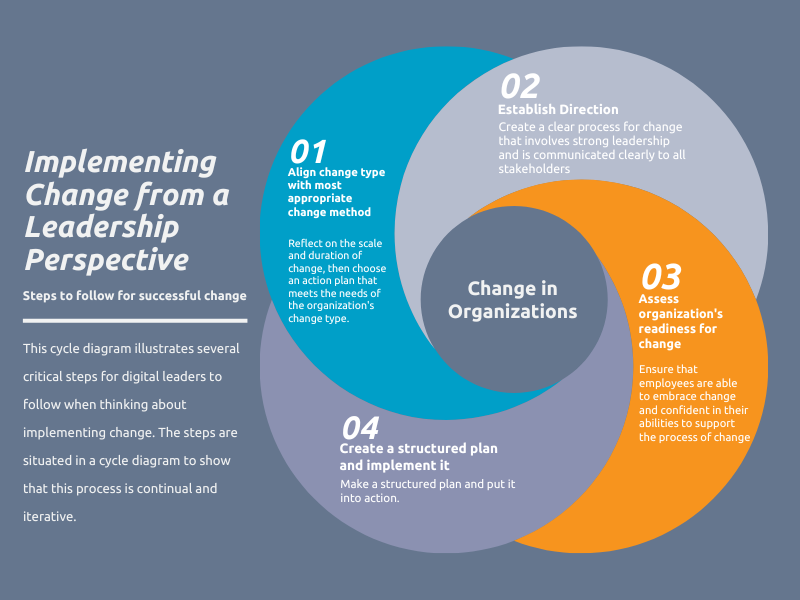
A digital leader then needs to instigate and implement change in the organization effectively. Several steps should be taken to promote organizational change and encourage desired outcomes. One of the first steps is to have a clear process for change. Al-Haddad & Kotnour (2015) propose that for change to be successful, organizations need strong leadership that can provide a structure for change, decrease barriers and foresee consequences, but also realize that businesses are diverse; finding a process that fits all businesses is unlikely. Therefore, Al-Haddad & Kotnour (2015) propose a framework for organizations that aligns a change type (aspects that describe forms of change, such as scale and duration) with a suitable change method (actions taken to cope with change, both systematically and with change management). Regardless of the chosen change direction, alignment with the scale and duration of change is key for success (Al-Haddad & Kotnour, 2015).
As Al-Haddad & Kotnour (2015) state, many change methods exist. It can be helpful to look to organizations and their leaders to help gain an understanding of what method to choose. Mindy Holman, a teacher-librarian for a Vancouver Island high school, discussed her role as a digital leader during the pandemic when British Columbian schools were required to go online. She recalled that she was given clear direction on what needed to be accomplished (teachers creating online platforms for students), which helped her attain outcomes (M.Holman, personal communication, February 16, 2023). The significance of direction is also echoed in an interview with Sandra Norum, a support teacher for K-12 education in BC. When implementing Universal Design for Learning (UDL) principles, she states that clear directions and expectations are helpful for implementing change (Harrison, n.d.). Clearly, when implementing change, digital leaders should provide clear direction for change to promote success.
Readiness for change is another aspect that digital leaders should be mindful of when planning. Mindy mentioned that a significant challenge in implementing a digital change in the K-12 education system was teachers who were entrenched in their non-digital ways; much time was spent encouraging, teaching, and persuading these educators to adopt this new technology (M.Holman, personal communication, February 16, 2023). Change readiness could have been more optimal; as Mindy discussed, several employees needed more preparation for this significant change. Wiener’s (2009) article discusses change management and organizational readiness; Wiener argues that organizational readiness (defined as members of the organization who are committed to change and confident in their abilities to do so) is key to successful change. One change method that addresses a part of change readiness is the Luecke method. Luecke developed a change process that highlighted change as an opportunity, not a barrier, and focused on encouraging employees to accept change (Al-Haddad & Kotnour, 2015). A digital leader can increase an organization’s readiness for change by encouraging all members to welcome it. Beich (2007) mentions Theory O, which also supports a notion of organizational readiness that focuses on employee participation and the bond with their organization, again focusing on employees who will welcome change, illustrating readiness.
Once there is a clear direction and a readiness for change, digital leaders can work on a structured plan. As Beich (2007) suggests, leaders need to have a plan for successful change; not only do they need a plan, but they also need to implement it. Beich (2007) suggests the CHANGE model to help create an actionable plan, as it is generic enough to adapt to many different situations and needs. There are six steps in the CHANGE model, including acknowledging the need for change, aligning leadership with organizational needs, activating commitment and ensuring readiness, creating a design, guiding implementation, and evaluating change (Beich, 2007). It is a continual process, which Udas (2008) puts forward as a significant factor for success.
For the best chance at successful change, digital leaders should consider several important factors, such as alignment of change type with a change method, clear direction, ensuring the organization is ready for change and creating and implementing a plan. Following these steps, digital leaders can take helpful steps to achieve their goals.
References
Al-Haddad, S., & Kotnour, T. (2015). Integrating the organizational change literature: a model for successful change. Journal of Organizational Change Management, 28(2), 234-262. https://doi.org/10.1108/JOCM-11-2013-0215
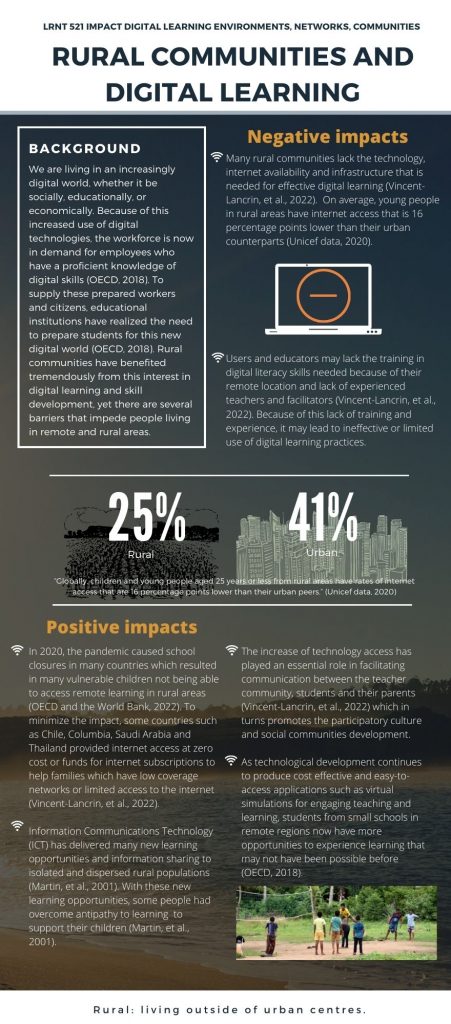
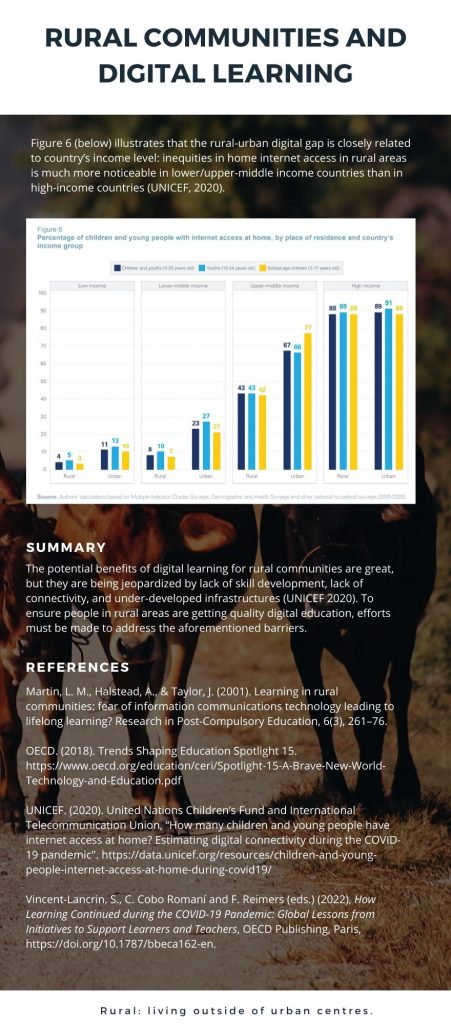
We have talked a lot about the benefits of digital learning these past few weeks; how beneficial DLE’s, LMS’ and various technological tools can be to educators, and how students are adept at implementing and using technologies, but what happens when students are not able to access these tools?
I struggle with several barriers to technology in my own workplace: lack of computers for students, inconsistent and weak wifi connectivity, and students who lack the skills to manoeuvre within these digital environments all affect the usefulness and ability to use technology for learning.
To highlight both the benefits and challenges of digital learning, I worked alongside my peer, Megan, to create a visual that emphasizes what students in rural communities are facing.
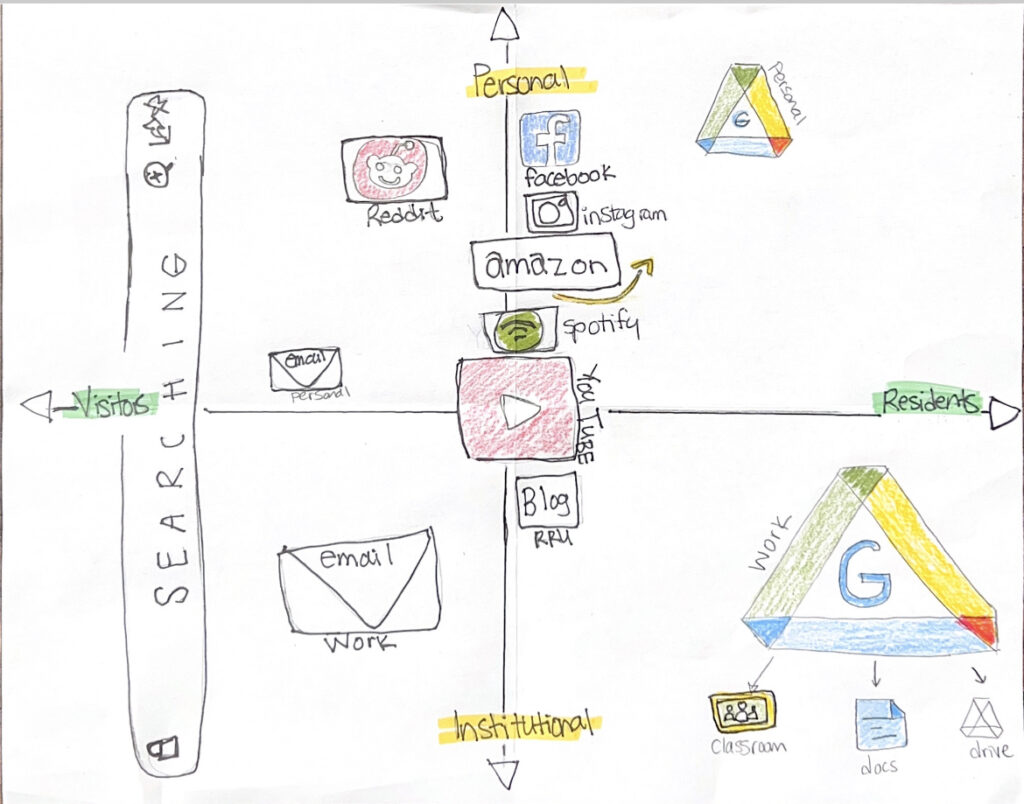
The image above represents a map of digital technology use divided into four quadrants. The idea comes from White and Le Cornu’s assertion that people’s use of the Web consists of ‘Resident’ and ‘Visitor’ mindsets. ‘Visitors’ to the internet use it as a tool and leave a relatively small imprint behind, whereas ‘Residents’ invest time, create relationships, and create a much more visible presence online (White & Le Cornu).
My map illustrates a more prominent ‘resident’ role in my work life using Google Suite. It is quite literally my ‘home’ when at work. All my classes are on Google Classroom, and most assignments are created or housed in Google Drive.
Socially, my footprint is somewhat less. I have two social media platforms where my privacy settings are quite high, and I only post on rare occasions.
What surprised me most was YouTube. Personally and professionally, I frequently use it and have subscribed to various channels, making me more visible than I realized.
Reflecting on my digital usage and ‘footprint’, I am satisfied with where I am, although I know that this map has captured only a moment in time. The interesting question is, how will this map look in two, five, or ten years’ time?
References
White, D. S., & Le Cornu, A. (2011). Visitors and Residents: A new typology for online engagement. First Monday, 16(9). https://doi.org/10.5210/fm.v16i9.3171