Walking Backwards into 2035: Kwak’wala Learning and the Future of EdTech

Walking Backwards into 2035: Kwak’wala Learning and the Future of EdTech

What if Kwak’wala language revitalization could do more than benefit from digital tools—what if it could reveal what educational technology actually requires of us by 2035?

I am interested in what community-governed digital learning environments for Indigenous language revitalization might look like, and how that might challenge our assumptions about what educational technology is for. Rather than providing recordings, dictionaries, or automated tools, these spaces could support active language practice and intergenerational learning shaped by community priorities and relationships. What if technology adapted to how communities learn, rather than requiring learning to fit the technology?

Roberts (2023) and Singh and Maughan (2014) prompt examination of who shapes technology and whose futures it serves—questions central to community-governed approaches.

Rangiwai’s (2021) work on prophecy and Indigenous educational futures has shaped my thinking about temporality and responsibility; imagining the future also means considering what we carry forward through Kwak’wala, community knowledge, and the priorities of future generations.

I am cautiously optimistic, not because technological development guarantees better learning, but because Indigenous revitalization may offer another way to question its purposes. By 2035, could community priorities help us imagine—and reshape—educational technology, rather than relying on technological progress alone?

References

Rangiwai, B. (2021). Walking backwards into the future: Prophecy as an approach for embedding Indigenous values in tertiary education. Te Kaharoa: The eJournal on Indigenous Pacific Issues, 17(1), 1–30. https://doi.org/10.24135/tekaharoa.v17i1.360

Roberts, J. S. (2023, July 10). Decolonizing AI ethics: Indigenous AI reflections. Medium. https://medium.com/accel-ai/decolonizing-ai-ethics-indigenous-ai-reflections-50dd4d6a2367

Singh, S. S., & Maughan, T. (2014, June 18). The future of ed tech is here, it’s just not evenly distributed. Futures Exchange. https://medium.com/futures-exchange/the-future-of-ed-tech-is-here-its-just-not-evenly-distributed-210778a423d7


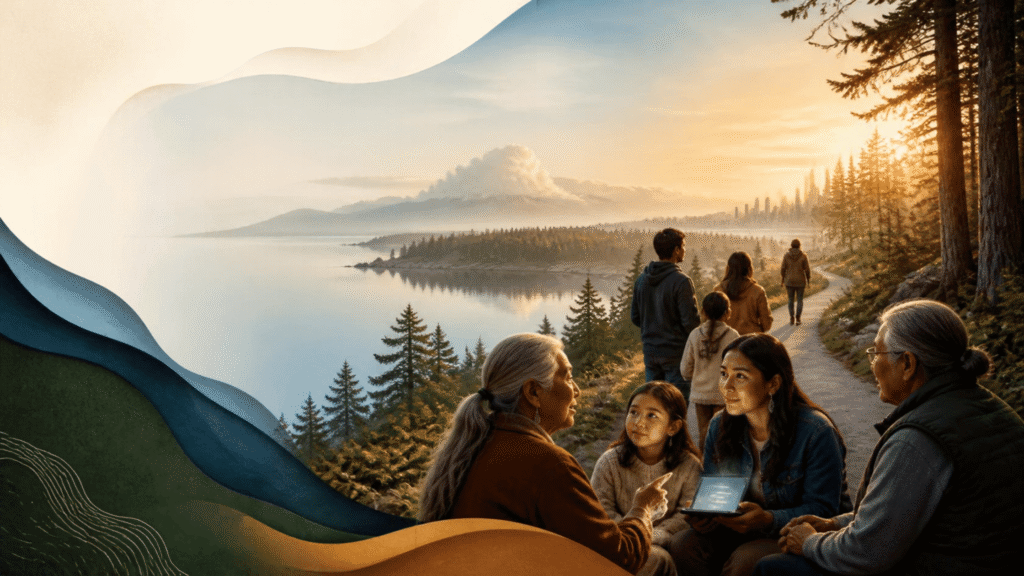
Figure 1

Three People Metaphorically Walking Backwards into the Future on a Scenic Trail
Note. Image generated using Canva AI by Voyageur, C., 2026. The composition reflects the conceptual metaphor of advancing backward into the future of educational technology while keeping the physical gaze fixed on past ancestral knowledge. The image features a diverse group positioned centrally on a trail with explicit reverse body mechanics and balancing postures.

Generative AI Plan and Transparency Statement

For this assignment, I used generative AI as a structural sounding board to organize initial thoughts, test ideas against assignment requirements, and check sentence clarity. To guard against hallucinations, fabricated citations, and inaccurate academic information, I independently verified sources and factual claims against original materials. Working with standard AI models such as ChatGPT or Gemini required critical filtering, particularly when responses oversimplified Indigenous knowledge or used generic language that did not reflect the cultural context. I used Sage AI as an additional review layer to assess and refine the structure while keeping the research, interpretation, and final writing my own. I also used Canva AI to support image creation for the visual elements of this assignment.

Reflection

Using AI for this assignment required ongoing direction and critical evaluation. I repeatedly had to redirect responses when they went beyond my requests, changed what I was trying to communicate, or offered generic language that did not reflect the Indigenous context. This made the process less seamless than I had hoped.

Creating the visual representation of walking backwards into the future was its own challenge, and amusement. Getting the backwards-walking movement to look natural took considerable trial and error, and I eventually turned to Gemini to help achieve the intended visual.

Using Sage AI for an additional review gave me another chance to assess the structure and identify potential homogenization. Sagechat.ai is an Indigenous-led alternative to generic corporate AI, informed by oral traditions, community-reviewed Indigenous wisdom, and traditional ways of knowing. Its approach aligned more closely with my need to preserve Indigenous worldviews and cultural specificity rather than flattening them into generic language. This reinforced for me that who develops AI, what knowledge informs it, and whose values shape its responses matter.

I remained responsible for evaluating AI suggestions and keeping the argument, research, interpretation, and cultural grounding rooted in my own understanding.


Two Technologies, One Old Question: What Makes Learning Happen?

Two Technologies, One Old Question: What Makes Learning Happen?

Two Technologies, One Old Question: What Makes Learning Happen?

A collaboratively authored post by Kelly Haylock and Carla Voyageur.

Claims about technology transforming education are everywhere, especially now that generative AI has entered nearly every corner of the classroom. In 1994, Richard Clark and Robert Kozma debated a version of the same question. Clark argued that media are only vehicles for delivering instruction, and that it is the instructional method, not the technology, that causes learning. Kozma reframed the question, asking not whether media influence learning but under what conditions they will, depending on a medium’s specific capabilities and how they interact with learners.

More than thirty years later, that debate is still the sharpest tool available for testing claims made about ed-tech. In this post, we examine two recent examples: a company blog post from Hurix Digital on AI tutoring, and a newspaper article on a virtual reality project for Indigenous health education. Using Clark and Kozma as two different lenses, we ask whether the benefits each claim come from the technology itself, from the instructional design behind it, or from both together.

Article 1: “How AI Tutors Personalize Education at Scale” (Hurix Digital, 2026)

This is a company blog post by Reena Shah, Vice President of Delivery at Hurix Digital, which sells digital content and learning services (Shah, 2026). The post argues that AI tutoring solves Bloom’s “two sigma problem,” the finding that one-on-one tutoring far outperforms classroom teaching but can’t be scaled. It says that in several peer-reviewed studies, AI tutoring outperforms one-on-one instruction, and it closes with an invitation to book a consultation.

The evidence does not match the claim. The Harvard trial it relies on compared and AI tutor with in-class active learning, not with a human tutor (Kestin et al., 2025). The second study, as the post describes it, supports a human-AI hybrid rather than AI alone. Market growth figures and student attitude surveys are offered as if they showed learning. In fairness, the post also calls AI tutoring “the delivery mechanism”.

Clark’s Response

He would find that word revealing. Calling AI a delivery mechanism concedes that method, not the medium, influences learning (Clark, 1994, pp. 23, 26). His replaceability test (p. 22) applies: Bloom’s result came from human tutors using mastery learning and feedback, a method humans can also deliver. What AI changes is cost and reach, which is a real but different claim. The Harvard authors themselves credit personalized feedback and self-pacing, both methods (Kestin et al., 2025). Market projections and attitude surveys measure enthusiasm, not learning (Clark, 1994, p. 27).

Kozma’s Response

He would give the post more credit. Immediate individual feedback and self-pacing are capabilities a classroom can’t easily offer, and he argues that capabilities enable methods (Kozma, 1994, p.16). But he would ask for the mechanism and process evidence (pp. 14-15). The study reports test scores, time on task, and ratings, but as far as we read, no analysis of the tutoring conversations. He would also ask for which learners and tasks, since the study covered two lessons in one physics course (Kestin et al., 2025). He warns that a student working alone with a computer recalls the teaching machine, and that media help only when designed into social context (pp. 16-17). The post’s advice to keep humans for motivation fits that view, but its headline claim that AI tutoring itself transforms learning does not.

Article 2: “U of S researchers use VR to revolutionize Indigenous health education” (The Saskatoon StarPhoenix, 2025)

This article, written by Aidan Jaager for The Saskatoon StarPhoenix, focuses on the VINE (Virtual Reality for Indigenous Youth and the Next Generation of Emerging Health Professionals) project, which uses VR to create more culturally responsive health sciences education resources and expand learning opportunities for Indigenous students. The VINE project uses 3D brain models that bring together Western neuroanatomy with traditional Indigenous teachings, along with 360-degree virtual campus tours for remote youth. VR is framed as a “modern technology avenue” to “revolutionize Indigenous health education,” positioning the technology as a major driver for addressing learning gaps and overcoming institutional barriers.

The project seeks to address curriculum gaps stemming from the historical exclusion of traditional Indigenous knowledge and community perspectives in standard healthcare education. It also addresses systemic and geographic barriers by tackling physical isolation in remote communities and the ongoing underrepresentation of Indigenous students in the health professions. Techno-determinism appears in the media headlines and narrative, which attributes systemic solutions directly to the medium, framing VR as a “modern technology avenue” inherently capable of “revolutionizing” education. At the same time, the project’s implementation resists pure determinism by centering a “community-driven, community-based” model led by Elders, Knowledge Keepers, and youth (Jaager, 2025). This tension highlights the divide between viewing technology as the primary driver of educational change and viewing it as a tool whose impact depends on how it is designed, implemented, and situated within a particular social and educational context.

The underlying research presents a more complicated picture than the media framing alone suggests. The NFRF project description describes VR as having “transformative potential” but positions that potential within a community-based participatory research process involving Indigenous youth and community members in co-developing the resources (NFRF, 2024)

Clark’s Response

Clark would separate the medium from the instructional conditions surrounding it. VR may be the delivery method, but the learning comes from the curriculum, Indigenous knowledge, community involvement, and student engagement (Clark, 1994, pp. 22–23). USask described the project as a “proof-of-concept,” that will hopefully lead to continued development (Olson, 2025). This matters for Clark because any eventual learning outcomes would raise the question of what can be attributed to VR itself and what comes from the curriculum, culturally relevant content, and community-based design surrounding it (Olson, 2025). His replaceability argument raises the question of whether someone could achieve the same learning through a home computer, video, or physical materials; Clark would question whether VR itself makes the difference (Clark, 1994, p. 22). The cost and access requirements also raise questions about whether its observed benefits come from the technology itself or reflect the additional resources and support it brings (Clark, 1994, p. 27).

Kozma’s Response

Kozma would consider how VR’s particular affordances shape the learning experience. Three-dimensional manipulation and 360° environments may enable forms of spatial exploration and interaction that are difficult to reproduce through a textbook or flat screen (Kozma, 1994, p. 11). This also supports the project’s stated rationale for using VR. The planned brain model allows students to move and manipulate a three-dimensional brain, which the researchers argue may help them understand the complexity of brain anatomy and neurophysiology while connecting Western health research with traditional Indigenous teachings (Olson, 2025). The Kozma question then becomes whether these specific capabilities actually contribute to learning and under what conditions. These capabilities operate within a social and instructional context; their value depends on how they are designed and used (Kozma, 1994, pp. 16–17). Community involvement, including Elders, youth, and Knowledge Keepers, helps shape what learners encounter and how they interpret the experience.

Conclusion

Read side by side; the Hurix and U of S articles show two different faces of techno-deterministic thinking. Hurix’s claim that AI tutoring outperforms one-on-one instruction rests on evidence that does not quite say that, and its framing of AI as a delivery mechanism supports Clark’s argument more than its own headline does. The U of S coverage is more hedged and community-led, but its opening claim that VR will revolutionize Indigenous health education still credits the technology before any results exist. In both cases, Clark would ask what instructional method is doing the work and whether it could be delivered another way, while Kozma would ask what capability of the medium is actually in play and whether it’s been designed into the right social and cultural context.

This is not only an academic exercise. In nursing, each new electronic medical record has arrived with the same promise: faster charting, easier communication, more time for patients. In practice, nurses now spend more time charting and less time at the bedside than before paper records disappeared, and when a system goes down, staff fall back on paper, the very method the technology was meant to replace. The EMR didn’t fail to deliver better care because the software was flawed; it succeeded at what it was actually built to do, capture more data, while the promise of more time with patients depended on staffing and workflow decisions the software was never designed to touch.

We leave readers with a simple habit: whenever a headline says a technology will transform learning, ask what method it is inside, and ask what evidence shows the medium itself, and not just its promise, is doing the work.

Transparency Statement

Generative AI was used to help analyze sources and refine wording: both authors verified citations and are responsible for final content.

References:

Clark, R. E. (1994). Media will never influence learning. Educational Technology Research and Development, 42(2), 21-29. https://www.jstor.org/stable/30218684

Jaager, A. (2025, July 29). U of S researchers use VR to revolutionize Indigenous health education. Saskatoon StarPhoenix. https://thestarphoenix.com/news/saskatchewan-news/u-of-s-researchers-use-vr-to-revolutionize-indigenous-health-education/

Kestin, G., Miller, K., Klales, A. et al. AI tutoring outperforms in-class active learning: an RCT introducing a novel research-based design in an authentic educational setting. Sci Rep 15, 17458 (2025). https://doi.org/10.1038/s41598-025-97652-6

Kozma, R. B. (1994). Will Media Influence Learning? Reframing the Debate. Educational Technology Research and Development, 42(2), 7–19. http://www.jstor.org/stable/30218683

Olson, M. (2025, July 15). USask community research uses virtual reality for Indigenous health education. University of Saskatchewan. https://news.usask.ca/media-release-pages/2025/usask-community-research-uses-virtual-reality-for-indigenous-health-education.php

Shah, R. (2026, July 3). How AI tutors personalize education at scale [Blog post]. Hurix Digital. https://www.hurix.com/blogs/how-ai-tutors-personalize-education-at-scale/

Social Sciences and Humanities Research Council of Canada. (2024). Co-creating a VINE: Virtual Reality for Indigenous Youth and the Next Generation of Emerging Health Professionals. New Frontiers in Research Fund. https://sshrc-crsh.canada.ca/funding-financement/nfrf-fnfr/exploration/2024/award_recipients-titulaires_subvention-eng.aspx

 

Learning Through Place: The Work of Elaine Westbrook

Learning Through Place: The Work of Elaine Westbrook

Learning Through Place: The Work of Elaine Westbrook

Dr. Elaine Westbrook is an Assistant Professor of Science Education at Montana State University Billings. Her work focuses on STEM education, informal learning, place-conscious pedagogy, and rural and Indigenous communities. I selected Westbrook because her work brings together areas I am interested in, particularly learning and technology, Indigenous knowledge, and place-based learning. Her work shows how technology can support learning without separating it from culture, community, and place, while strengthening relationships between different knowledge systems and creating opportunities for immersive, hands-on learning.

A key feature of Westbrook’s work is her application of place-conscious approaches in STEM education. According to her research, student interest in STEM grew through collaborative work, acquiring new knowledge, and conducting action research within a rural, place-based curriculum (Westbrook, 2022). Westbrook has since extended this research into immersive, community-based projects that actively braid Indigenous knowledge with Western science. The Northern Cheyenne Star Stories project builds on this approach by combining Indigenous and Western views of astronomy in an immersive learning experience grounded in the Two-Eyed Seeing framework, while supporting the preservation of the Northern Cheyenne language and culture (KTVQ, 2024).

Westbrook’s research aligns with new trends within educational technology, where digital and immersive tools offer fresh ways to learn. Her work shows that technology should do more than just deliver information. It can help students connect with culture, play, and different ways of thinking. She also co-authored research exploring how gaming can develop spatial skills and build pathways toward STEM learning through Minecraft (Hughes et al., 2020). She recently spoke at ISTELive 25: The Intersection of Indigenous Culture and Technology (EdTech Magazine, 2025) about combining Indigenous culture, technology, and makerspaces.

Westbrook’s work advances a view of learning as experiential, situated, and collaborative. It allows multiple knowledge systems to coexist without prioritizing one over the other. In this sense, technology becomes more than a content delivery mechanism: it connects learners to place, culture, community, language and different ways of understanding the world.

References

EdTech Magazine. (2025, July 3). ISTELive 25: The intersection of Indigenous culture and technology [Video]. https://edtechmagazine.com/k12/media/video/istelive-25-intersection-indigenous-culture-and-technology

Hughes, B. E., Willoughby, S. D., LaMeres, B. J., Frank, B., Westbrook, E. M., & Lux, N. (2020, June). Gaming spatial-skill development: Building STEM pathways with the use of the Minecraft gaming platform. 2020 ASEE Virtual Annual Conference Content Access. https://par.nsf.gov/biblio/10252148

KTVQ News. (2024, March 23). MSUB hosts Northern Cheyenne language project’s ‘Star Stories’ with Stellar Insights. Q2 News. https://www.ktvq.com/news/local-news/msub-hosts-northern-cheyenne-language-projects-star-stories-with-stellar-insights

Westbrook, E. (2022). STEMulating interest with a rural place-conscious curriculum. Theory & Practice in Rural Education, 12(2), 197–220. https://doi.org/10.3776/tpre.2022.v12n2p197-220

 Generative AI Plan and Transparency

For this assignment, I planned to use generative AI tools minimally and for specific support functions. I intended to use ChatGPT to test my initial ideas against the assignment requirements, organize my scattered thoughts into a working outline, and identify areas to tighten my writing by reducing unnecessary length or redundancy. I intended to use Grammarly for final-stage editing to check grammar, spelling, punctuation, and sentence clarity. My guardrails were to keep the research, interpretation, and final writing my own, while critically examining and independently verifying any information generated by AI. I checked biographical details, institutional affiliations, publication claims, and any AI-provided sources and links against the original materials. In practice, I used relevant outline points as working material for my own research and writing, while disregarding unsolicited AI-generated sentences and paragraphs. I also assessed the responses for language that could oversimplify or flatten Indigenous knowledge into generic cultural references, and revised or disregarded those suggestions.

 Reflection

Using AI for this assignment was useful, especially for getting my ideas into a workable structure and seeing where I could tighten my writing. At the same time, I found myself repeatedly redirecting ChatGPT when it went beyond what I asked for, changed what I was trying to say, or offered generic language that didn’t fit. This was especially frustrating when working through an Indigenous lens, where the cultural context and specificity mattered to me. It reinforced how important it was for me to stay grounded in my own research, interpretation, and understanding rather than letting AI shape the work. Overall, I found AI useful as a support, but not as something I could hand the thinking over to.


The History We Forget

The History We Forget

My experiences with educational technology have been vast, for the most part.

In the early 90s, I attended an alternative school where Nautikos, a computer-based learning program developed by Odyssey Learning Systems, was used. It used a pre-test to identify topics students had already mastered, then automatically exempted them from those topics so they could focus solely on their knowledge gaps.

Before reading Weller (2020), I hadn’t thought about this experience as part of the field’s history. It was merely part of my own history, within my personal education and learning journey. Weller’s historical account has prompted me to reconsider earlier experiences with technology-supported learning and look back on them differently.

What I found compelling across these chapters was how much history sits behind the technologies we now take for granted, and how many ideas we associate with contemporary educational technology were already being explored through earlier technologies. Weller reconstructs the field by situating contemporary technologies within a longer history of experimentation and development. His discussion of historical amnesia also made me think about how quickly earlier technologies and ideas can disappear from view as new ones emerge. At the same time, his attention to the limits and gaps in that history made me think about the histories that sit outside the dominant narrative—the ones that don’t make it into these conversations.

That is where my interest in an Indigenous parallel arises. I would like to know what an Indigenous history of technology and education might offer when placed alongside the history Weller traces. I have not yet thoroughly examined that link, but Ruth’s (2020) work on Indigenous wisdom, technology, and education gives me a starting point. I am interested to see what comes to light.

References

Ruth, D. (2020). Indigenous wisdom, capital, technology and education. New Zealand Journal of Educational Studies, 55, 405–422. https://doi.org/10.1007/s40841-020-00181-1


Weller, M. (2020). 25 years of Ed Tech. Athabasca University Press. https://doi.org/10.15215/aupress/9781771993050.01

 AI Statement

I used ChatGPT to organize my thoughts and connections, and Grammarly AI to revise for clarity.