
k̓a'xa̱'nakwa̱la
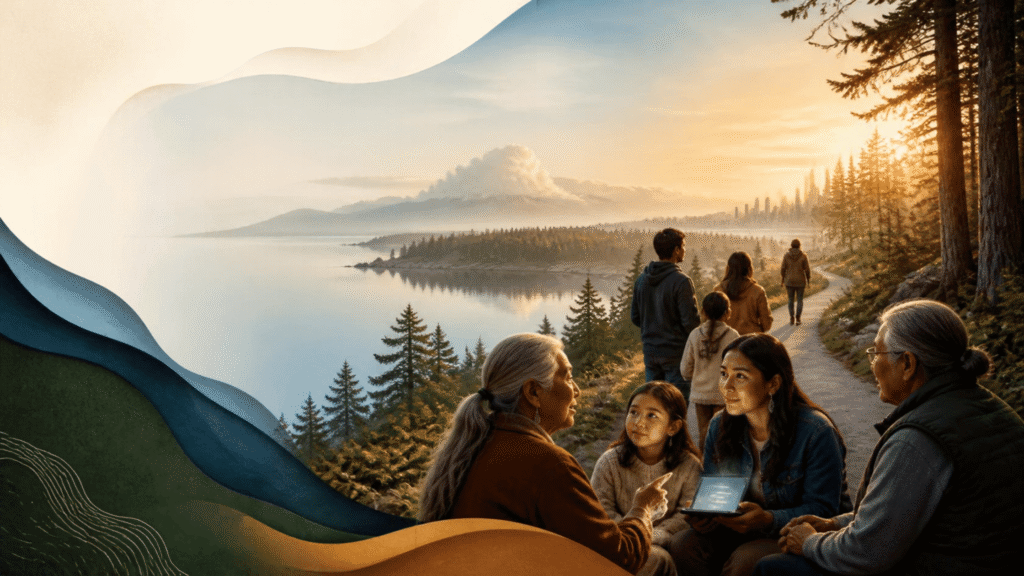
I am interested in what community-governed digital learning environments for Indigenous language revitalization might look like, and how that might challenge our assumptions about what educational technology is for. Rather than providing recordings, dictionaries, or automated tools, these spaces could support active language practice and intergenerational learning shaped by community priorities and relationships. What if technology adapted to how communities learn, rather than requiring learning to fit the technology?
Roberts (2023) and Singh and Maughan (2014) prompt examination of who shapes technology and whose futures it serves—questions central to community-governed approaches.
Rangiwai’s (2021) work on prophecy and Indigenous educational futures has shaped my thinking about temporality and responsibility; imagining the future also means considering what we carry forward through Kwak’wala, community knowledge, and the priorities of future generations.
I am cautiously optimistic, not because technological development guarantees better learning, but because Indigenous revitalization may offer another way to question its purposes. By 2035, could community priorities help us imagine—and reshape—educational technology, rather than relying on technological progress alone?
References
Rangiwai, B. (2021). Walking backwards into the future: Prophecy as an approach for embedding Indigenous values in tertiary education. Te Kaharoa: The eJournal on Indigenous Pacific Issues, 17(1), 1–30. https://doi.org/10.24135/tekaharoa.v17i1.360
Roberts, J. S. (2023, July 10). Decolonizing AI ethics: Indigenous AI reflections. Medium. https://medium.com/accel-ai/decolonizing-ai-ethics-indigenous-ai-reflections-50dd4d6a2367
Singh, S. S., & Maughan, T. (2014, June 18). The future of ed tech is here, it’s just not evenly distributed. Futures Exchange. https://medium.com/futures-exchange/the-future-of-ed-tech-is-here-its-just-not-evenly-distributed-210778a423d7
Figure 1
Generative AI Plan and Transparency Statement
For this assignment, I used generative AI as a structural sounding board to organize initial thoughts, test ideas against assignment requirements, and check sentence clarity. To guard against hallucinations, fabricated citations, and inaccurate academic information, I independently verified sources and factual claims against original materials. Working with standard AI models such as ChatGPT or Gemini required critical filtering, particularly when responses oversimplified Indigenous knowledge or used generic language that did not reflect the cultural context. I used Sage AI as an additional review layer to assess and refine the structure while keeping the research, interpretation, and final writing my own. I also used Canva AI to support image creation for the visual elements of this assignment.
Reflection
Using AI for this assignment required ongoing direction and critical evaluation. I repeatedly had to redirect responses when they went beyond my requests, changed what I was trying to communicate, or offered generic language that did not reflect the Indigenous context. This made the process less seamless than I had hoped.
Creating the visual representation of walking backwards into the future was its own challenge, and amusement. Getting the backwards-walking movement to look natural took considerable trial and error, and I eventually turned to Gemini to help achieve the intended visual.
Using Sage AI for an additional review gave me another chance to assess the structure and identify potential homogenization. Sagechat.ai is an Indigenous-led alternative to generic corporate AI, informed by oral traditions, community-reviewed Indigenous wisdom, and traditional ways of knowing. Its approach aligned more closely with my need to preserve Indigenous worldviews and cultural specificity rather than flattening them into generic language. This reinforced for me that who develops AI, what knowledge informs it, and whose values shape its responses matter.
I remained responsible for evaluating AI suggestions and keeping the argument, research, interpretation, and cultural grounding rooted in my own understanding.