
i'ax̱a̱la
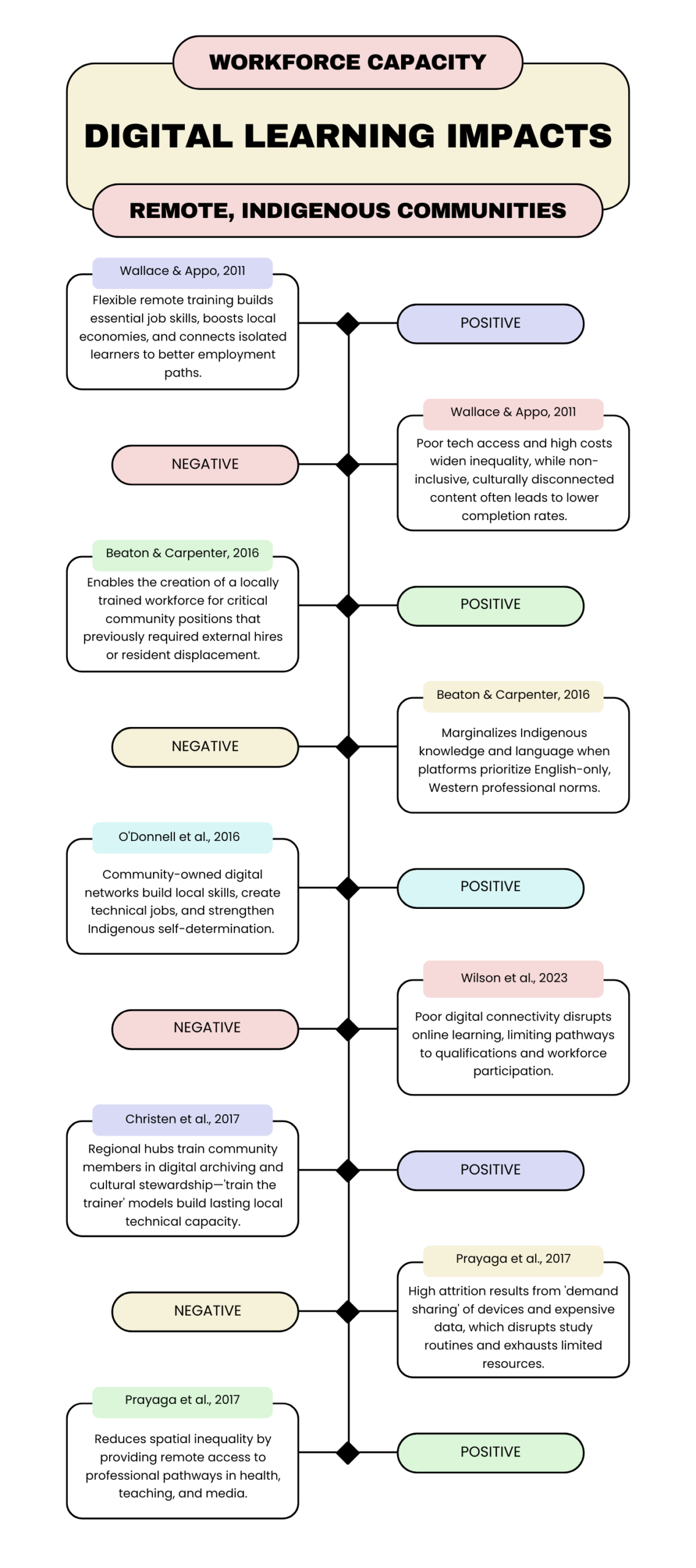
Digital learning can help build Indigenous workforce capacity in remote coastal BC, but only if access, context, and community needs are truly considered. Some coastal communities in BC can only be reached by float plane or boat, and even that depends on the weather. Reliable internet in these isolated places is not guaranteed; setting it up is often costly and requires special equipment. The experiences and challenges of using digital learning are as diverse as the Nations along the coast. Much of the research is not local, but it still relates to these conditions. This post reviews the limited evidence available.
Ten years ago, O’Donnell et al. (2016) found that more than 18,000 households in northern Canada did not have usable broadband. In BC, almost 20% of First Nations households on reserves and modern treaty lands still lack high-speed internet, according to the First Nations Technology Council (2024), and the actual figure is likely higher. Wilson et al. (2023) link this lack of access to fewer people earning credentials.
Getting a good internet signal and access to online learning is not just about having a space that works for everyone. Digital learning platforms are not neutral; they come with built-in ideas about what knowledge is and how it should be shared. Wallace and Appo (2011) found that people do not disengage simply because of motivation. When local protocols are ignored, participation drops. English-only platforms also exclude other knowledge systems. Beaton and Carpenter (2016) say that in these cases, the platform itself becomes a barrier.
Digital learning systems usually measure success by whether someone finishes a course. But things like sharing a device at home, running out of prepaid data in the middle of a lesson, or caring for a sick child do not show up in dropout statistics. Prayaga et al. (2017) found a 29% dropout rate among remote Indigenous online learners. Completion rates only count those who finished. Beaton and Carpenter (2016) suggest a different approach: staying on territory while earning a credential is a success in itself.
The research reviewed for this post does not include long-term data linking digital learning to real workforce outcomes in remote Indigenous communities. This gap is important because the focus is workforce capacity, not just access. Prayaga et al. (2017) focus on access and participation barriers among remote Indigenous online learners, including high dropout rates. Wilson (2008) discusses broader structural constraints in education systems and how knowledge production and access are shaped.
Wilson (2008) explains that Indigenous self-determination includes control over knowledge—who creates it, who benefits from it, and what counts as proof of success. Workforce capacity includes learning tied to family, responsibility, and place. It might mean a band administrator upgrading skills locally or a young person building work in their community. These outcomes do not appear in platform dashboards or completion reports.
Digital learning can make a difference, but only if communities control the design, the data, and what success means.
Beaton, B., & Carpenter, P. (2016). Digital technology innovations in education in remote First Nations. In Education, 22(1), 42–60. https://journals.uregina.ca/ineducation/article/view/266
Christen, K., Merrill, A., & Wynne, M. (2017). A community of relations: Mukurtu hubs and spokes. D-Lib Magazine, 23(5/6). https://doi.org/10.1045/may2017-christen
First Nations Technology Council. (2024). BC First Nations community internet connectivity. https://technologycouncil.ca/wp-content/uploads/2024/09/FNTC-IDES1.pdf
O’Donnell, S., Beaton, B., McMahon, R., Hudson, H. E., Williams, D., & Whiteduck, T. (2016). Digital technology adoption in remote and northern Indigenous communities in Canada. Canadian Sociological Association Annual Conference. http://susanodo.ca/wp-content/uploads/2017/06/2016-CSA-Digital-Technology-Adoption.pdf
Prayaga, P., Rennie, E., Pechenkina, E., & Hunter, A. (2017). Digital literacy and other factors influencing success of online courses in remote Indigenous communities. In J. Frawley et al. (Eds.), Indigenous pathways, transitions and participation in higher education (pp. 189–210). Springer. https://doi.org/10.1007/978-981-10-4062-7_12
Wallace, R., & Appo, R. (2011). Indigenous dot com: E-learning in Australian Indigenous workforce development and engagement. In R. Catts et al. (Eds.), Vocational learning: Innovative theory and practice (pp. 93–107). Springer. https://doi.org/10.1007/978-94-007-1539-4_6
Wilson, A. M., III, Buckley, A., Downing, M., Owen, J., & Jackson, M. (2023). The Indigenous digital divide: COVID-19 and its impacts on educational delivery to First Nation university students. Journal of Higher Education Theory and Practice, 23(17). https://doi.org/10.33423/jhetp.v23i17.6552
This post was developed using AI tools to help organize initial ideas and support drafting based on research notes and sources provided by the author. All content was then reviewed, revised, and rewritten by the author to ensure alignment with course expectations, voice, and academic integrity. AI was used as a support tool, not as a substitute for authorship or analysis.