Learning Through Connection
ḵ̓a̱mdza̱kw
Rhizomes, Salmonberry, and Place
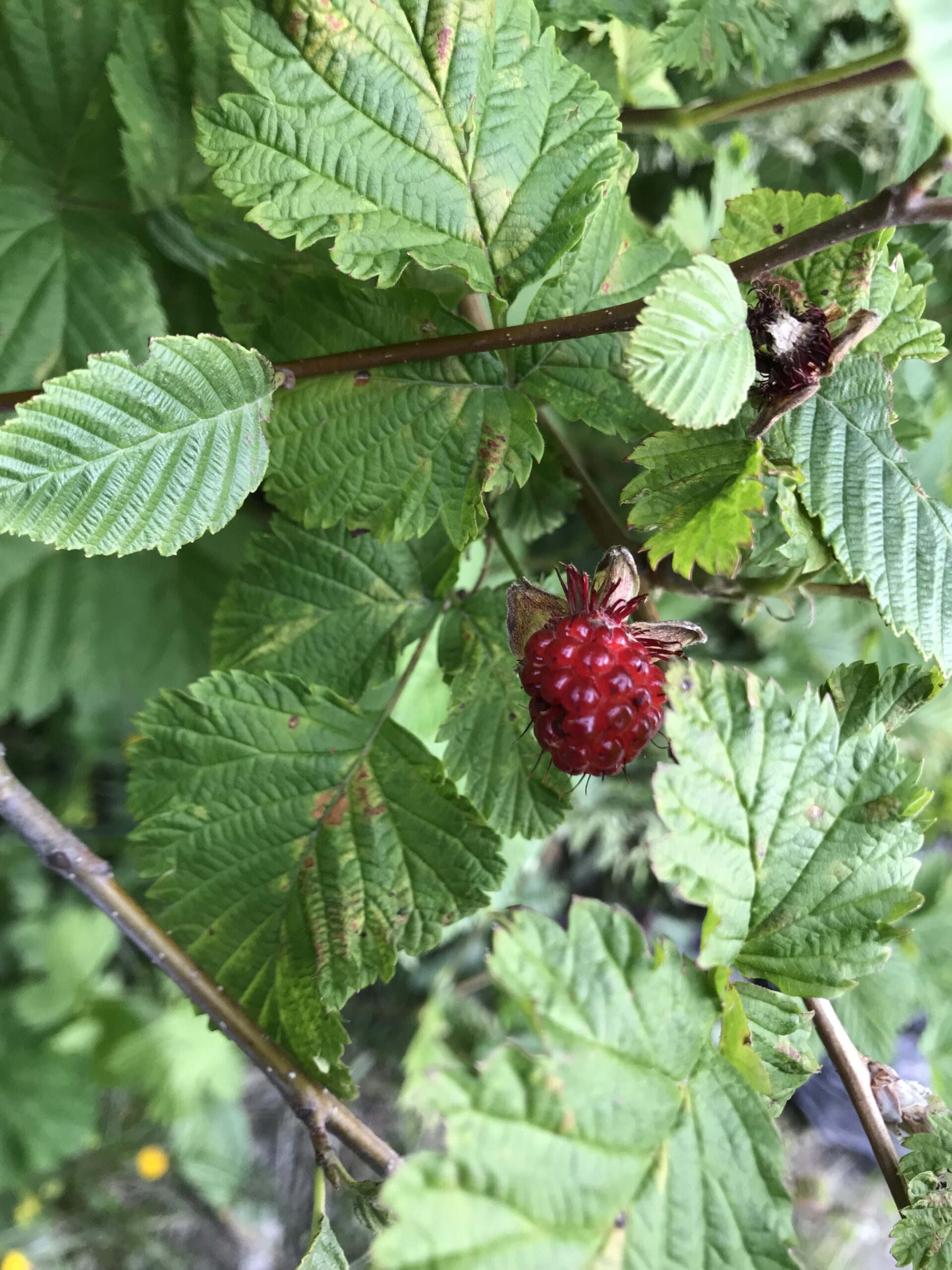
During the Virtual Symposium hosted by Royal Roads University’s MALAT/DipLAT programs, I participated in a range of presentations on digital learning. What stayed with me most were ideas connected to open education, particularly Cormier’s rhizome metaphor of learning (Cormier, 2008). What struck me was not how new it felt, but how familiar it was. My mind immediately went to salmonberry—especially at this time of year, when they begin to emerge and signal broader seasonal shifts.
Cormier’s concept of rhizomatic learning understands knowledge as non-linear, networked, and emergent. He describes openness in learning as something that spreads and develops like a rhizome, rather than following a fixed or centralized structure. This shifts learning away from hierarchy toward connections and context. Interaction develops knowledge in this sense, and ecology shapes it.
This way of understanding learning becomes visible in land-based systems. Salmonberry, for example, grows in relation to seasonal conditions. In my experience, salmonberry is not just a berry-producing plant, but something that signals broader environmental patterns, with its abundance often understood in relation to the strength of upcoming salmon runs. This aligns with relationships described in Thriving Together: Salmon, Berries and People (The Tyee, 2021), where salmon nutrients support interconnected forest ecosystems. These relationships reflect rhizomatic learning, where the environment shapes knowledge as it develops through connection.
What stands out to me is how rhizomatic learning and salmonberry knowledge both frame learning as relational and ecological. I understand this perspective as rooted in relationships, place, and direct observation rather than something fixed or isolated. This aligns with relational approaches to knowledge reflected in Indigenous educational frameworks such as the 6 R’s of Indigenous OER (BCcampus, n.d.). It also brings me back to ecological shifts that occur without relational grounding. I began to question whether openness is always positive when it is disconnected from context and other forms of knowledge. This led me to reflect on how mainstream approaches to learning can reproduce non-relational and decontextualized patterns when not accountable to communities. In the future, these ideas will make me more attentive to how place and relationships shape knowledge.
BCcampus. (n.d.). The 6 R’s of Indigenous OER. BCcampus Open Education. https://pressbooks.bccampus.ca/openubcpub/chapter/the-6-rs-of-indigenous-oer/
Cormier, D. (2008). Rhizomatic education: Community as curriculum. Dave’s Educational Blog. http://davecormier.com/edblog/2008/06/03/rhizomatic-education-community-as-curriculum/
The Tyee. (2021, May 11). Thriving together: Salmon, berries and people. https://thetyee.ca/Culture/2021/05/11/Thriving-Together-Salmon-Berries-People/
Hi Carla,
I really loved your connection between rhizomatic learning and the salmonberry: it made the concept feel more grounded and real. The way you described learning as something relational and connected to place resonated with me. I have lived and either worked or studied in a few different countries, and one thing I have noticed is how much learning depends on where you are and who you are learning with so I really enjoyed the salmonberry metaphor.
It was such a powerful way to show how knowledge develops through relationships and environment, not just in isolation. It gives me a new way of thinking about learning beyond the classroom. Thanks for sharing!
Hi Carla,
I didn’t catch Cormier’s metaphor in the Symposium, so I enjoyed reading about it in your post. Thank you for sharing. I found your question very interesting about whether openness without grounding and context is always positive. I don’t have any thoughts to further the conversation at this point, but I have dog-eared the idea so I can come back to it.
Also, here’s a quote from Alexandra Morton that is a favourite of mine, and is tangentially related to your post: “You can actually measure the size of the salmon run by looking at the growth rings of the trees.”