
Community of Inquiry framework
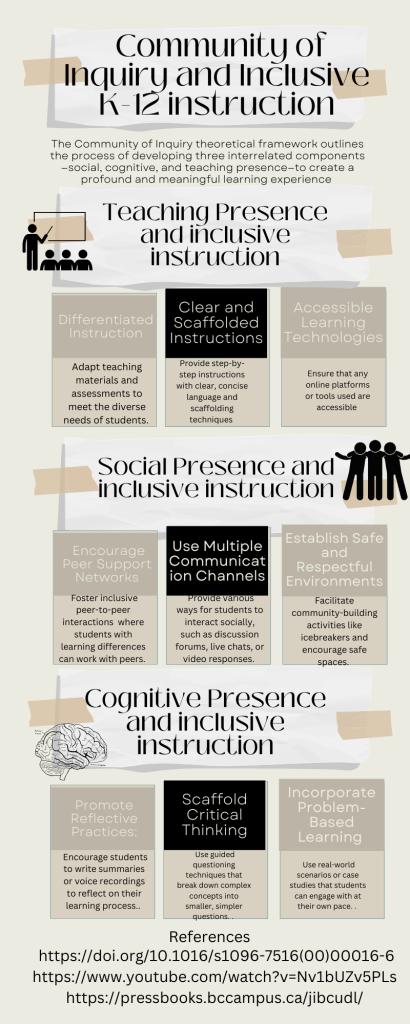
The Community of Inquiry (CoI) framework, as stated by Garrison et al. (1999), provides a foundational model for creating meaningful learning experiences through the integration of Teaching, Social, and Cognitive presences. As an instructor working with students from kindergarten to Grade 12, I chose to focus on how to implement CoI framework especially to students with learning differences and explore strategies tailored to address diverse learner needs.
Teaching Presence
Teaching presence can shape how students learn by guiding lesson design, organization, and flow. One strategy for making learning more inclusive is differentiated instruction, which means adapting lessons and assessments to meet the unique needs of each student. This adheres to the Universal Design for Learning theory and can help students to assimilate information better(Takacs, 2022). Accommodations could involve using various ways to present content—like videos, text, and audio—so that all students, no matter their learning style or ability, can fully engage with the material.
It’s also important to give clear, step-by-step instructions. Breaking down tasks into manageable chunks and using simple, direct language helps students with cognitive or language challenges move through lessons at their own pace. Finally, incorporating accessible learning technologies can be helpful. By ensuring that online platforms work seamlessly with tools like screen readers and speech-to-text programs, educators can provide equal opportunities for students with disabilities, allowing them to fully participate and thrive in their learning.
Social Presence
Social presence is essential for creating a learning environment where students feel connected, valued, and supported (Garrison et al., 1999). Facilitators can strengthen this sense of community by encouraging peer support networks. Students can learn from each other by forming collaborative groups while building social confidence. This is especially helpful for those who struggle with social interactions, as it provides a safe and structured space to practice and develop their social skills.
Offering different ways for students to communicate—like discussion forums, live chats, or video responses—also helps. This flexibility allows students to choose the method of interaction that feels most comfortable to them, which is particularly important for those with communication difficulties or anxiety in more traditional settings. It allows them to express their full personality (Garrison et al., 1999).
By creating a safe and respectful atmosphere through community-building activities like icebreakers and promoting a culture of inclusivity and respect, educators help students feel safe expressing themselves without fear of judgment.
Cognitive Presence
Cognitive presence is about helping learners make sense of new ideas through reflection and thoughtful discussion (Garrison et al., 1999). For students with cognitive challenges, offering different ways to reflect—whether through journals, blogs, or voice recordings—gives them the freedom to express their understanding in a way that plays to their strengths, whether they’re more comfortable writing or speaking.
Another key element is supporting critical thinking. Educators can break down complex ideas into smaller, easier-to-digest parts by asking guided questions. This step-by-step approach is especially helpful for students who may find it harder to process information quickly. It allows them to build their critical thinking skills at their own pace.
Incorporating Problem-Based Learning into lessons also encourages deeper engagement. Presenting real-world scenarios or case studies that students can work through at their own pace makes learning more interactive. By providing multiple ways for students to approach problem-solving, educators can ensure that every student, regardless of ability, has the chance to contribute meaningfully, using their individual strengths to tackle challenges.
Through this exploration I have found that educators can effectively support teaching, social, and cognitive presences by strategically implementing inclusive and adaptive strategies within the Community of Inquiry framework.
References
Clint Lalonde. (2020, August 23). Facilitation in a community of inquiry [Video]. YouTube. https://www.youtube.com/watch?v=Nv1bUZv5PLs
Garrison, D., Anderson, T., & Archer, W. (1999). Critical inquiry in a Text-Based Environment: Computer Conferencing in Higher Education. The Internet and Higher Education, 2(2–3), 87–105. https://doi.org/10.1016/s1096-7516(00)00016-6
Takacs, S. (2022a, February 10). A comprehensive guide to applying universal Design for learning. Pressbooks. https://pressbooks.bccampus.ca/jibcudl/