
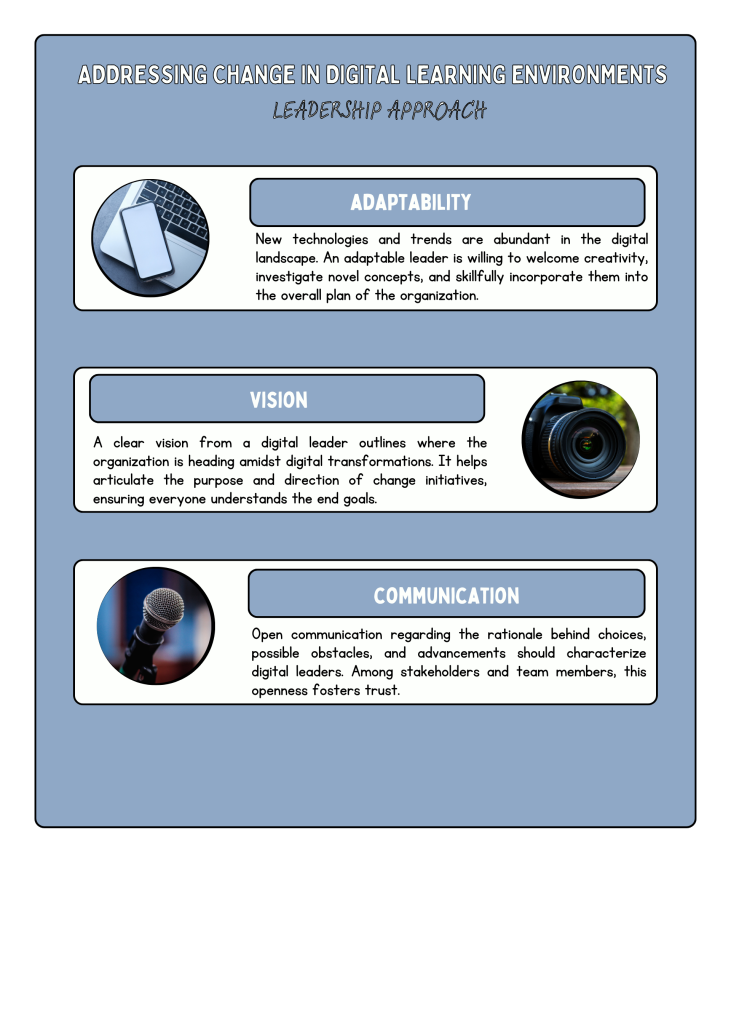
Innovation in the digital space is unrelenting, with new technologies constantly changing businesses and sectors. Digital leaders manage complexity, foster creativity, and utilize technology breakthroughs to accomplish strategic goals. However, the rate of change presents previously unheard-of difficulties, calling for proactive vision, communication and adaptation in digital leadership.
As mentioned by Christina Jones in the Voices in Leadership interview, “When applying technology to learning, you’re going to miss people. ” This statement further emphasizes the challenges leaders face when making changes, as there is no one-size-fits-all solution. For leaders to develop successful change within an organization, they need to possess a collaborative vision that is clearly communicated to all the stakeholders. Articulating a compelling vision and mission for the organization’s future direction and purposeful pursuit is essential for organizational success as the “north star” that guides the organization’s focus (Gill,2006 as cited in Workman & Cleveland-Innes, 2012, p 316).
In an interview with my colleague, we discussed one of our organization’s significant changes during the 2019 COVID-19 pandemic. My colleague highlighted the sudden changes that were needed in the changing landscape of providing services to students with learning differences during a pandemic. Providing the online learning platform was a huge success and it was guided by the organization’s vision of providing accessible education to all students .This allowed the organization to serve more families and reduce the potential travel and scheduling barriers that families usually face as well as provide continued education (B. Bishop, personal communication, February 14, 2024). As highlighted by Al-Haddad & Kotnour (2015), possessing a “creative vision” of providing accessible education and ensuring that colleagues bought into the vision prepared them for the changes our organization faced in the wake of the pandemic.
Similarly, the Luecke method emphasizes the need to acknowledge the necessity and immediacy of transformation ( Luecke 2003, as cited by Al-Haddad & Kotnour,2015) . Our organization’s success during the pandemic was coupled with the belief that all stakeholders viewed change as an opportunity rather than a danger; therefore, the shift to online learning for students was an opportunity for the organization to grow and foster learning in more students ( Luecke 2003, as cited by Al-Haddad & Kotnour,2015).As a result, by encouraging agreement on concepts and goals, the notion of adaptive leadership played a crucial role in assisting our educational institution in attaining their vision(Khan, 2017, p.180)
My colleague also highlighted the need to continue to make the educational landscape more inclusive and data-driven, embracing change as a constant and leveraging technology to adapt to the ever-changing environment (B. Bishop, personal communication, February 14, 2024). This aligns with the Insurrection model, which encourages making non-linear transformations and innovations within organizations that diverge from competitors’ strategies ( Hamel,2000 as cited by Al-Haddad & Kotnour, 2015 ). By providing more inclusive and data-driven changes within the digital learning landscape, our organization has been able to provide niche services to students from various backgrounds that are not yet provided elsewhere.
According to Bayerl et al. (2013), as cited by Al-Haddad & Kotnour (2015), organizational change is brought about by coordinating the new change processes and patterns with the organization’s current structure. Throughout the transition process, teamwork and cooperation were improved through transparent communication, which fostered trust among stakeholders and team members.
All things considered, effective communication is critical to digital change leadership because it guarantees transparency, clarity, alignment, and feedback—all of which are necessary for navigating digital changes successfully (Al-Haddad & Kotnour , 2015, p. 260).
References
Al-Haddad, S., & Kotnour, T. (2015). Integrating the organizational change literature: a model for successful change. Journal of Organizational Change Management, 28(2), 234–262. https://doi.org/10.1108/jocm-11-2013-0215
Khan, N. (2017b). Adaptive or Transactional leadership in current Higher Education: A brief comparison. The International Review of Research in Open and Distributed Learning, 18(3). https://doi.org/10.19173/irrodl.v18i3.3294
Jones, C. (n.d.). Voices of Leadership. Royal Roads University. https://malat-coursesite.royalroads.ca/lrnt525/schedule/voices/ Jan 22 2024.
Workman, T., & Cleveland-Innes, M. (2012c). Leadership, personal transformation, and management. The International Review of Research in Open and Distributed Learning, 13(4), 313. https://doi.org/10.19173/irrodl.v13i4.1383