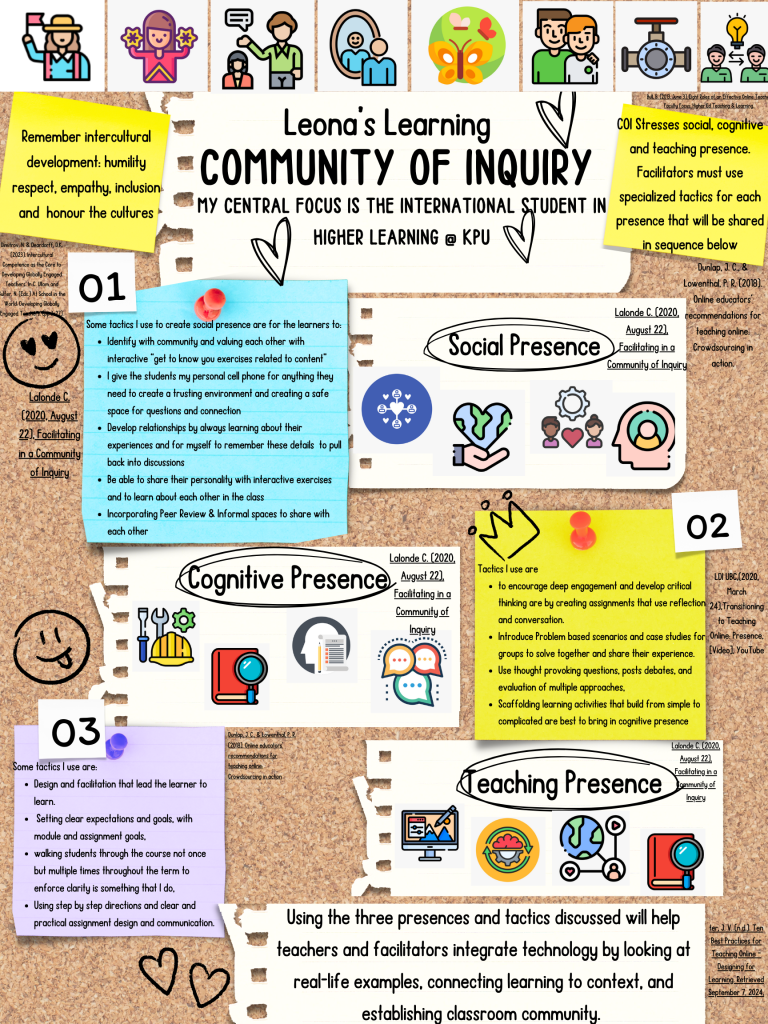
The Community of Inquiry (CoI) framework stresses teaching, social, and cognitive presence to develop and facilitate effective online learning experiences. Facilitators must use specialized tactics for each presence to create an engaging, dynamic, and safe space for learning. Dunlop et al. (2018).
My program that I teach at Kwantlen Polytechnic University is Human Resources Management. I offer Post Baccalaureate courses for international students, as well as the BBA program for local students.
I started with social presence, as there is so much community connection that needs to happen for international students to feel safe, secure, and protected in this extremely new environment of learning (Lalonde, 2020).
Forum posts and discussions help students and I identify and learn about our community, creating a psychologically secure area to value and appreciate one another. We use interactive icebreakers and content-related “getting to know you” exercises. I build relationships by learning about each student through forum postings and group icebreakers, then remembering and applying this knowledge throughout interactions and discussions. Through forum posts and in-class exercises, I use peer review, group projects, and information spaces to interact (Vaughan et al., 2013).
Cognitive presence refers to the learner’s ability to deeply engage with knowledge, develop critical thinking abilities, and construct meaning via reflection and conversation (Lalonde, 2020). Throughout my courses, I embrace reflective learning and develop scaffold learning activities that build students’ knowledge and skills from simple to complex. In problem-based learning, students apply theory to practice. (Boettcher, n.d.). Questions like assessing multiple solutions may help students apply their knowledge. I also aim to include puzzles in the course that strengthen the subject matter and foster teamwork.
Teaching presence ensures that the instructor creates, organizes, and leads the course to help students learn. I design and facilitate learning activities that guide students throughout the weeks of my courses. I begin with clearly defined learning objectives and well-defined learning goals, including module or assignment goals. This provides students with a plan and keeps them focused. Setting explicit expectations helps students stay on track and focused on their learning goals (Vaughan et al., 2013). I ensure that I walk students through the course multiple times as we progress through the modules, explaining how earlier topics relate to the ones we are going to begin. I always use feedback for assignments, group projects, e-portfolios, and weekly lesson work.
My teaching presence must include activities that encourage reflection and discourse, so students can learn together in a safe space and have a deeper cognitive and social experience in my courses.
The COI concept emphasizes harmonizing each presence’s overlapping duties to produce a unified learning experience. Facilitators can help students achieve their goals while feeling engaged and challenged by using these tactics, creating a rich, immersive learning experience (Lalonde, 2020).
September 13, 2024 at 1:51 am
Leona, your infographic on the Community of Inquiry with a focus on international students in higher learning at KPU is really neat. I love the cork board aesthetic – it gives a warm, collaborative vibe. Correct me if I’m wrong, but you’re in the MAIS stream? Have you taken any of the MAHEAL courses? I’ve met a few people in that program working in the same department as you at their schools.
I’m curious – in your experience, what specific strategies have you found most effective in fostering this sense of community and trust among international students? Have you noticed any unique challenges or opportunities in building social presence with this diverse group of learners?
September 15, 2024 at 2:17 pm
Thanks Matt, I love a good cork board 😉
I haven’t taken any of the MAHEAL courses, I will check it out and see if I can add it to my learning path.
Yes, I was a little remiss in my post about specific strategies. Thanks for the question.
To foster community with the vast groups of learners that I do each semester it is important to create that safe space for them. I verbally open all my classes with the respect and openness to learn from them as much as they will learn from me. I am extremely curious to learn more about their learning and growth along their lives if they are willing to share it with me. I specifically learn their names and things about them. This is hard when teaching four courses each semester of 35 students each, but it is my job to ensure that they feel safe and valued. I use name cards, I design icebreakers of them introducing themselves with images of who they are and what they love and then I keep those pieces of paper and use them like flashcards to learn their names and items they shared with me. These are a few things I do. Every course I have them do this same type of thing with a forum post, so when I reply back to each one I jot down notes about each one to remember and touch back with them in class if I can with personal details. I always try to create a warm and welcoming “aura” to my classes whether online or in person and it is to break down any fear or confusion they may have. I can’t imagine doing higher learning in a second language, leaving my family, finding somewhere to live, work and go to school all not understanding the culture right away. These students are extremely resilient and focused and I constantly watch them for mental health issues and high stress situations. “Clarity is kindness,” – Brene Brown, so I am always available by text, email or phone when they need me and I will always help them through instructions of an assignment, what it means and how I can help them succeed at any time.
September 14, 2024 at 1:36 pm
Hi Leona,
As I read through your blog, I thought I would love to be a student in Leona’s course. Your strategies are thoughtful and promote inclusiveness. I have wanted to learn more about using e-portfolios, and your creation of puzzles sounds engaging for learners. After you complete our gallery walk, I wonder if there is a facilitation strategy that you now plan to try that you haven’t used before. If so, can you share the strategy and your plan for incorporating it?
Cheers,
~M