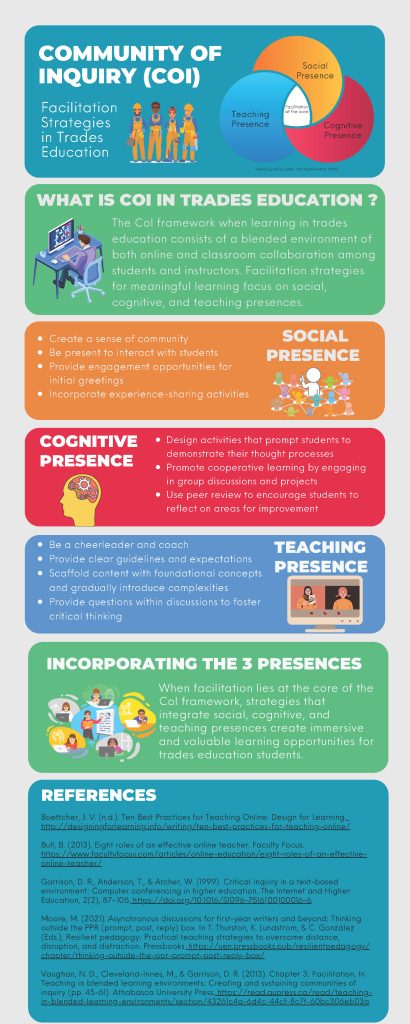
Infographic created using Canva: Link to Download
At my college, trades instructors use a blended delivery model consisting of online and classroom learning. Due to campus renovations, limited space, and the pandemic challenges, facilitation tips became crucial for instructors to be effective in digital learning environments. The Community of Inquiry (CoI) framework identifies three presences required for successful online learning experiences: social presence, cognitive presence, and teaching presence (Garrison et al., 1999). Vaughan et al. (2013) emphasized that “facilitation manages the overlaps between all three presences and is at the core of the dynamics of community of inquiry” (p. 46), with the instructor as facilitator playing a pivotal role in my trades education context.
Social Presence
As social presence involves feeling a sense of belonging, facilitation strategies are integral to creating a sense of community. Instructors nurture their trades community by helping students interact right from the start of their courses with initial greetings and icebreakers (Bull, 2013). Student interactions ensue throughout their courses as the instructors incorporate activities for sharing student and their own industry experiences (Vaughan et al., 2013). Furthermore, these instructors stay connected by supporting students with regular check-ins and ensuring their presence through timely responses on their online forums (Boettcher, n.d.).
Cognitive Presence
Instructors play an impactful role in enhancing their students’ cognitive presence by fostering critical thinking and knowledge creation through facilitation strategies. They achieve this by designing activities that prompt students to articulate and demonstrate their thought processes (Boettcher, n.d.). Moreover, Vaughan et al. (2013) highlighted collaborative learning through group discussions and projects. In turn, students benefit from problem-solving and learning diverse perspectives. Another effective strategy is incorporating peer review into the learning process. This peer review activity encourages self-assessment and identifying areas for improvement (Garrison, 1999).
Teaching Presence
Instructors’ teaching presence is instrumental in guiding students through course design. Additionally, these instructors are coaches and cheerleaders who model learning and encourage students throughout their learning (Bull, 2013). Another key facilitation strategy is establishing clear guidelines and expectations to help students navigate the requirements for success (Boettcher, 2019). Furthermore, scaffolding content by introducing foundational concepts before introducing complexities allows for confidence building (Vaughan et al., 2013). Instructors also purposely provide time to scaffold questions within discussions to encourage critical thinking (Moore, 2021).
By implementing these facilitation strategies, which incorporate the CoI’s social, cognitive, and teaching presences, trades instructors empower their students to take control of their learning journey. This approach fosters a trades education community where inquiry can thrive, both in the classroom and online.
References
Boettcher, J. V. (n.d.). Ten Best Practices for Teaching Online. Design for Learning. http://designingforlearning.info/writing/ten-best-practices-for-teaching-online/
Bull, B. (2013). Eight roles of an effective online teacher. Faculty Focus. https://www.facultyfocus.com/articles/online-education/eight-roles-of-an-effective-online-teacher/
Garrison, D. R., Anderson, T., & Archer, W. (1999). Critical inquiry in a text-based environment: Computer conferencing in higher education. The Internet and Higher Education, 2(2), 87–105. https://doi.org/10.1016/S1096-7516(00)00016-6
Moore, M. (2021). Asynchronous discussions for first-year writers and beyond: Thinking outside the PPR (prompt, post, reply) box. In T. Thurston, K. Lundstrom, & C. González (Eds.), Resilient pedagogy: Practical teaching strategies to overcome distance, disruption, and distraction. Pressbooks. https://uen.pressbooks.pub/resilientpedagogy/chapter/thinking-outside-the-ppr-prompt-post-reply-box/
Vaughan, N. D., Cleveland-Innes, M., & Garrison, D. R. (2013). Chapter 3: Facilitation. In Teaching in blended learning environments: Creating and sustaining communities of inquiry (pp. 45-61). Athabasca University Press. https://read.aupress.ca/read/teaching-in-blended-learning-environments/section/43261c4a-6d4c-44cf-8c7f-60bc306eb03a
Matt Poole
Marni, your infographic on the Community of Inquiry (CoI) framework in trades education is very fitting given your goals. The inclusion of the Venn diagram showing the intersection of Social, Teaching, and Cognitive Presence at the top is particularly effective. It visually captures the interconnected nature of these elements in creating a comprehensive learning environment. I wish I had thought to include something similar in my own infographic!
I’m especially drawn to your description of social presence: “Instructors nurture their trades community by helping students interact right from the start of their courses with initial greetings and icebreakers (Bull, 2013). Student interactions ensue throughout their courses as the instructors incorporate activities for sharing student and their own industry experiences (Vaughan et al., 2013). Furthermore, these instructors stay connected by supporting students with regular check-ins and ensuring their presence through timely responses on their online forums (Boettcher, n.d.).”
This detailed explanation really highlights the importance of intentional community-building in education.
It got me thinking about how this might compare to other learning contexts. Do you sense there’s a difference between how trades approach social presence versus an academic learning community? Why or why not?
Marni Russell
Thank you, Matt, for complimenting my Venn diagram and for asking about comparing my social presence to other learning contexts. To start, I chose trades education because I am currently working closely with supporting trades instructors with facilitation tips and can confidently attest to their implementation of these best practices. That said, I would use the same social presence strategies in other academic programs. In fact, I plan to revise the infographic in the future to use in presentations with other academic areas when deemed appropriate. Cheers, ~M