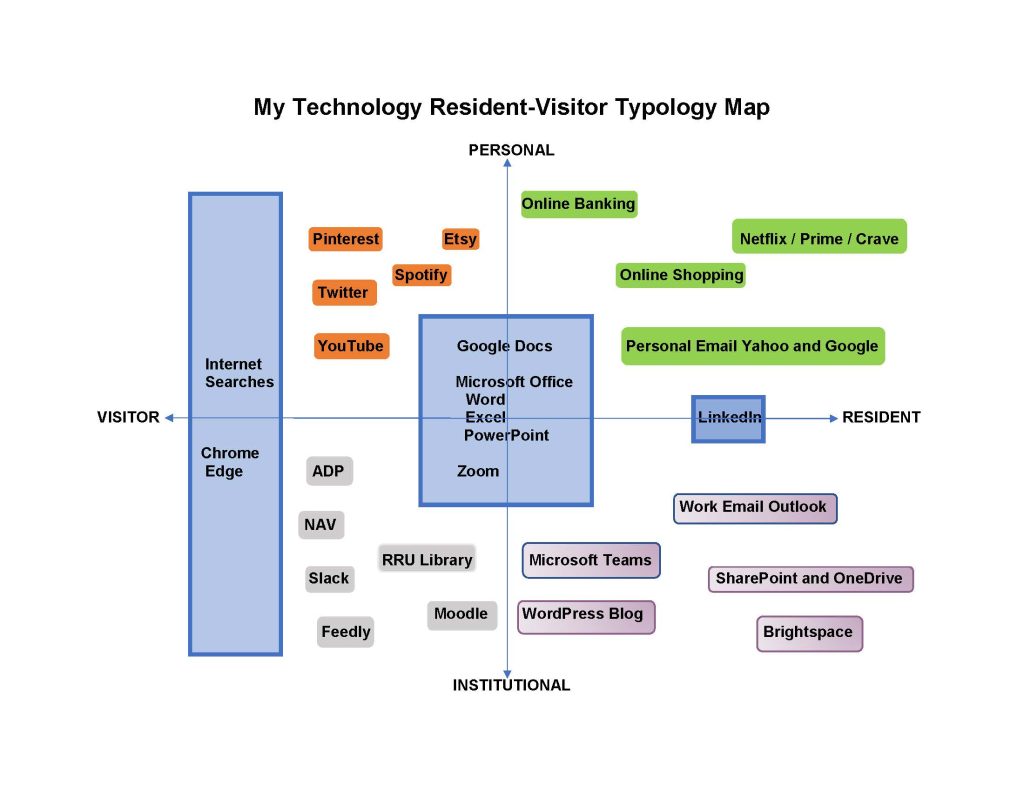
While creating my technology map based on Dave White’s (2013) resident-visitor typology, I fell into another self-discovery journey. I was initially shocked to connect ALL my relationship interactions, communications, and work productivity during the past week to technology.
My technology usage depends on the day of the week and time. I am a heavy resident while working at my institution during weekdays. All workday tasks tie back to using technology. When our network went down recently, team members scrambled to figure out alternative ways to work. Life without technology equaled chaos!
On a personal level, technology usage is light compared to my institutional usage. I relate more to the visitor typology where I consider myself as an observer most of the time. Informal learning through Internet searches is paramount during evenings and weekends. Although I consider myself mostly a visitor in this personal realm, technology is still always in play.
Lastly, I will be interested to discover if my personal technology usage, such as Twitter, can make its way into my resident quadrant as I complete the MALAT program. Breaking out of my comfort zone into residency is key.
Reference
White, D. (2013, September 13). Just the mapping. YouTube. Retrieved April 22, 2023, from https://www.youtube.com/watch?v=MSK1Iw1XtwQ
Catherine
Marni, It was very interesting to read about your network maps. I find myself in the opposite where during my work I tend not to use a lot of technology. I tend to use it mostly for school and personal use. Although like you mentioned, it could depend on the day as it can change from one to the next.
I also found myself leaning more towards the visitor typology, and like you will continue to try to break through more into the resident typology. Are there any ways you have thought about how to be more of a resident and less so a visitor?
Marni Russell
Good question, Catherine. My strategy moving forward is to continue researching so I can determine the right path forward. Boyd (2011) made me realize that my privacy issues could be in a transitional state right now. At the moment, I live with Gen Z family members who discuss ‘cancel culture’ frequently. These concerning discussions are typically prompted by someone posting on social media. As I gain more knowledge and experience posting, I anticipate that I will not be so concerned as I learn how to navigate this culture of openness.
Reference
Boyd, D. (2011). Social network sites as networked publics: affordances, dynamics, and implications. In Z. Paracharissi (Ed.), A Networked Self (pp. 39-58). New York, NY: Rutledge.
Tracy
Great map. Thanks for sharing. What is Brightspace? It’s interesting you mention Twitter as possibly being your next space that you’ll explore more potentially for school. I have a love/hate relationship with the platform in my work and personal spheres. I hate relying on it so much for our organization but there hasn’t yet been anything that comes close to its current reach and effectiveness. Are you working remotely, hybrid, or face to face? Just curious how this impacts technology choices.
Marni Russell
Hi Tracy, nice to hear from you!
This time last year I had been working remotely for a tech company for six years. I seemed to always be on Microsoft Teams and Zoom meetings. We used a Learning Management System (LMS) called Litmos to train our global customers.
Last summer, I returned to the post-secondary world where I have spent most of my career. The environment is hybrid and Brightspace is our LMS. One of my roles involves supporting instructors on developing their courses and incorporating their digital learning resources in Brightspace. The idea of blended learning programs at the college is new to most instructors. Therefore, I currently have a steep mountain to climb.
Today, I developed a position description for an LMS Analyst. I outlined a list of reports that could be generated by using the student data from our LMS, e.g., attrition and retention reports. My long report list got me thinking about the students’ digital presence that will be tracked within Brightspace.
I found this point interesting because I was concerned at one time about always being tracked on my phone. Where in turn, I am doing the same analytic tracking of students but only in a more ‘closed’ environment.
Any thoughts on this topic?
Andrea
Very interesting map, Marni, and I don’t think it’s too much different from my own!
I’ve wondered some of these same things as an LMS Admin at my own corporate workplace. What about developing a policy for your learners explaining exactly how you are using the information you collect from your LMS? For example, course evaluation survey data is used to help us improve our course offerings and evaluate instructor performance, your quiz data is only ever shared with your instructor and is used to ensure you are meeting performance metrics, etc. Perhaps there is an opportunity to transform a tool seen as necessary for corproate, compliance-based learning into an opportunity for accountability and transparency?
Marni Russell
Thank you for your suggestion, Andrea.
You might be interested to learn that I brought your idea up with my colleagues. They liked the idea and also suggested involving a focus group of students to develop the policy along with the policy committee. Interesting idea indeed!