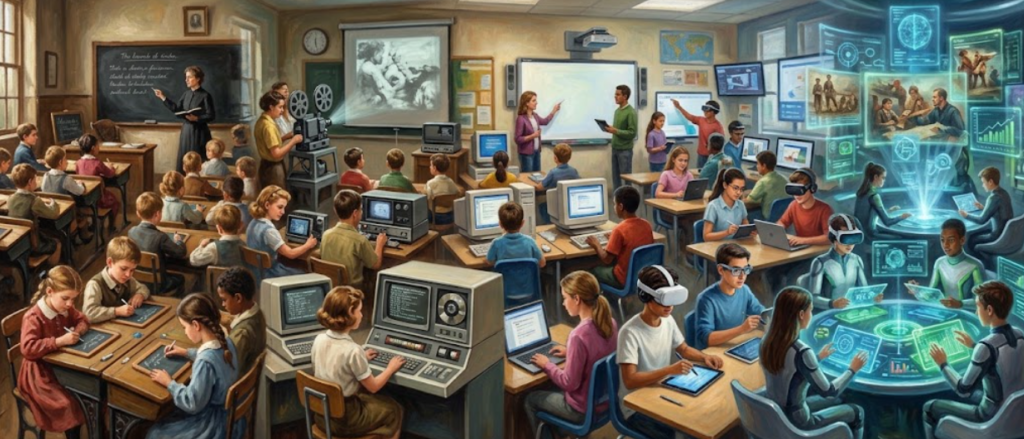
Is the point to educate people to help them navigate their lives and develop personal growth or are we really just going to double down on training students to understand increasingly complex commercial systems so they can work jobs that AI might take anyway? I think that ideas about future classrooms may have underestimated the impact new AI technology is really going to have. As a high school teacher, I have already seen AI create a huge challenge for teachers wanting to continue a traditional educational experience. In the readings, Selwyn et al. (2020) wrote that future technology could increasingly control educational experiences and decisions, but really it seems that generative AI introduces a much deeper change and problem. AI may actually change why we choose to educate students, and for what reasons we do. AI can answer any questions and will increasingly be asked to do many tasks in the workplace. Moreover, it seems that AI not only can accurately produce student work, which has traditionally been a benchmark to evaluate student learning, but it can also think for students as well. I feel somewhat pessimistic about the future of education because I think it is going through an identity crisis. I think we are looking at the commercialization of education because these new technologies are not designed with education in mind, but packaged to schools as educational systems. (Selwyn et al., 2020) One thing is for sure, AI is exposing a flaw in the education to job market model that needed to be addressed years ago.
References
Selwyn, N., Pangrazio, L., Nemorin, S., & Perrotta, C. (2020). What might the school of 2030 be like? An exercise in social science fiction. Learning, Media and Technology, 45(1), 90–106. https://doi.org/10.1080/17439884.2020.1694944
My interest in virtual reality technology has led me to Mel Slater who is a foundational figure in VR research. VR has the ability to simulate real world experiences and allows its users to explore environments that they would otherwise not have access to. Due to this incredible potential, it seems promising that this type of technology could revolutionize educational experiences. The work Slater has done since the late 1980’s has focused on users interactions and reactions within entirely computer generated worlds. His research helped create realistic simulation models that would allow professionals to accurately practice real skills in a safe space. These models have directly benefited fields such as medicine, healthcare, and emergency response. (Slater & Sanchez-Vives, 2016)
Mel Slater began his career at the University College London and later moved to the University of Barcelona’s Event Lab where he worked publishing several papers. (ICREA, 2016) At the University of Barcelona, Slater’s work focused on the psychological feeling of truly being inside a virtual environment and the experience of feeling that a virtual body is your own. Moreover, his research made important contributions to the study of embodiment, which shows that the human brain can relate to a virtual body much in the same way it does a physical one. (Slater et al., 2009)
I have become increasingly interested in VR and its practicality in being a genuinely valuable educational tool. Having used VR on several occasions, I believe that it has enormous educational potential because of the incredible immersion that it provides. Slater’s research is going to be pivotal in helping to realize this potential because he demonstrates that effective learning in immersive simulations is not only possible, but that these virtual simulations have similar impacts on the human brain as real world experiences, even when people know they are experiencing a virtual reality.
References
Slater, M., Perez-Marcos, D., Ehrsson, H. H., & Sanchez-Vives, M. V. (2009). Inducing illusory ownership of a virtual body. Frontiers in Neuroscience, 3(2), 214–220.
Slater, M. (2009). Place illusion and plausibility can lead to realistic behaviour in immersive virtual environments. Philosophical Transactions of the Royal Society B: Biological Sciences, 364(1535), 3549–3557.
Slater, M., & Sanchez-Vives, M. V. (2016). Enhancing our lives with immersive virtual reality. Frontiers in Robotics and AI, 3, Article 74.
ICREA. (2016). Slater, Mel. ICREA Memoir 2016.
Relevant Links
Meet the Brains – Mel Slater: Virtual Environments in Psychology and Cognitive Neuroscience (Institute of Neurosciences UB, YouTube): https://www.youtube.com/watch?v=oSWrtyBVH2A&t=6s
Mel Slater’s publications are listed at http://publicationslist.org/melslater
AI Transparency Statement
AI was used during this assignment to help brainstorm and identify a researcher who is foundational to the understanding of virtual reality. All links, authors and academic sources were investigated independently and verified for accuracy.
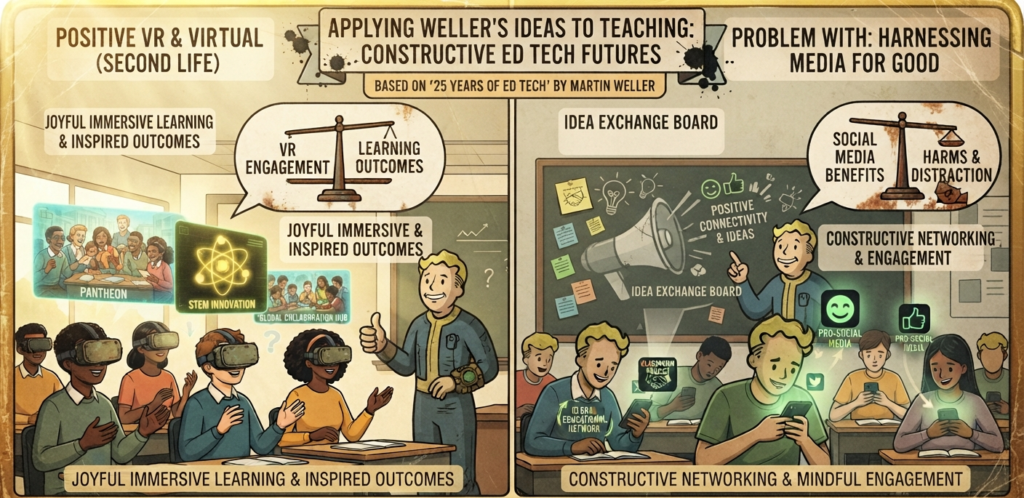
1. Exploring the ideas behind the virtual world Second Life.
While reading Weller’s book, 25 years of Ed Tech, I was especially intrigued at the section discussing the ideas behind the virtual world of Second Life. Weller explored this game because it is a great example of the potential benefits of VR, specifically in the area of open learning. He points out that when the game was released it carried with it a profound promise to revolutionize educational opportunities. This is because it provided people with a space to explore a digital classroom, effectively emulating the experience that students in the real world would have. However, while Second Life provides an entertaining experience, Weller questions the overall value it provided when delivering a lesson; albeit his point seems to be in regards to general education. Weller does go on to say that in specific contexts, such as medicine or engineering, that VR can provide a useful mechanism for simulation; even if that potential has yet to fully be realized.
As a teacher, having explored the use of VR learning, I think that his point about virtual worlds is very interesting and correctly highlights the pros and cons of the technology. In my experience, when I explored the use of VR in a classroom, I found that the initial impact on students was very effective specifically in bring to life the content that we were engaging with. However, when I compared the results of student learning with other cohorts, I didn’t notice any significant difference in the learning outcomes when I taught the same units later without the VR addition. So should learning be defined simply by the end results? No, I think learning is a process of discovery. Does this mean that VR shouldn’t have a place in the classroom? Well, in today’s current context I would say while we shouldn’t dismiss VR simply because it hasn’t yet demonstrated superior learning outcomes there are logistical issues that prevent its realistic implication. The technology is just not ready yet, but if I asked all the students I’ve taught: What do you remember most about our classroom? I would be confident that the kids that experienced VR would remember that experience as a meaningful part of their education.
2. Exploring the problem with Social Media.
I found the section where Weller explores social media particularly interesting because it demonstrates just how quickly technology can change from its educational use into something fundamentally different. Weller explores social media, particularly Twitter, reflecting on how the technology was exciting in the beginning because it allowed educators to build effective networks of communication. I can see how this innovation could have been genuinely appealing in gathering collective educational ideas quickly in a large network because the conversations would include many new people. The problem is however that the harms of social media have increasingly become problematic enough to a point where they mostly overshadow any of the intended benefits. Weller does articulate that social media can have pros and cons, but this is where I feel his analysis doesn’t go far enough because the weight of the pros and cons are not equal and within certain contexts, especially for teenagers, social media can be actually harmful, as is evident in classroom settings. There is substantial evidence to demonstrate that social media is a problem for student learning because the attention it demands interferes with the learning process (Pyhältö et al., 2025). Looking from an even larger view, social media has also been a large problem educationally for society because it allows misinformation to permeate almost all layers of online conversations on its platforms (OECD, 2024). I think if Weller was to revise his chapter on social media, he might see just how problematic it has become for educational purposes and be more cautious when evaluating its benefits and harms.
References
Pyhältö, K., Rekola, H., Salovuori, S., Kosola, S., & Anttila, H. (2025). The relationship between academic achievement and off-task social media and smartphone usage: Evidence from a systematic literature review.
OECD. (2024). PISA 2022 results (Volume V): Learning strategies and attitudes for life. OECD Publishing. https://doi.org/10.1787/c2e44201-en
Weller, M. (2020). 25 years of ed tech. Athabasca University Press.
Image made with Gemini
AI Use Statement: AI was used to help locate relevant sources, brainstorm ideas, and organize my thoughts. I also used it to discuss my ideas and improve the grammar of the final reflection. The analysis, writing, and personal experiences presented are my own.
As I read Weller’s book, 25 Years of Ed Tech, I am reminded of the times in my classroom that a student wanted to use a new technology (typically an app) in order to create some learning fun in class for everyone. They would describe how other teachers would use the tech that they liked and subsequently I would usually try out the technology. (I like exploring new ways to make learning fun.) However, I often wondered what real benefit the technology was providing for students short of playtime or novelty and, in most cases, I could not detect any. Weller seems to touch on this topic as well investigating how new technologies are often touted as a solution to old problems, a way to engage students, or a way to change the face of education. But has learning really improved? Or, has it actually gotten worse? I could see that the students were very interested in the activities however; they did not seem to really retain the overall concepts particularly well. This intriguing concept was explored in Children’s and Adolescents’ Learning with Educational Technology, where the American Psychological Association cautions that high student engagement can be frequently mistaken for authentic learning. It explains how fun educational software and gamified learning apps can excel at keeping students engaged and entertained during the activities but that the learning involved is not well retained after the activity. Moreover the study suggests that the interactive interfaces are not equivalent to deep conceptual understanding. (American Psychological Association, 2026)
The concept of the ‘year zero’ mentality explored in Weller’s book is interesting because it shows how people can become excited about what a new technology can do, even if existing technologies are similar and can provide similar experiences. It can lead schools to buy the latest ‘new’ or ‘innovative’ technology because it is the latest, rather than because it specifically improves learning. I suspect this is not necessarily a feature of technology in education but rather how people view new technologies in general. Regarding this, I think a clear example is the new wave of AI technology in company applications. At first there was an overwhelming air that this new technology would revolutionize the work place, but the reality seems to be playing out rather differently. In fact, many companies are looking to roll back their AI initiatives due to ineffectiveness. (Estrada, 2025)
Estrada, S. (2025, August 18). MIT report: 95% of generative AI pilots at companies are failing. Fortune. https://fortune.com/2025/08/18/mit-report-95-percent-generative-ai-pilots-at-companies-failing-cfo/
Weller, M. (2020). 25 Years of Ed Tech. Athabasca University Press.
Footnote: ChatGPT was used to help locate relevant academic and news sources and serve as a brainstorming partner while I developed and organized my ideas. The opinions, analysis, and conclusions expressed in this reflection are my own.
“If we knew what we were doing, it would not be called research, would it?”
– Albert Einstein
What makes a good research Question?
Conducting research is the backbone of scientific discovery. As Dahlberg and McCaig write in the book, Practical Research and Evaluation, “The mission of research is to provide us with knowledge. Research describes and explains phenomena surrounding us”(Dahlberg & McCaig, 2010). For many aspiring students who want to learn how to conduct proper research reading this book can provide them with sound advice, namely suggesting that for students to best understand how research is conducted it is important for them to understand the fundamentals of research. Upon reading Practical Research and Evaluation it becomes evident that these fundamentals begin with a good research question. Dahlberg and McCaig (2010) discuss the importance of this by saying, “research projects and evaluations start with a question or problem. This may be both broad and vague. To make it possible to illuminate the problem through research, the problem has to become specific and focused, that is, it has to be developed into one or several research questions. Research questions are closely linked to the purpose of the research study. The identification of research questions and the purpose of the study is part of the planning of the study” (Dahlberg & McCaig, 2010). Here the authors provide a clear understanding on the meaning of a good research question and why understanding this process is important. In order to make clear the process of formulating a good research question, the authors provide several well explained points that a potential researcher must follow in order to have their research be of top quality. Of the examples highlighted in the book I have looked closely at two points here in my blog as they seemed very relevant; that is the need for a focused and researchable question.
Focused – This means a research question needs to be specific, narrow and precise. It needs to concentrate on a particular part of a larger topic and avoid being too broad. This allows for an in depth peer reviewable investigation on a topic rather than a generalization leading to a much clearer informational outcome. “Vaguely stated theories and hypotheses serve no purpose… theories that are stated precisely and make specific predictions can be shown more easily to be wrong and are therefore better” (Dahlberg & McCaig, 2010).
Researchable – This means that the research topic should be something that can be answered through systematic investigation and research. It should not look into topics that are considered pseudoscientific because information in these areas cannot be researched or even verified by peer reviewing. Similarly, philosophical questions are inherently opinion-based and do not lend themselves to observable research which is required in the peer reviewing process.
It is evident that the nature of a good research question can be summarized by its specificity and its ability to be effectively researched. The development of a precise and focused research question is essential when beginning to conduct a comprehensive research that would provide peer reviewable results. Moreover, as Dahlberg & McCaig point out, a research question should be researchable, which means that the answer to the question should be achievable through research and based on evidence that can be observed by others (Dahlberg & McCaig, 2010). Thus, by following these principles researchers will be able to meet global scientific standards for quality and bring valuable findings to the scientific community.
Impact of Digital Learning on poverty and Digital Divide
How inequality and poverty affect people around the world. Digital learning has significant impact on both poverty and the digital divide, with various positive and negative implications. By Mo K.
Digital learning can be defined simply as: “learning that is supported by Technology.” Walker, Mark. (2024) Poverty is defined as the state or condition in which people or communities cannot meet a minimum standard of living because they lack the proper resources. These include (but are not limited to) financial resources, basic healthcare and education clean drinking water and infrastructure (poverty, n.d.)
Here are the notes associated with the understanding that has taken place on this topic:
Some insight is given first on the meaning of the terminologies used in the topic title followed by the bulleted list of impacts with relevant explanations.
Digital Learning encompasses a broad range of educational practices that utilizes digital technologies to facilitate learning. It includes various modes of delivery such as:
Online Learning – A form of distance education where the primary delivery mechanism is via the internet.
Blended Learning – This combines both online and face-to-face teaching.
Hybrid Learning – Similar to blended learning, but often involves a more significant redesign of the learning experience. Students do the majority of their learning online, coming to campus only for specific face-to-face activities that cannot be done satisfactorily online.
HyFlex Learning – This model gives student the choice of how they participate in the course, whether online or in-person, and allows them to switch between modes as needed.
Open learning – This includes open educational resources (OER) like open text books, which are freely accessible and can be downloaded by students and instructors.
MOOCs (Massive Open Online Courses) – These are fully open courses available online to any one, and often for free.
Flexible learning – This approach provides student with more choices regarding when, where and how they learn.
Digital divide is a term that refers to the gap between demographics and regions that have access to modern Information and Communication Technology (ICT), and those that don’t or have restricted access. This technology can include the Telephone, television, personal computers and Internet connectivity. (digital-divide, n.d.)
Positive Impacts can be described as follows:
Increased access to education:
Digital learning provides educational opportunities to individuals in remote or underserved areas where traditional educational infrastructure is lacking. This helps in bridging the educational gap between urban and rural areas.
A developing country can draw on teachers with superior knowledge from advanced countries rather than local teachers who first have to learn the requisite skills before they can train others. Khan, H. & Williams, J. (2006).
Flexibility and Convenience:
Digital learning offers flexibility, allowing students to learn at their own pace and on their own schedule. This can be particularly beneficial for working adults or those with family responsibilities.
Cost-effective education
Digital learning reduces the cost associated with traditional education, such as transportation, housing, and physical text books. Open educational resources (OER) and MOOCs (Massive Open Online Courses) provides free or low cost learning materials.
Skill Development:
Digital learning platforms often offers courses in high demand skills, such as coding, digital marketing and data analysis, which improves employability and potentially lift individuals out of poverty.
Negative Impacts can be described as follows:
Access Inequality:
Not everyone has equal access to the necessary technology and internet connectivity required for digital learning. This is particularly true for low income families and those in rural or remote areas, exacerbating the digital divide.
Quality of Learning:
The quality of digital learning can vary significantly. Student from Wealthier backgrounds may have access to better resources, such as high quality devices and faster internet, as well as more support from parents and tutors.
Digital Literacy:
Effective participation in digital learning requires a certain level of digital literacy. Those who lack these skills, often from poorer backgrounds, may struggle to benefit fully from online education.
Support systems:
Student from low income families may lack the necessary support systems at home, such as quite place to study or parental guidance, which can hinder their ability to succeed in a digital learning environment.
Mitigation Strategies can be exampled as follows:
Government and Institutional Support:
Government and educational institutions can provide subsidies or loans for digital devices and internet access for low income families. They can also invest in public Wi-Fi hot spots and community centers with internet access.
Teacher Training:
Training teachers to effectively use digital tools and platforms can improve the quality of Online education and ensure that all student receive a high standard of education.
Digital Literacy Programs
Implementing digital literacy programs can help equip student and their families with the necessary skills to navigate and benefit from digital learning platforms.
Policy Interventions:
Policies aimed at reducing poverty, such as improving economic opportunities and social services, can indirectly improve access to digital learning by addressing the root cause of the digital divide.
In conclusion, while digital learning has the potential to reduce educational inequalities and provide opportunities for those in poverty, it also risks exacerbating existing disparities if not carefully managed. Ensuring equitable access to technology and support systems is crucial for maximizing the benefit of digital learning for all.
Controlled Access: How China’s Internet Policies Shape Learning
How China’s Communist Party policies affect the digital learning landscape in China: Positive and Negative Points about China’s Online Infrastructure. By Vince R.
How China’s Policies Affect Student Learning and Education in China
The Chinese government has made efforts to build a nationwide digital learning system with abundant open resources to promote education equity. This initiative has been met with both positive and negative features when related to the learning quality for Chinese students. It is evident that a more constructive learning outcome is associated with better DLE equipment and network conditions, which positively affects learning performance in students. This also highlights evident negative features which denote that positive learning performance is linked to economic conditions.
Positive: The CPC has emphasized online education in the 19th National Congress report, which demonstrates major development. China has demonstrated that it is focused on building basic infrastructure for online education, which has been referred to as the implementation of the “Modern Distance Education Project.” Development of the National K-12 Education Resource Network.
Positive: When the iPhone was introduced in 2007 it greatly accelerated Internet access across China. It was this adoption of mobile Internet which led to a significant increase in online education; shifting it from a supplementary role to a key pillar of Chinese education.
Positive: The “Double Reduction” policy was brought in to reduce homework and significantly eliminate off-campus training burdens. Also included were measures to standardize and regulate online education.
Positive: China has gone through four stages in the development of online education policies, and the future of online education in China looks promising due to the existing polices and different measures to promote lifelong learning and education for all.
Negative: Despite the rapid development of online education, challenges remain. Some issues within the development of online education are the digital divide, supervision of the teaching process, and cooperation with the enterprise, which needs more comprehensive initiatives for further improvement.
Negative: Some of the concerns which are associated with the topic include “false propaganda” and “price gouging” by some institutions that offer education.
Positive: In the last few years, there is an increase in the use of online education in the rural areas.
The Online Learning Survey conducted by the Big Data Center of the Graduate School of Education, Peking University, showed that China’s policy was indeed supportive of digital education. It determined the following: The findings of the study revealed that family income, parents’ education level, and professional status influenced online learning among students in China.
Positive: During Covid 19 the Chinese Ministry of Education mandated a nationwide shift to online learning to maintain educational continuity during the pandemic.
Negative: 18.4% of students reported inadequate equipment. 37.3% faced network issues. 46.95% of high school students reported a decrease in overall learning scores.
Positive: Governments and schools provided free access to extensive online learning materials and platforms like Zoom and Tencent Classroom.
Negative: However, some challenges were observed during the implementation of the program, including network congestion, poor quality of hardware, and limited interactions between the teachers and students. As a result, students who had access to better resources at home were able to use online resources to their advantage, which could have further amplified the existing disparities in learning outcomes between students from different backgrounds.
Positive: Over 200 million students participated in online classes as part of the official curriculum from February to August 2020.
Negative: There was a significant positive relationship between student success and equipment and internet quality. The students from the low economic class experienced more challenges. These challenges affected the quality and efficiency of online teaching negatively. Furthermore, these problems revealed the existing digital divide in China, which did not disappear during the pandemic and affected the fairness of online learning.
It is evident that China’s Communist Party policies in the field of digital learning are diverse and can be observed in both positive and negative aspects. The government’s long-term commitment to the implementation of a comprehensive digital learning system has greatly enhanced educational equality and student inclusion throughout the country. Measures such as the “Modern Distance Education Project” and the “Double Reduction” policy show a clear willingness to build online education facilities, decrease homework pressure, and regulate online education.
There are positive aspects inherent in China’s digital initiative such as strengths of China’s web infrastructure which include the fast growth of primary infrastructure, the extensive utilization of a mobile web (after the advent of iPhone), and the large-scale application of online education in rural regions. Such advancements have made it possible to have a sound online education system. Moreover this is evident with the government’s preparedness during the COVID 19 outbreak where over 200 million students were taking their classes online and there was a wide range of free online learning resources available.
Nevertheless, these advancements come with significant challenges. The issue of digital divide persists, as the quality of equipment and the access to the internet differ, leading to the creation of different learning environments. Chinese family income and parents’ education level heavily determine the online learning experience of students, thus exacerbating the disparities in the education sector. Other challenges such as network congestion, lack of hardware, and limited face-to-face interaction between teachers and students also contribute to these problems.
Sources
Guo C, Wan B. The digital divide in online learning in China during the COVID-19 pandemic. Technol Soc. 2022 Nov;71:102122. doi: 10.1016/j.techsoc.2022.102122. Epub 2022 Sep 13. PMID: 36118102; PMCID: PMC9468296.
Jiang, Y., Shang, J., & Jiao, L. (2023). Review of China’s Online Education Policy, 1999–2022. ECNU Review of Education, 6(1), 155-182. https://doi.org/10.1177/20965311221099581
Walker, M.D. What is Digital Learning? In: Digital Learning. How modern technology is Changing education. Sicklebrook publishing, Sheffield U.K.,2024
Khan, Habibullah & Williams, Jeremy. (2006). Poverty Alleviation Through Access to Education: Can E-Learning Deliver?. SSRN Electronic Journal. 10.2139/ssrn.1606102.
During the unit 3 readings it struck me just how much the internet has changed over the years and what implication that has for people navigating today’s digital landscape. When I was about seventeen, I remember going over to my friend’s house to see this new concept on his computer called ‘the internet’. It was text based and while it really opened my mind to what was technologically possible, it was predominantly in the realm of written information and therefore truly lacked any type of user interaction. All these years later the internet has become unrecognizable. It is now so much more than finding information; it is communities, interactions and connections.
The internet has grown and changed in many magnificent ways and also created unintended consequences for humanity. We use the internet for virtually every aspect of our lives and there is growing evidence that this fact increasingly comes at a human cost. A paper called the ‘Psychological Effects of the Internet Use’ mentions on this topic that “the ever-increasing use of computers has a negative impact on the health of users affecting various systems and causing physical and mental problems.” (Diomidous M, 2016) I suspect that the internet in the coming years will be considered in a different light and navigated with far more savvy, careful consideration and mindfulness then may have been needed in years past. I think this idea is reflected in the Participatory Open video (Stewart, Phipps, & Cormier, 2019) where it was evident (even a few years ago) that people have been demonstrating a growing mindset towards online caution and communal awareness.
Sources
Diomidous M, Chardalias K, Magita A, Koutonias P, Panagiotopoulou P, Mantas J. Social and Psychological Effects of the Internet Use. Acta Inform Med. 2016 Feb;24(1):66-8. doi: 10.5455/aim.2016.24.66-68. Epub 2016 Feb 2. PMID: 27041814; PMCID: PMC4789623. https://www.ncbi.nlm.nih.gov/pmc/articles/PMC4789623/
Stewart, B., Phipps, L., & Cormier, D. (2019). The Participatory open: Can we build a Pro-Social, Pro-Societal web? [Video]. https://www.youtube.com/watch?v=1D4tg1FnE_s
For the unit 3 visual network map task, I have made an interesting illustration of my online activities and the corresponding interlocking connections. In order to facilitate this assignment I have used the website called Kumu, which I have not used before this point although I found to be rather easy to learn. There were several features that became evident in this assignment, namely the fact that many of the online applications that I use are very much interconnected providing numerous diverse interactions among my professional and personal life.
I know that I spend a fair amount of my time online and this illustration is a testament to this fact, however upon review it is clear that the majority of this activity time is spent mostly with personal communications and interactions with family and friends. One of the significant reasons that I am interacting so frequently online in this manner is due to challenges posed by large geographical distances. As I have been working overseas for some time, I have had a diminished ability to stay connected with friends and family other than utilizing online platforms. Moreover many of my friends have also moved away to other distant locations for various reasons and online interactions have become a consistent way to keep connected. As reflected in my diagram, I use a few different methods of connecting online to propagate my social interactions, however I tend to use the media platform Steam the most frequently.
While staying connected in my personal life online is important, many of the various online platforms I use are for work or school reasons.
In the MALAT program there are numerous online platforms and activities that have been brought to my attention, some of which I have never used before and am unsure I will again after the program. I can tell that I gravitate to a few network hubs and avoid having large network connections that will remain mostly un utilized.
In the case of work I use minimal digital social networking connections. I tend to prefer having work interactions being in person (when possible) and thus focus more on information gathering websites when online. There are several reasons why I limit online social networks within my work sphere, although the main reason I would say is that I am a proponent of the idea of ‘unplugging’ after a work period. I find the more minimal my work related social network activity is, the easier it is to accomplish disconnecting from my work environment.
Video How AIs, like ChatGPT, Learn: Video by CGP Grey
Should snow days be cancelled? In the advent of online learning, should childhood experiences be altered due to the ability to remain connected online? Video by CGP Grey
‘I will never go back’: Ontario family doctor says new AI notetaking saved her job – By Colin D’Mello & Isaac Callan Global News, Posted May 2, 2024 3:00 am, Updated May 1, 2024, https://globalnews.ca/news/10463535/ontario-family-doctor-artificial-intelligence-notes/
AI and the impact on student wellbeing.
In the advent that AI software becomes more prevalent throughout society, has there been any real consideration (or guidance) to the ramification of having students interacting with AI software in classrooms.
The video below discusses the impact AI can have on emotional wellbeing. When watching the video we can consider how AI software is impacting adult relationships, therefore what could the increased use of AI in the classroom mean for the developmental emotional wellbeing for young students? Are we potentially introducing students to a new way of building relationships?
Some interesting research has recently come out suggesting that video games can have significant cognitive benefits. A recent paper written on the subject suggests that video gaming may be associated with improved navigation ability.
Emre Yavuz, Chuanxiuyue He, Christoffer J. Gahnstrom, Sarah Goodroe, Antoine Coutrot, Michael Hornberger, Mary Hegarty, Hugo J. Spiers, Video gaming, but not reliance on GPS, is associated with spatial navigation performance, Journal of Environmental Psychology, Volume 96, 2024, 102296, ISSN 0272-4944,
https://doi.org/10.1016/j.jenvp.2024.102296.
Abstract:
Recent evidence suggests that greater reliance on GPS-assisted devices is associated with poorer navigation ability. Studies have also shown that video gaming may be associated with navigation ability.
We investigated the effect of video game experience and reliance on GPS on navigation ability using the mobile app Sea Hero Quest, which has been shown to predict real-world wayfinding performance. We tested a group of US-based participants’ wayfinding performance (n = 822, 367 men, 455 women, mean age = 26.3 years, range = 18–52 years) and asked them a series of questions relating to reliance on GPS and video game experience. A multiple linear regression model found no significant association between reliance on GPS and wayfinding performance. There was a significant association between weekly hours of video gaming and wayfinding performance. These findings provide a platform for future intervention-based research studies investigating whether daily activities may causally enhance or disrupt specific cognitive abilities.
“Technology will never replace great teachers, but in the hands of great teachers, it’s transformational.” – George Couros
MY DIGITAL REFLECTION AND PLAN
Digital Reflections
For many years I have been fascinated with online technology and have commonly used it for entertainment, education and work. I would not consider myself particularly adapt or savvy when it comes to using online technology, and many aspects of it are unfamiliar to me, although I do feel I established a basic understanding of the most common technological online platforms. I would say I am and reasonably good at using searching engines for finding the real truth behind something, connecting with friends on Facebook or even finding out some modding techniques for games using a Youtube help video. However, my ideas of modern technology, specifically those using online technological platforms, are for the most part limited in scope and biased in nature. This is to say that I mostly viewed technology through concepts somewhat rooted in science fiction which are clearly not practical in nature. I would read about a new company that has integrated AI software into its online program, and would find myself wondering if it might become self aware and begin attacking America. This is called ‘technology fiction’ by Rasa, T., Laherto who states in Young people’s technological images of the future that “the notion that technology is strongly associated with imagined future worlds—a connection embodied in science fiction, … could also be called ‘technology fiction’ or ‘future fiction’”. (Rasa, T 2022) By thinking in terms of technology fiction, it is evident just how little real understanding I have had regarding the facts behind technologies and online digital platforms.
Current Online Behavior
As I reflected on the digital map assignment and my current use of online technology, there are two main observations that I have made regarding my online personality and usage. My first observation shows that in some ways, I am somewhat cautious (perhaps even hesitant) of the digital spaces that I encounter as I have largely limited my presence in many areas online. The digital diagram I created shows that my online use is very limited to personal connections and casually visiting various websites, more often than not for entertainment purposes. There are a few reasons that think may have created this behavior (which I will investigate further in this blog) however it leads me to my second observation, namely that I have noted that my current use of online technology is not consistent with the integration I am seeking within professionally oriented online communities.
I recognize that am currently in a neutral, if somewhat conflicted, position regarding the use and benefits of technology and online interactions. This is to say that while I enjoy my personal use of technology, get excited over new technological advancements and happily connect digitally with friends and family, I am somewhat skeptical of the education benefits of technology and how it can be effectively used to further student learning. Moreover, I recognize that I significantly limit my use of social media websites, save for my personal use of Facebook and virtual fraternizations on Steam. My preference is the private social media within a personal realm. This does not come as a surprise to me. I have for some time now harbored a mistrust of social media and questioned the conventional ideas surrounding it. I find that research for social media as being an overall positive experience is somewhat inconclusive in nature. As “some research has identified a range of social, developmental, and emotional benefits associated with social media use”, (Keum BT, Wang YW, Callaway J, Abebe I, Cruz T 2022) other “research has identified a pattern of small to medium positive associations between higher levels of social media use and harmful psychological outcomes (i.e., anxiety, depression, and distorted body image), and negative relationships between levels of social media use and subjective well-being.” (Keum BT, Wang YW, Callaway J, Abebe I, Cruz T 2022)
My teaching practice has also reflected this conflicted ideology. I have been very excited in some cases to introduce students to new immersive virtual reality technologies, even bringing a class on a ‘VR field trip’ where the students used rented VR machines to interact with English curriculum lessons. However I have been more technologically regressive in other areas. I have limited, or disallowed social media websites within my lessons and struggle to see the real value they provide over face to face interactions. In addition I have not found a successful way to integrate the use of AI in assignments and continually see the machines as doing the ‘heavy lifting’ during the student learning process when using them.
Growing my Online Understanding
Having made the careful introspection concerning my digital developmental trajectory, I can now consider the directional course I aspire to undertake; specifically here in the MALAT program. My online learning goals in the MALAT program are centered on organizing my digital presence to be in line with my higher aims, which can be described in the following way: Firstly, I would like to understand on a deeper level how technology can or will benefit student learning. Secondly, I would like to learn about which of these technologies are most beneficial in the classroom (as I am sure not all of them are) and how those can be best utilized to make learning engaging. Thirdly I would like to be able to understand the viability of bringing in some of my favorite technologies into the classroom, such as VR or AR. Lastly I would like to establish a stronger professional presence online and understand how to best utilize this process to build a better educational career.
Building a Digital Plan
There are several ways that I can create a digital success plan to achieve growth regarding the aforementioned goals and determine any measures of success:
Conduct comprehensive research on the new educational technologies in order to amass sufficient knowledge of their influence on student learning. Determine which online technology seems to best fit the educational goals I have and then explore the best ways to use this technology within the classroom. Such methods to achieve this would involve reading relevant academic literature, attending further webinars and consulting with fellow MALAT colleagues regarding areas they are finding meaningful online educational engagement.
Develop skills within the virtual world of digital instruments and platforms. This can mean taking part in various online opportunities available to me throughout the program. I can try out available various online educational tools, and ask for feedback from fellow MALAT colleagues regarding their opinions on effectiveness to develop my experience.
Become involved in some virtual communities and be active in the associations, even if I feel somewhat uncomfortable. This can broaden my knowledge of online technologies and will also provide me with opportunities to meet other educational professionals who may share similar ideas and concerns.
Keeping a ‘digital diary’ to further explore my online strengths and address ongoing areas needing improvement. This activity can serve to address a number of learning outcomes and is most effective when I have decided on narrowing down technological areas I want to focus on. I can evaluate which strategies and practices are working best for me and evaluate my understanding of knowledge in educational technologies, including, for example, the role of AI and the effects of social media on student well being. The diary can meet the precision observed in the learning objectives of the SMART criterion.
Create a personal development plan within the digital diary with a series of tasks and achievements that serve as stepping stones to pass through. These can take the form of questions that I create and answer to help me build ongoing critical thinking; such as evaluating professional growth by monitoring my personal observations including my continued understanding of online technologies, specifically as it pertains to my previous concerns and ideas. Other questions can be similar to: How well was this new technology working and what potential problems could I note with it? What did the other MALAT students think and what were any strategies they used when interacting with the technology?
Moreover I can use this method to measure any gaps in my understanding as I am reflecting on my journey and examining the avenues that have worked best, and those which have been difficult. A continued defining of new targets will also allow for the sustained improvement of my technological goals.
Sources
Couros, G. (2015). The Innovator’s Mindset: Empower Learning, Unleash Talent, and Lead a Culture of Creativity. San Diego: Dave Burgess Consulting, Inc.
Keum BT, Wang YW, Callaway J, Abebe I, Cruz T, O’Connor S. Benefits and harms of social media use: A latent profile analysis of emerging adults. Curr Psychol. 2022 Jul 21:1-13. doi: 10.1007/s12144-022-03473-5. Epub ahead of print. PMID: 35891891; PMCID: PMC9302950.
Rasa, T., Laherto, A. Young people’s technological images of the future: implications for science and technology education. Eur J Futures Res 10, 4 (2022). https://doi.org/10.1186/s40309-022-00190-x