Firefighters are expected to understand a large library of knowledge and skills across several disciplines; however, not all firefighters enter into those disciplines with the same level of inherent knowledge or lived experience. This requires training to be accommodating for novice and experienced learners alike – not just in cognitive understanding but tool use, technique, and skill. I compared Four-Component Instructional Design (4C/ID) and Jonassen’s Constructivist Learning Environments (CLE) model to explore how Fire Training Officers can adapt instructional sessions and hands-on training to different levels of firefighting experience and practical expertise.
4C/ID integrates learning tasks, supportive information, procedural information, and part-task practice (van Merriënboer et al., 2002). Jonassen’s (1999) CLE supports investigation of authentic problems through resources, collaboration, modeling, coaching, and scaffolding. Both connect meaningful activity with instructional support. Their distinctive emphases are useful: 4C/ID organizes integrated practice, while CLE foregrounds problem interpretation and construction of understanding.
Figure 1 presents my proposed instructional emphases. I favor 4C/ID for inexperienced firefighters, a combination for those with intermediate experience, and CLE for experienced firefighters. The horizontal axis recognizes that firefighting experience and trade expertise are different dimensions. Typically, the firefighting profession tends to attract recruits with a wide variety of backgrounds. A recruit with framing or fabrication experience may bring embodied understanding of tool control, material resistance, and movement, while a recruit transitioning with a professional Human Resources background may not.
This interpretation reflects my professional observations; it does not establish a measured correlation between trade experience and fireground proficiency. I envision the CLE and the 4C/ID models serving novice or experienced firefighters in their respective ways. Assessment would determine the support each learner requires, including when an experienced firefighter encounters unfamiliar demands.
The comparison informs my practice by encouraging differentiated entry points, progressively demanding tasks, and opportunities to explain and test existing understanding. Instruction should remain responsive to developing expertise and cognitive demands (van Merriënboer & Sweller, 2005). Evaluation would examine performance, retention, engagement and transfer and not necessarily from a direct measurement of proprioception.
I chose a quadrant graphic because it makes contrasting learner profiles and complementary instructional responses visible. Its blended middle emphasizes that structured practice and supported inquiry can coexist. This is quadrant graphic is also effective in showing other contrasting but correlated factors like the Eisenhower Matrix (Priority vs. Urgency) and in Gordon Graham’s Frequency vs. Risk analysis (Hurtado, 2012). Neither years of service nor occupational background alone should determine a learner’s instructional pathway.
Figure 1 presents my proposed instructional emphases. I favor 4C/ID for inexperienced firefighters, a combination for those with intermediate experience, and CLE for experienced firefighters. The horizontal axis recognizes that firefighting experience and trade expertise are different dimensions. Typically, the firefighting profession tends to attract recruits with a wide variety of backgrounds. A recruit with framing or fabrication experience may bring embodied understanding of tool control, material resistance, and movement, while a recruit transitioning with a professional Human Resources background may not.
Figure 1
Proposed Instructional Emphases Across Firefighting Experience and Practical Expertise
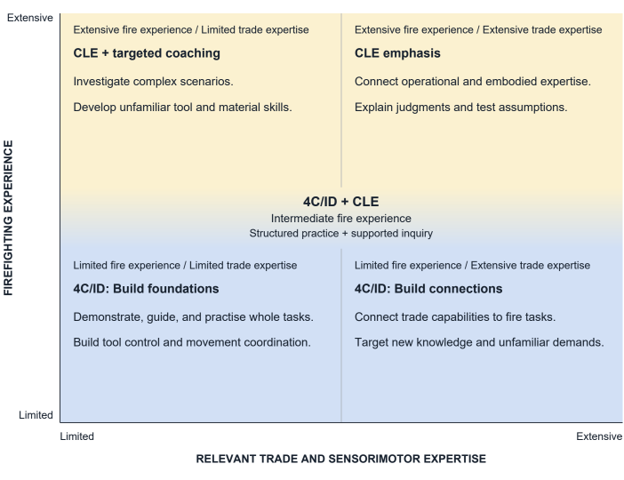
Note. Proposed applications informed by Jonassen (1999) and van Merriënboer et al. (2002). CLE = Constructivist Learning Environments; 4C/ID = Four-Component Instructional Design. Regions indicate instructional emphasis, not exclusive suitability or measured effectiveness. Assessment determines support.
This interpretation reflects my professional observations; it does not establish a measured correlation between trade experience and fireground proficiency. I envision the CLE and the 4C/ID models serving novice or experienced firefighters in their respective ways. Assessment would determine the support each learner requires, including when an experienced firefighter encounters unfamiliar demands.
The comparison informs my practice by encouraging differentiated entry points, progressively demanding tasks, and opportunities to explain and test existing understanding. Instruction should remain responsive to developing expertise and cognitive demands (van Merriënboer & Sweller, 2005). Evaluation would examine performance, retention, engagement and transfer and not necessarily from a direct measurement of proprioception.
I chose a quadrant graphic because it makes contrasting learner profiles and complementary instructional responses visible. Its blended middle emphasizes that structured practice and supported inquiry can coexist. This is quadrant graphic is also effective in showing other contrasting but correlated factors like the Eisenhower Matrix (Priority vs. Urgency) and in Gordon Graham’s Frequency vs. Risk analysis (Hurtado, 2012). Neither years of service nor occupational background alone should determine a learner’s instructional pathway.
References:
References
Hurtado. (2012, July 27). High risk/low frequency events in the fire service [Video]. YouTube. https://www.youtube.com/watch?v=Og9Usv82CdU
Jonassen, D. H. (1999). Designing constructivist learning environments. In C. M. Reigeluth (Ed.), Instructional-design theories and models: A new paradigm of instructional theory (Vol. 2, pp. 215–239). Lawrence Erlbaum Associates.
van Merriënboer, J. J. G., Clark, R. E., & de Croock, M. B. M. (2002). Blueprints for complex learning: The 4C/ID-model. Educational Technology Research and Development, 50(2), 39–61. https://doi.org/10.1007/BF02504993
van Merriënboer, J. J. G., & Sweller, J. (2005). Cognitive load theory and complex learning: Recent developments and future directions. Educational Psychology Review, 17(2), 147–177. https://doi.org/10.1007/s10648-005-3951-0
Appendix
AI Use Declaration
I used OpenAI’s ChatGPT to explore instructional design models, develop and refine the quadrant graphic, identify potential references, and draft and revise the reflection. I supplied the firefighter training context, professional observations, and proposed instructional emphases.
AI helped organize the comparison and communicate its application visually. Its limitations reinforced the need to distinguish professional observations and proposed designs from established research findings. All ideas, concepts and anecdotes are mine.
Leave a Reply