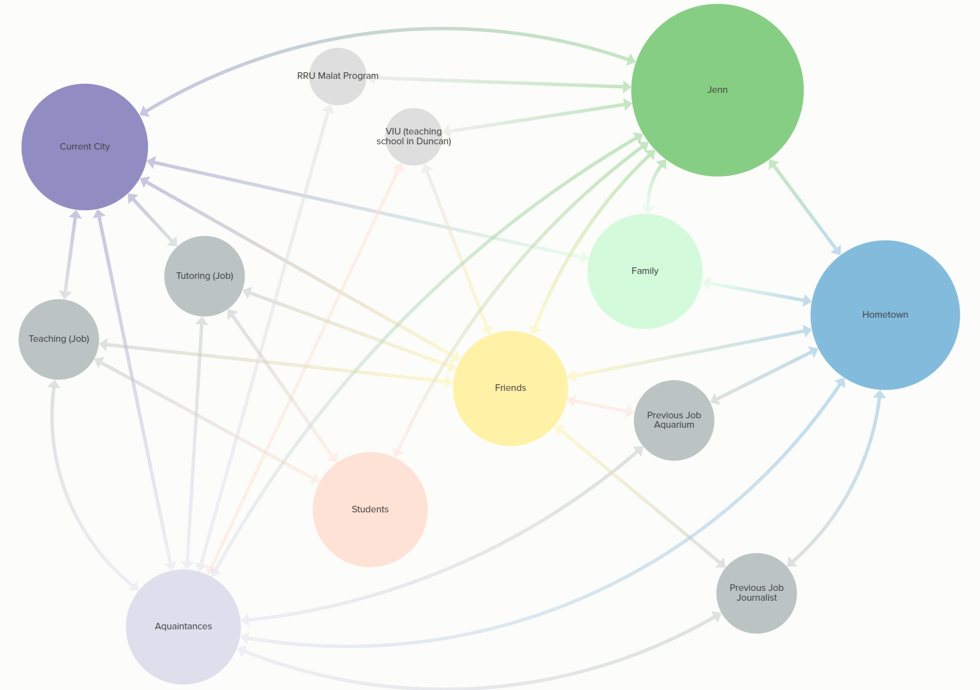
Creating this visual network map asked me to step back and look at my adult life through a different lens. When deciding how to structure the map, I focused on where I have lived and the types of work I have done, as those two factors have shaped most of my professional and personal connections. I chose broad categories such as family, friends, students, and acquaintances (including colleagues) because they best represent the people I connect with regularly and meaningfully, even though those boundaries often overlap in real life. I created the map using Kumu, and I genuinely enjoyed the creative process of visually organizing relationships and seeing how they connected to one another.
What surprised me most was how central my current city appeared in the map. I have only lived here for about six years, so I did not expect it to show up as such a strong hub of connections. However, when I reflected on how immersed I am in my work and the local community, it made sense. The visual representation helped confirm that I have built a strong and supportive network in a relatively short amount of time, even without consciously tracking those connections day to day.
Boyd and Ellison (2007) describe social network sites as spaces that make social connections “visible” and “navigable,” rather than creating entirely new relationships. Seeing my own network laid out visually made this idea tangible. The map did not introduce new connections, but it made existing ones easier to recognize and reflect on. It also highlighted how networks are shaped by everyday choices—where we live, where we work, and who we spend time with.
As a teacher, this exercise has made me think more about my students and the networks they are just beginning to form. Through classroom projects, collaboration, and peer interactions, students are constantly building networks, even if they are not consciously aware of it yet. This makes me wonder how often we pause to help students recognize these developing connections. I hope that, as educators, we can intentionally support students in growing networks that are supportive, inclusive, and nurturing as they move forward in their lives.
Footnote: ChatGPT was used to refine the language in the final draft. All concepts and ideas are mine.
boyd, d. m., & Ellison, N. B. (2007). Social network sites: Definition, history, and scholarship. Journal of Computer‑Mediated Communication, 13(1), 210–230. https://www.danah.org/papers/JCMCIntro.pdf