
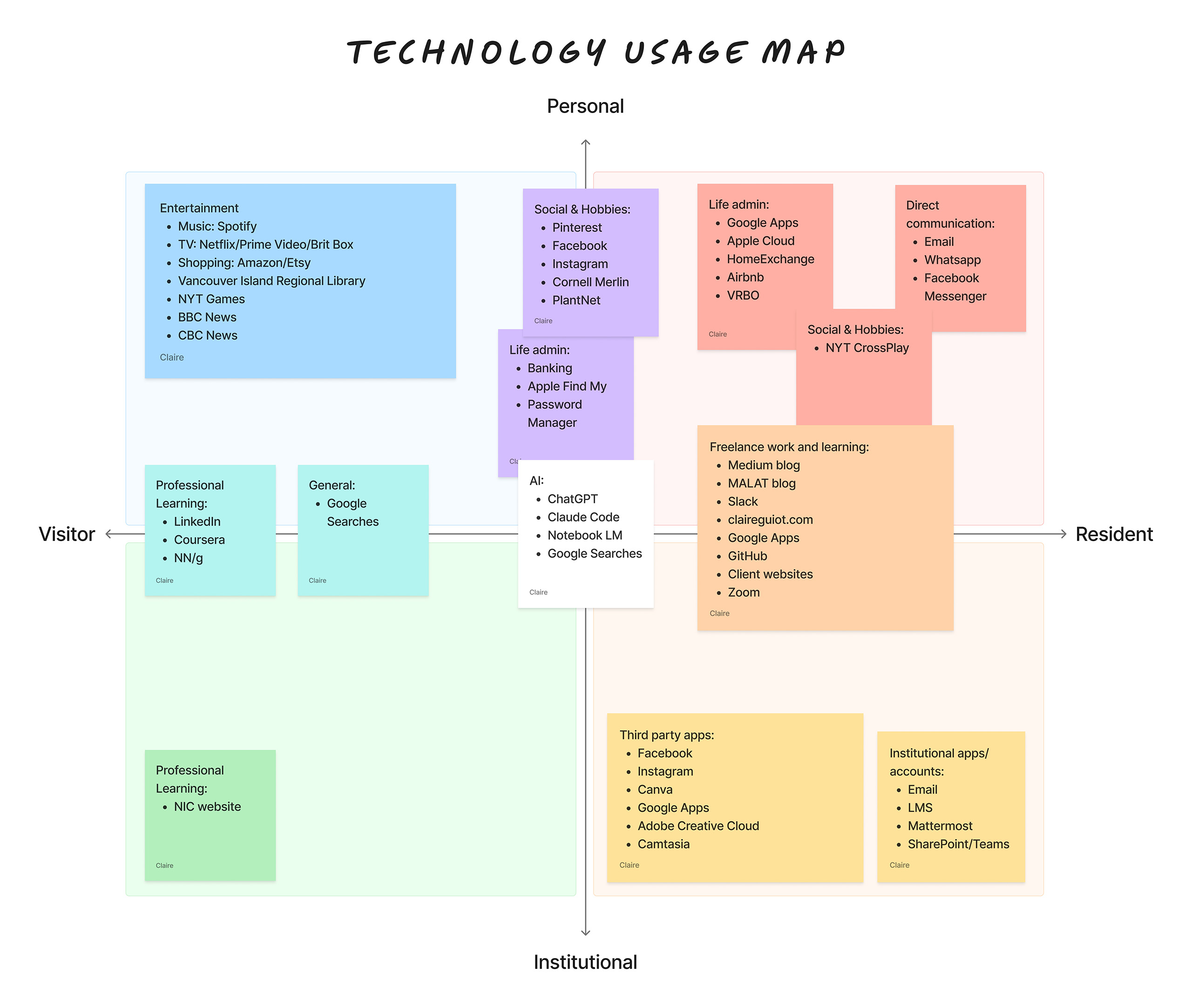
My Technology Usage Map shows a clear split: most of my screen time happens at work, using a small set of tools where my thinking is convergent, focused and task-driven. Outside of work, my thinking becomes more divergent, and I move across a wider range of interfaces. Not surprisingly, my most inspired ideas tend to surface on week-ends, when I’m less constrained by workflows and expectations.
I agree with Alison Le Cornu and David White (2011) that Marc Prensky’s (2001) Digital Native/Immigrant binary is too reductive. It overlooks the complexity of motivation, context, and the plural nature of digital literacies described by Colin Lankshear and Michele Knobel (2008). That said, I’m not fully convinced by the Visitor/Resident typology either, as it still feels overly neat for what is actually a messy, shifting practice.
Dave Cormier’s alternative resonates more. His Analogue/Digital and Individual/Collaborative axes focus on the “digital quality” of an activity rather than the user’s identity. For example, when I use the Cornell Merlin app to identify bird songs, I am outdoors in nature, and the technology enhances my analogue appreciation of nature, while still contributing to the online community. That experience is very different from, for example, using Notebook LM to help me identify appropriate quiz questions for my students, where the digital interface is dominant and often cognitively narrowing.
These examples suggest that similar tools can support very different kinds of thinking depending on context and on how and why they are used. Ultimately, tension pairs are useful prompts, but they fall short of capturing the messy, layered, fluid nature of our digital lives.
Footnote: AI was used to improve the language in the final draft of this reflection. All ideas are authentically mine.
References
Cormier, D. (2018, March 31). Digital practices mapping: Intro activity for digital literacies course. https://davecormier.com/edblog/2018/03/31/digital-practices-mapping-intro-activity-for-digital-literacies-course/
Knobel, M., & Lankshear, C. (2008). Digital literacies: Concepts, policies and practices. Peter Lang.
Le Cornu, A., & White, D. (2011). Visitors and residents: A new typology for online engagement. First Monday, 16(9). https://firstmonday.org/ojs/index.php/fm/article/download/3171/3049
Prensky, M. (2001). Digital natives, digital immigrants. On the Horizon, 9(5), 1–6. http://www.marcprensky.com/writing/Prensky%20-%20Digital%20Natives,%20Digital%20Immigrants%20-%20Part1.pdf
Hi Claire,
I agree with you about the categories of visitor-resident and personal-professional feeling too neat. I think that I probably moved most of the items on my map at least three times as I was going back and forth with myself to identify what was correct for me.
I really like the way that you have categorized your map; using headers to group platforms with different uses.
Thanks, Gen! Once I got started, I realized there were far too many apps and websites to list individually. It was actually a bit of an eye opener.
Hi Claire!
I really like the use of the mind map. I’m so used to thinking in paragraphs and grunts and points, I neglect the drawings more than I should.
I may use your map as inspiration if you don’t mind!
Hi Claire,
Your map is very interesting. I like how you categorized your items, and I also liked the idea that your more creative ideas come when you’re outside of structured work environments. I am the same. I also felt I was adding too much when I was working on my map, but I realized this is not as simple and clear-cut as it seems. It helped me evaluate how I spend my time online, and realize that I am most of the time online! 🙃
Hi Claire,
It’s refreshing to see that I’m not the only one who found the resident–visitor typology a bit too neat and lacking context. I do think it’s a valuable starting point for reflection, but it can miss some of the nuance that really captures the complexity of how people engage online.
Looking at your map also made me realize there are online tools and spaces I hadn’t fully considered when creating my own. For example, professional learning didn’t even come to mind, even though it’s something I regularly engage with—funny how that happens sometimes. I also appreciated how you took the time to distinguish between different uses of common platforms like Facebook, highlighting how your engagement shifts between personal and institutional contexts.
Celine