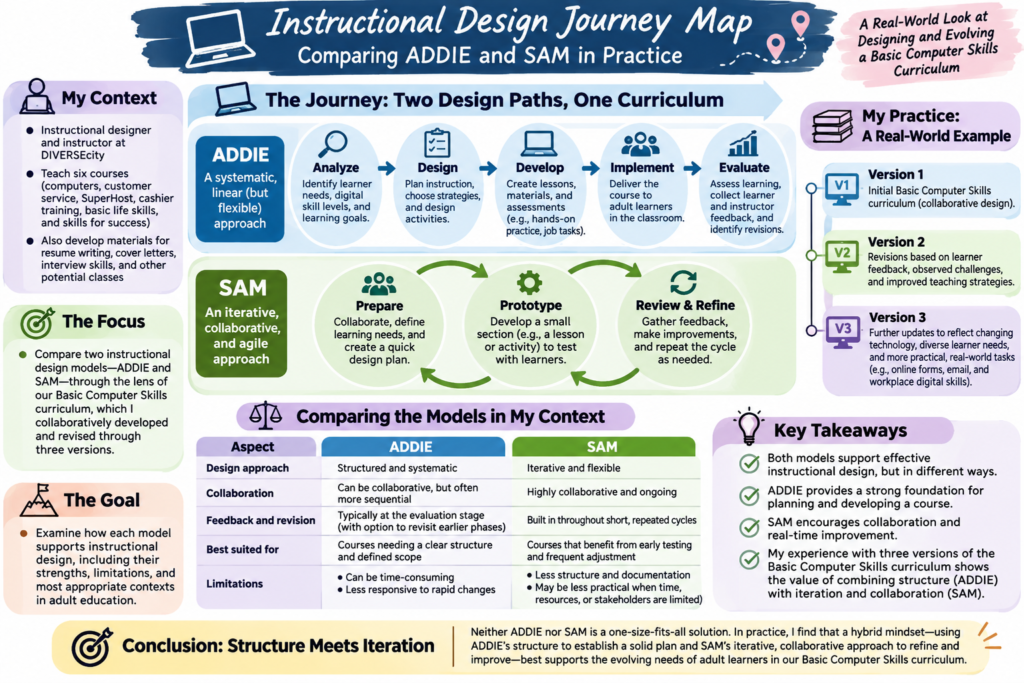
Having developed and revised three versions of a Basic Computer Skills curriculum for adult newcomers to Canada, I chose to compare ADDIE and the Successive Approximation Model (SAM). Although I have considerable experience developing curriculum, examining these models helped me better understand the instructional design decisions I have made throughout my work.
ADDIE provides a systematic approach through analysis, design, development, implementation, and evaluation. While often presented as linear, its phases can be revisited as needed (Dousay, 2017). SAM emphasizes rapid prototyping, feedback, and continuous refinement (Allen & Sites, 2012). Both approaches recognize the importance of learner needs and evaluation, but they differ in how frequently feedback informs the design process.
Reflecting on the three versions of my curriculum, I recognize elements of both models in my practice. The initial version required considerable planning, organizing content, and establishing learning objectives, reflecting ADDIE’s structured approach. Subsequent revisions involved incorporating feedback from instructors and learners, adjusting activities, and responding to different levels of digital literacy. These experiences reflect SAM’s iterative approach, although I was not consciously following either model at the time.
Creating a journey map allowed me to illustrate how my curriculum development evolved rather than simply presenting the models’ characteristics. More importantly, the comparison challenged my assumption that instructional design follows a predictable sequence. Giacumo and Breman (2021) highlight the variety of models and approaches used by instructional designers in workplace learning, reinforcing the importance of selecting approaches appropriate to the context.
Moving forward, I see value in combining ADDIE’s structure with SAM’s flexibility. For adult newcomers with diverse educational backgrounds, language abilities, and digital experiences, effective instructional design requires careful planning alongside opportunities to respond to learners’ changing needs.
References
Allen, M., & Sites, R. (2012). Leaving ADDIE for SAM: An agile model for developing the best learning experiences. ASTD Press.
Dousay, T. A. (2017). Instructional design models. In R. E. West (Ed.), Foundations of learning and instructional design technology. https://edtechbooks.org/lidtfoundations/instructional_design_models
Giacumo, L. A., & Breman, J. (2021). Trends and implications of models, frameworks, and approaches used by instructional designers in workplace learning and performance improvement. Performance Improvement Quarterly, 34(2), 131–170. https://doi.org/10.1002/piq.21349
Leave a Reply