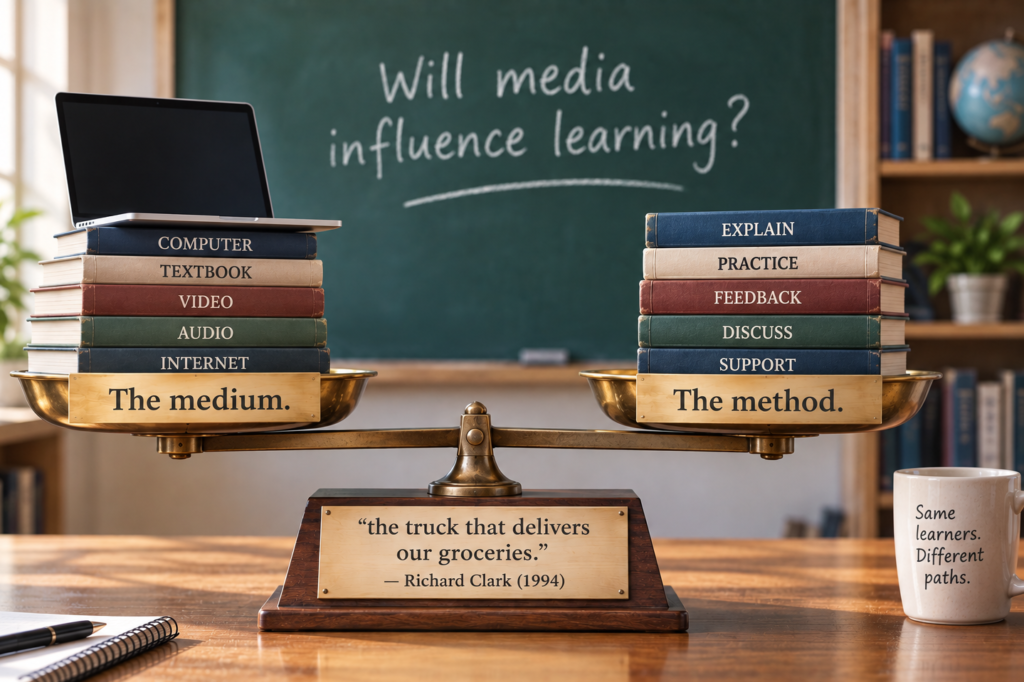
Where does the cause of learning sit? Image generated with AI.
A collaboratively authored post by Christina Steklin and Craig Watson.
Claims about artificial intelligence are becoming increasingly common in education, often promising to transform teaching, personalize learning, and improve student outcomes. These claims can reflect technological determinism when the technology itself is treated as the cause of educational change.
The argument is older than it looks. In 1994, Richard Clark and Robert Kozma debated whether media influence learning. Clark argued that media are vehicles for delivering instruction and that instructional methods, rather than the medium itself, influence learning. Kozma acknowledged that decades of research had failed to establish a consistent relationship between media and learning, but reframed the question, asking not whether media influence learning, but under what conditions they will.
More than thirty years later, the same debate is playing out around artificial intelligence in education. In this post, we examine two recent examples from the educational technology industry: Swivl’s discussion of AI and the changing role of teachers, and Cengage’s claims about its generative AI Student Assistant. Using the Clark-Kozma debate as two different lenses, we consider whether the benefits attributed to AI come from the technology itself, the instructional methods used with it, or the interaction between the two.
Can AI Really “Replace” Teachers?
In How to Replace Teachers with AI (It’s Not What You Think), Kasen-Kells (2024) presents a provocative argument about the role artificial intelligence could play in education. Published on the educational technology company Swivl’s website, the article does not actually suggest replacing teachers with AI. Instead, it argues that AI could replace an outdated and overburdened model of teaching by taking on tasks such as analysing student responses, providing feedback, and identifying learning patterns. This, according to the article, could give teachers more time to focus on the human aspects of education, including mentoring, discussion, relationship-building, and supporting individual students.
At first glance, this seems like a balanced argument. The article does not claim that teachers are becoming unnecessary and even emphasizes the importance of human relationships in education. However, some of its claims also reflect techno-deterministic thinking. Statements such as “AI changes that” and “better data leads to better teaching” suggest a relatively direct relationship between introducing AI and improving educational practice. The underlying assumption is that because AI can analyse information more quickly, provide immediate feedback, and reduce teachers’ workloads, better teaching and learning will follow.
Clark (1994) would likely challenge this assumption. Clark argues that media are vehicles for delivering instruction and that it is the instructional method, rather than the technology itself, that influences learning. He maintains that different media can often perform the same instructional function and produce similar learning outcomes. His “replaceability challenge” is particularly relevant to Kasen-Kells’s argument (Clark, 1994): if another medium or approach could accomplish the same instructional goal, then the medium itself cannot be considered the cause of learning. From Clark’s perspective then, the important question would not be whether AI improves teaching, but what instructional methods are being used through AI and whether those same methods could be provided in another way. AI might make some processes faster or more efficient, but efficiency is not the same as improved learning.
Kozma (1994), however, would approach Kasen-Kells’s claims differently. Rather than asking simply whether media influence learning, Kozma argues that we should examine the conditions under which they will influence learning. He proposes looking at how the capabilities of a medium and the instructional methods that use those capabilities interact with the cognitive and social processes involved in constructing knowledge. Kozma identifies processing capabilities such as storing, retrieving, organizing, transforming, and evaluating information as potentially important characteristics of media. From this perspective, AI’s ability to analyse student responses, recognize patterns, and provide rapid feedback could have educational value, but only when those capabilities are meaningfully connected to instructional methods and learners’ needs.
Does AI Create a Better Learning Experience?
In April 2025, Cengage announced that its generative AI Student Assistant would reach more than one million students across more than 100 products. Embedded in MindTap, the tool provides tailored, just-in-time feedback and connects students to relevant course resources. Cengage says it does not simply provide answers but helps students understand concepts and reach answers on their own (Cengage, 2025). The techno-deterministic thinking becomes more apparent when Cengage moves from describing what the tool does to claiming what it will do for learning. Cengage states that its approach creates a “better learning experience,” while CEO Michael Hansen says that “AI will continue revolutionizing learning” and that “the future of learning depends on our ability to evolve and continuously innovate alongside AI” (Cengage, 2025). In that framing, technology becomes the driver of educational change. Yet the release provides no study, comparison group, or learning outcome data, instead reporting encouraging feedback and support for the tool.
Clark (1994) would likely challenge Cengage’s own description of the Student Assistant. When a new medium appears to improve learning, the method is often bundled with the technology, making it difficult to determine what caused the improvement. Supporting a student to understand a concept and reach an answer independently is an instructional method. The Student Assistant does this through guidance, relevant resources, and well-timed feedback, none of which are unique to generative AI. Cengage therefore describes the instructional method built into its product and then gives the technology credit for the resulting learning experience.
Clark’s (1994) replaceability challenge makes the distinction clearer. If a teacher, tutor, or another digital system could provide similar feedback and guidance using the same instructional method, Cengage has not demonstrated that AI itself is responsible for better learning. This does not mean Clark would see no value in the tool. He separates learning effects from advantages such as cost, speed, and access. An assistant available at two in the morning is a real benefit, and reaching one million students demonstrates considerable scale. Those advantages are different from demonstrating that AI itself improves learning.
Kozma (1994) would approach the Student Assistant differently. The question is not simply whether the Student Assistant could be replaced, but what its capabilities allow a learner to do. The Student Assistant can respond while a student is working, connect questions directly to course material, and tailor its support to the learner’s context (Cengage, 2025). Kozma (1994) describes media partly through their symbol systems and processing capabilities, including their ability to retrieve, organize, transform, and evaluate information. If these capabilities interact with a learner’s cognitive processes in ways that support understanding, then the medium may play a meaningful role in learning.
What Kozma would still want, and what the release does not provide, is evidence of how those capabilities interact with the learner’s thinking. Cengage describes what the Student Assistant does but provides little evidence of what happens in the learning process itself. Saying that AI is “revolutionizing learning” does not demonstrate how its capabilities produce better learning outcomes.
Conclusion
Looking at both the Swivl and Cengage articles through these perspectives reveals why the Clark-Kozma debate is still relevant more than thirty years later. Both articles move from describing what AI can do to making broader claims about what those capabilities could mean for teaching and learning. Clark would question whether AI is being given credit for instructional methods that could be delivered in other ways, while Kozma would encourage us to investigate how AI’s particular capabilities interact with teachers, learners, and the learning process. Together, their perspectives remind us that claims about AI transforming or “revolutionizing” education need to be demonstrated rather than assumed, and that introducing a new technology does not, by itself, guarantee educational improvement.
References
Cengage. (2025, April 8). Powering personalized learning with AI: Cengage Student Assistant expansion delivers new GenAI capabilities to 1M+ students [Press release]. https://www.cengagegroup.com/news/press-releases/2025/cengage-student-assistant-expansion-1m-students
Clark, R. E. (1994). Media will never influence learning. Educational Technology Research and Development, 42(2), 21–29. https://doi.org/10.1007/BF02299088
Kasen-Kells, C. (2024, September 10). How to replace teachers with AI (it’s not what you think). Swivl. https://www.swivl.com/2024/09/10/how-to-replace-teachers-with-ai/
Kozma, R. B. (1994). Will media influence learning? Reframing the debate. Educational Technology Research and Development, 42(2), 7–19. https://doi.org/10.1007/BF02299087
Leave a Reply