
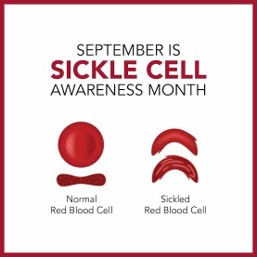
Image is courtesy of Sickle Cell Disease and Social Security – Gillette Law Group
September is National Sickle Cell Awareness Month. Sickle cell disease (SCD) is a “genetic, hereditary, chronic pathology with rare chances of a cure, where oxygen is absent or reduced, altering the shape of the red blood cell, which acquires a sickle shape” (Santana et al., 2024). SCD can affect any organ and could result in strokes in the brain, kidney damage, or complications (Tanabe et al., 2020). Statistics show that over 8 million people worldwide have SCD (National Heart, Lung, and Blood Institute, 2025).
Melanie Fields is a physician, and associate professor of pediatrics, neurology, hematology, and oncology at Washington University School of Medicine. She is the mentor behind the interactive game called Game to Raise Awareness for Patient/Provider/Public Education of SCD or GRAPES at the St. Louis Children’s Hospital in Missouri. Through GRAPES SCD patients, their families, and healthcare providers discuss symptoms, treatments, and obtain life encouragement (National Heart, Lung, and Blood Institute, 2021). As Fields indicates this tool is important and impacting because:
Patients learning more about SCD, they may feel more empowered to advocate for themselves in different health care settings, schools, or work environments. Plus, a patient’s clinical outcomes or experience could improve as their knowledge about the disease increases. Documented bias among doctors and nurses exists, such as a clinician not realizing how much pain a patient is in. The game explains lab results don’t always reflect pain, which can last for 3-4 days or more. (Fields, 2020)
Personally, I have family and friends who live and have died from SCD’s altering symptoms and chronic pain. In agreeance with Fields that “it’s not that the patients and medical staff are clicking quickly or efficiently, but that they are talking about the disease” (Fields, 2020) and this is a disease very much worth talking about.
September is National Sickle Cell Awareness Month. Sickle cell disease (SCD) is a “genetic, hereditary, chronic pathology with rare chances of a cure, where oxygen is absent or reduced, altering the shape of the red blood cell, which acquires a sickle shape” (Santana et al., 2024). SCD can affect any organ and could result in strokes in the brain, kidney damage, or complications (Tanabe et al., 2020). Statistics show that over 8 million people worldwide have SCD (National Heart, Lung, and Blood Institute, 2025).
Melanie Fields is a physician, and associate professor of pediatrics, neurology, hematology, and oncology at Washington University School of Medicine. She is the mentor behind the interactive game called Game to Raise Awareness for Patient/Provider/Public Education of SCD or GRAPES at the St. Louis Children’s Hospital in Missouri. Through GRAPES SCD patients, their families, and healthcare providers discuss symptoms, treatments, and obtain life encouragement (National Heart, Lung, and Blood Institute, 2021). As Fields indicates this tool is important and impacting because:
Patients learning more about SCD, they may feel more empowered to advocate for themselves in different health care settings, schools, or work environments. Plus, a patient’s clinical outcomes or experience could improve as their knowledge about the disease increases. Documented bias among doctors and nurses exists, such as a clinician not realizing how much pain a patient is in. The game explains lab results don’t always reflect pain, which can last for 3-4 days or more. (Fields, 2020)
Personally, I have family and friends who live and have died from SCD’s altering symptoms and chronic pain. In agreeance with Fields that “it’s not that the patients and medical staff are clicking quickly or efficiently, but that they are talking about the disease” (Fields, 2020) and this is a disease very much worth talking about.
Additional Information:
To learn more about Melanie Fields, MD, MSCI:
https://physicians.wustl.edu/people/melanie-fields-md
https://profiles.wustl.edu/en/persons/melanie-fields
Article: Innovating sickle cell disease education models
https://www.nhlbi.nih.gov/news/2021/innovating-sickle-cell-disease-education-models
Article: GRAPES (Game to Raise Awareness for Patient/Provider/Public Education of SCD)
National Library of Medicine – https://pubmed.ncbi.nlm.nih.gov/35441455/
REFERENCES:
GRAPES Game. (n.d.). GRAPES game. http://www.tinyurl.com/GRAPESgame
National Heart, Lung, and Blood Institute. (2020, September 1). Announcement of requirements and registration for the Hope for Sickle Cell Disease Challenge. National Institutes of Health. https://www.nhlbi.nih.gov/sites/default/files/media/docs/03%20%20SCD%20Challenge%20Announcement%2020200923.pdf
National Heart, Lung, and Blood Institute. (2021, July 7). Innovating sickle cell disease education models. National Institutes of Health. https://www.nhlbi.nih.gov/news/2021/innovating-sickle-cell-disease-education-models
National Heart, Lung, and Blood Institute. (2025, December 10). What is sickle cell disease? National Heart, Lung, and Blood Institute. https://www.nhlbi.nih.gov/health/sickle-cell-disease
Santana, R. C., Silva, L. F. da, Gama, P. da S. M. da, Nascimento, L. de C. N., Silveira, A. L. D. da, & Moraes, J. R. M. M. de. (2024). Educational technologies for the self-care of children with sickle cell anemia: An integrative review. Cogitare Enfermagem, 29. https://doi.org/10.1590/ce.v29i0.96369