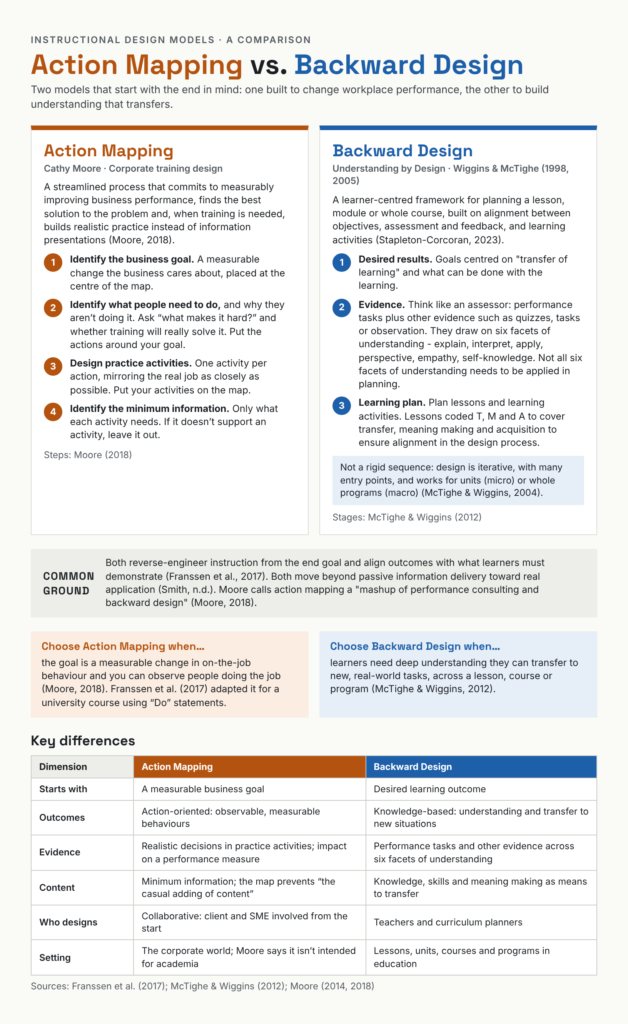
The field of instructional design (ID) is versatile and fluid in a manner that can be embedded in various industries and professions. As I reflected upon my industry and profession, I found myself applying ID models innately in my daily work. There are two ID models that caught my attention as they both start with the end in mind but are intended for different contexts. I compared the ID models Action Mapping by Cathy Moore and Backward Design by Wiggins and McTighe.
In the world of talent acquisition, recruiters are asked to create recruitment assessments and/or interview questions based on a job description or information gathered from a subject matter expert (SME). Recruiters then analyze knowledge, skills and abilities to help support the recruitment process and build recruitment tools to identify the most suitable candidate for the job. Generally, recruiters don’t apply ID models when designing interview questions, however, it sparked curiosity in how one can utilized these models to develop meaningful, deeper questions that support the recruitment process. One can utilize ID models methodologies, especially action mapping in this context, by creating a brainstorming session with a SME to map out the necessary requirements of the job, and map it out to elicit the right question or assessment format to assess a candidate considered for the role.
Both ID models start with the end in mind, clearly outlining the desired outcome and avoiding unnecessary steps or information within the planning process. These models can be crucially useful in the recruitment process to clearly define the hiring objective and work backwards to design the assessments and interview questions.
With their similarities, come their differences. The Action Mapping process is designed to achieve business goals and not intended for academia; however, Backward Design is designed to plan educational units, modules, or courses. Even though each model is intended for a particular context, I believe one can utilize aspects of these models and layer the stages to support an outcome similar to how Franssen et al., 2017leveraged Action Mapping for an academic course. Instructional design models present flexibility in the planning process and allows one to shape the design process for a particular audience, industry, business and educational outcome.
AI Transparency Statement:
Generative AI (ChatGPT and Claude AI) were used in the creation of this assignment. ChatGPT was first used as a search engine to explore ID models within the context of talent acquisition. The author of this post researched the instructional design models, choosing and comparing the two ID mentioned in this post. She researched peer-reviewed articles, eliciting and comparing all the information presented in the infographic.
Claude AI was used to make the infographic. The author researched both ID models and elicited all the essential elements, stages and key teachings, grouping necessary information and ideas together. The author then used all the information gathered and inputted it into Claude AI to create the infographic. The author decided to use Claude AI to create the infographic because she had a difficult time in deciding on what elements to compare of both ID models. The author reviewed and cross referenced the information with her research and amended sections to ensure integrity of the information. Claude AI also helped the author to paraphrase context taken from the resources. AI helped the author to visually present the information in a manner that is easily digestible and can be a resource to the context and audience described in the blog.
ChatGPT was also used to create the reference list and in-text citations. The reference list and in-text citation were cross-referenced with APA 7th Edition formatting and guidelines.
The reflection section of the blog is solely created by the author as it is a self-reflection that is personal, one that AI cannot generate.
References
Franssen, C. L., Lowry, G. S., & Franssen, R. A. (2017). Using action-mapping to design a non-majors neuroeconomics course to teach first-year collegiate skills. Journal of Undergraduate Neuroscience Education, 16(1), A52–A59. https://pmc.ncbi.nlm.nih.gov/articles/PMC5777838/
McTighe, J., & Wiggins, G. (2004). Understanding by design professional development workbook. Association for Supervision and Curriculum Development. https://files.ascd.org/pdfs/publications/books/mctighe2004_intro.pdf
McTighe, J., & Wiggins, G. (2012). Understanding by design framework. ASCD. https://files.ascd.org/staticfiles/ascd/pdf/siteASCD/publications/UbD_WhitePaper0312.pdf
Moore, C. (2014). Online learning conference anti-handout. https://blog.cathy-moore.com/online-learning-conference-anti-handout/
Moore, C. (2018). Action mapping: A visual approach to training design. https://blog.cathy-moore.com/action-mapping-a-visual-approach-to-training-design/
Smith, P. (n.d.). Understanding by design (UbD) and the backward design framework. In The open guide to teaching and learning in higher education. Pressbooks. https://pressbooks.pub/etsu/chapter/understanding-by-design-ubd-and-the-backward-design-framework/
Stapleton-Corcoran, E. (2023, January 25). Backward design. Center for the Advancement of Teaching Excellence, University of Illinois Chicago. https://teaching.uic.edu/cate-teaching-guides/syllabus-course-design/backward-design/
Leave a Reply