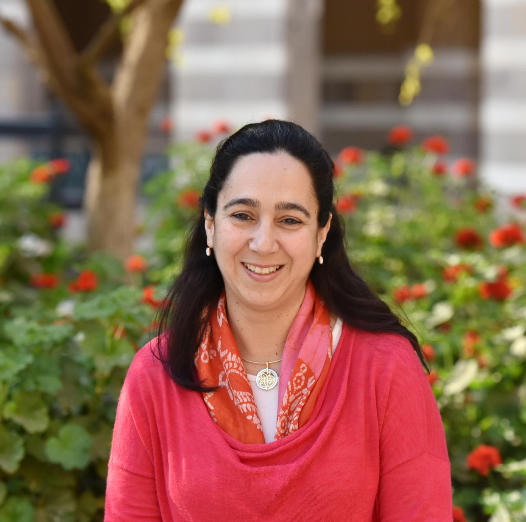
(The American University in Cairo, n.d.)
Human relations have always been a significant focus in shaping the way we understand, learn, communicate, and engage with others. In a world of digitization, human element can be perceived to have a lack of focus within this realm. Without the human brain, AI and technology would have not evolved to its current optimization and foreseeable ambitions.
Dr. Hoda Mostafa, an MD that transitioned her career to education, is a professor of practice and the director of the Center for Learning and Technology at the American University in Cairo (AUC) (The American University in Cairo, n.d.). Dr. Mostafa bridges human-centric pedagogy and educational technology. After she reflected upon her personal experience within a didactic system during medical school, she developed a curiosity for experiential learning (Stachowiak, 2017).
Dr. Mostafa co-developed a scientific thinking course at the AUC, embedding the human element within the learning process, merging design thinking with experiential learning. She assimilated a design thinking approach primarily utilized by large corporations into education. The learning process transformed into a reflective and personal approach as students shared the relevance of their learning on their blogs, unfolding their learning connection to their personal environment. The learning process became empathy centered and iterative with a focus on problem solving with a creative approach, bridging a human centric approach to learning and technology (Stachowiak, 2017).
Further to Dr. Mostafa’s work, she shifted the narrative to a human-centric approach in the age of AI by co-developing AI guidelines with, for and by students and faculty to ensure academic integrity throughout AUC (Bertram Gallant, 2025). Her work further emphasizes the importance of merging a human-centric approach to learning and technology.
Direct Links to Dr Hoda Mostafa’s work:
https://www.theoppositeofcheating.com/post/episode-38-maha-bali-hoda-mostafa
Reference List
Bertram Gallant, T. (2025, November 24). Episode 38: Maha Bali & Hoda Mostafa [Podcast episode]. The Opposite of Cheating. https://www.theoppositeofcheating.com/post/episode-38-maha-bali-hoda-mostafa
Marie, K. (2022, June 22). Creativity with compassion. AUC Today. https://auctoday.com/2022/06/22/creativity-with-compassion/
Stachowiak, B. (2017). Teaching creativity, with Hoda Mostafa [Audio podcast episode]. Teaching in Higher Ed. https://teachinginhighered.com/podcast/teaching-creativity/
The American University in Cairo. (n.d.). Hoda Mostafa. https://www.aucegypt.edu/fac/hoda-mostafa
Transparency Statement: Generative AI, ChatGPT, was used to create the reference list and in-text citations. It was also utilized as a search engine to find professionals who made significant contributions in this field. All text and conclusions were written by me.
14 September 2026 at 8:59 am
Hi Asma,
Thanks for your post. By the way, I noticed it is currently showing as “Uncategorized.” I think you may need to select the LRNT523 category so that it appears in the Student Blog section.
I am keen to explore Hoda Mostafa’s work further, as this part of your post especially resonated with me: “Without the human brain, AI and technology would have not evolved to its current optimization and foreseeable ambitions.”
Your discussion of experiential learning and design thinking made me reflect on the distinction between information, knowledge, and learning. While AI can efficiently search, curate, and synthesize vast amounts of information, I question whether it can truly replicate human learning. To me, knowledge is the understanding, integration, and application of information acquired through experience, education, observation, analysis, and social interaction. Learning goes a step further. It involves making meaning from those experiences and transforming our understanding, skills, perspectives, or even our sense of self.
This is why Dr. Mostafa’s human-centered approach is so compelling. Students were not simply consuming information. They were reflecting on it, connecting it to their own environments, empathizing with others, and iteratively refining their thinking. These processes are deeply human and difficult to reduce to data alone.
I wonder if the growing use of AI in education makes approaches like Dr. Mostafa’s even more important. Perhaps the value of education is shifting from access to information toward helping learners develop the critical reflection, empathy, creativity, and real-world application that transform information into meaningful learning.