I have many years’ experience in creating and managing internet content, and consider myself both digitally literate and digitally competent, based on my “confident and critical use of digital technologies for learning, work and leisure.” 1Ryberg. T., & Georgsen, M. (2010). Enabling digital literacy. Nordic Journal of Digital Literacy, 2(5).
1. Gerd Altman (2013) CC0, My networked self
On the other hand, I have about three weeks’ experience formally analyzing my past practices, and my future intentions in working with my networked public. 2Networked publics are publics that are restructured by networked technologies. As such, they are simultaneously (1) the space constructed through networked technologies and (2) the imagined collective that emerges as a result of the intersection of people, technology, and practice. Boyd, D. (2011). Social network sites as networked publics: Affordances, dynamics, and implications. In Z. Papacharissi (Ed.), A Networked Self (pp. 39–58). New York, NY: Rutledge.
Note: All external links open in a separate tab.
Introduction
In his discussion of social media literacies, Rheingold states, “They also understand the notions of reputation and diffuse reciprocity, which are increasingly important online.” 3Rheingold, H. (2010). Attention, and other 21st-century social media literacies. Educause Review, 45(5), 14.
Protecting my reputation—and in many cases, my privacy—online is extremely important, and included in my plan. I’m not overtly interested in wide dissemination of my content, so I haven’t placed as much emphasis on reciprocity.
My plan introduces the structure I currently maintain, and four action items to undertake as a MALAT student.
History
I have had a web site since 1992. One of my first sites was a gaudy purple thing, but I was so proud of it! I started developing an online presence in earnest in 1995. I wrote monthly articles about design software for an online magazine called Windowatch, and served as a contributing editor for the magazine until its retirement in 2002.
By then, I had written my first couple of books, so my focus shifted back to my web site where I hosted content about my books and user files.
Those were the days of paper books, and a CD in a sleeve on the back cover. It was striking—and damaging to my Amazon reviews—how often there were errors in the attached CDs, so the site featured corrections as well.

2. Lokena, 2016. CC0
I switched from building a site in Dreamweaver and uploading it to my host server to building online with WordPress in about 2004. I currently use WordPress to manage my professional blog and a hobby blog. I keep my coding wheels turning as technical editor for the For Dummies books on WordPress.
Fast forward to this year, and now I am a MALAT student, building a new blog.
So now what?
Branding and Messaging
Kleppinger and Cain define a personal digital brand as “a strategic self-marketing effort, crafted via social media platforms, which seeks to exhibit an individual’s professional persona.” 4Kleppinger, C. A., & Cain, J. (2015). Personal Digital Branding as a Professional Asset in the Digital Age. American Journal Of Pharmaceutical Education, 79(6), 1-4.
I have worked for many years to create and promote my personal digital brand, and adding MALAT content and information can enhance my brand across various platforms.
Focusing my Activity
In Campbell’s article on developing a personal cyberinfrastructure, he states, “To get there, students must be effective architects, narrators, curators, and inhabitants of their own digital lives.” 5Campbell, G. (2009). A personal cyberinfrastructure. Educause Review, 44(5), 58-59.
I’ve extrapolated these four roles to apply to me as a working professional, to help organize my existing internet experience and plans going forward.
I reworked a portion of my Visitor-Resident Typology map to include my MALAT blog and identify areas where I can extend or tether new content online.
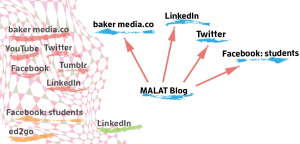
3. Extending my MALAT blog
Four online areas where I can include my MALAT activity are
- My professional site
- Students’ Facebook page
- LinkedIn profile
All areas require curation depending on the specific audiences. Twitter is a special case, as I describe below.
Professional and Training Site
My professional site includes blog posts and video tips on using Adobe software, particularly Acrobat and InDesign. The site auto posts to YouTube, Twitter, Facebook, Tumblr, LinkedIn and Adobe Forums. I have a section of the site in the planning stages where I intend to host and offer online courses.
Plan: Post some MALAT content to my site that is generic and of general interest.
Value: It’s vital to quantify and qualify my expertise on an ongoing basis to maintain and strengthen my professional brand. Adding information about my current field of studies enhances my credibility and status within my reader community. When my courses are ready for launch, the proof of ongoing academic pursuit adds to my ‘street cred.’
Student Facebook Page
I teach several InDesign and Acrobat courses through the ed2go system. I maintain a Facebook page for my students and graduates where I post links, reviews, and other topics of interest.
Plan: Include some general interest MALAT content to the page.
Value: I have students with ages ranging from 15 to 84, and enjoy interacting with my students in the courses’ discussion areas. Adding information about my current field of studies enhances my professional credibility with my students, and shows that I, too, actively pursue lifelong learning.
I maintain a full LinkedIn profile, and belong to several LinkedIn groups on design, eLearning, graphics and infographics, and software user groups. My professional site automatically posts to LinkedIn.
Plan: Post some content from my MALAT blog to LinkedIn. In some cases, I’ll need to edit for the LinkedIn audience, making the content more focused on business or design. I intend to adapt the content to fit the SlideShare structure on LinkedIn.
Value: Adding a stream of learning and technology-related content to my LinkedIn account will support my profile and enhance my status, deepening my personal brand.
Honing My “Crap Detection” Abilities
The fourth and final step in my plan is to use and engage with others on Twitter. Both my professional and hobby sites automatically post to Twitter under separate Twitter accounts.
One of Rheingold’s social media literacies is critical consumption, a.k.a. “crap detection,” where he explains that “social media is not a queue; it’s a flow.” 6Rheingold, H. (2010). Attention, and other 21st-century social media literacies. Educause Review, 45(5), 14. That statement was revelatory, and I’m adopting it as a guiding principle to make a change in my social media consumption.
I have a personal bias about interacting with some communities, particularly Twitter. Although I automatically tweet posts from my blogs, I rarely visit Twitter, don’t recall ever retweeting anything, and have hundreds more followers than those I’m following.

4. Coffeebeanworks, CC0
I find the rancor and false information disseminated throughout the Twittersphere over the last couple of years disgusting, and tend to avoid it. I occasionally wander through Twitter, but not with any purpose or regularity, finding it more a time suck than a productive experience.
On the upside, I started reading the MALAT Twitter feed, and enjoy what I’ve read!
Plan: Create a separate Twitter account for my student activities to learn and interact with my cohort and others in my field of study.
Value: I intend to learn how to become a critical consumer of Twitter content, and examine how I can achieve intellectual satisfaction from the experience.
References
Boyd, D. (2011). Social network sites as networked publics: Affordances, dynamics, and implications. In Z. Papacharissi (Ed.), A Networked Self (pp. 39–58). New York, NY: Rutledge.
Campbell, G. (2009). A personal cyberinfrastructure. Educause Review, 44(5), 58-59.
Kleppinger, C. A., & Cain, J. (2015). Personal Digital Branding as a Professional Asset in the Digital Age. American Journal Of Pharmaceutical Education, 79(6), 1-4.
Rheingold, H. (2010). Attention, and other 21st-century social media literacies. Educause Review, 45(5), 14.
Ryberg. T., & Georgsen, M. (2010). Enabling digital literacy. Nordic Journal of Digital Literacy, 2(5).
Image references
- Coffeebeanworks (Artist). (2017) Bubbles icon Twitter image [Digital image]. Retrieved from Pixabay website: https://pixabay.com/en/bubbles-icon-twitter-message-1968272/
- Altman, Gerd (Artist). (2013) Tree structure networks internet [Digital image]. Retrieved from Pixabay website https://pixabay.com/en/tree-structure-networks-internet-200795/
- Baker, D. (Artist). My digital network [Digital image].
- Lokena (Artist). (2016) WordPress Business Woman [Digital image]. Retrieved from Pixabay website: https://pixabay.com/en/wordpress-business-woman-red-1415678/
May 8, 2017
Your plan is very in depth! I think it’s very cool how you started making websites in 1992. I remember the websites in those days with the solid colour backdrops or the cheesy patterned wallpaper style backgrounds, with the little thumbnail photos that if you clicked on, they would load up so slowly, line by line, and the noise the modem would make when you’d go online. You’re a website pioneer, plus you’ve written a bunch of books. I’m not sure if you need the MALAT program for “street cred” because it looks like you have plenty already, but it’s great to have you on board!
May 8, 2017
Oh, holy smokes, that’s a lot of in-depth thought. I can’t believe how long you’ve already been in this field!! I’m going to be using your websites as a resource! 😉 Any lessons learned for what to avoid when personal branding?
May 8, 2017
I have been in the field for a long time, and overall it’s been a good time. With regards to personal branding, I think the key point is to identify what you want your brand to represent. Once you do that, you’ll have a guide to apply going forward.