LRNT 523 Assignment 1 – Relevant Resource: The Disruption of Digital Learning

The resource that I would like to share with the cohort is an article I found before I decided to apply for the DipLat program. In fact, it was one of the reasons that solidified my interest in exploring this field more, and have since been using this resource throughout my studies and while at work. The article is a detailed report called the Disruption of Digital Learning. The Disruption of Digital Learning _Bersin (3)

This report was conducted by Josh Bersin for Deloitte. It outlines all of the key trends within corporate learning and particularly highlights the past ten years.  In this course, we spent time studying the history of learning technology and how that can influence the future. The trends clearly outlined in this report examine what the traditional way of learning was, and shows concrete examples of new and enhanced learning technologies (Bersin, 2017). For example, the report outlines how the traditional learning management system technique is now a baseline system for online learning. Bersin (2017) explores microlearning platforms, program experience platforms, content libraries and delivery tools as the future of educational technology and provides valid suggestions in these areas, making this a resource for myself and my team when exploring new opportunities and vendors to work with.  This report can be used in a corporate setting to highlight key trends happening in the industry, the clarity and delivery of the information is helpful when proposing new partnerships and directional changes to an executive group. The most important piece of information from this report (that I have personally used in numerous presentations) is the “Understanding Macrolearning versus Microlearning” (p.9) chart. This visual aid help demonstrate the change in content delivery, giving you a better tool to articulate the foundations of learning and technology and how it’s changed.


Resources

Bersin, J. (2017) The Disruption of Digital Learning: 10 Things we’ve learned. Retrieved from Deloitte Consulting LLP

LRNT 523 Activity 7 – The Great EdTech Debate: Do Media Affect Learning Outcomes?

This week a few members of the Royal Roads University Masters of Arts in Learning and Technology (MALAT) cohort met virtually to debate whether media affect learning outcomes. We each read seminal works that outlined each side of the debate: Clark (1994) argued media absolutely do not affect learning outcomes while Kozma (1994) argued we have not yet found the link between media and learning, so he does not agree with the bold statement put forward by Clark (1994).

After grounding ourselves in both sides the education technology media debate, we each sought out an article published recently in the mainstream media and evaluated how each article related to the arguments put forward by Clark (1994) and Kozma (1994). Below are our findings.

Museums Test New Technology, Interactive Exhibits

Terra A.

The video “Museums Test New Technology, Interactive Exhibits” looks at the implementation of digital tools by museums across the globe.  In an effort to make the museum experience more engaging and informative, many prominent museums are implementing digital tools such as interactive displays; 3D videos; and movies accompanied by smells (e.g. gunpowder), moving sets and seats, and weather simulations (e.g. snow and wind). It is implied, though not explicitly stated, that the museums believe the use of these digital tools and accompaniments will help to increase learning in their visitors – children and adults alike.  The museums’ belief that digital tools will increase the engagement and learning of their visitors is in stark contrast with Clark’s (1983) assertion that media are “mere vehicles that deliver instruction but do not influence student achievement”.  

Clark, R. (1983). Reconsidering Research on Learning from Media. Review of Educational Research, 53(4), 445–459.

Clark, R. (1994). Media will never influence learning. Educational Technology Research and Development, 42(2), 21–29. https://doi.org/10.1007/BF02299088

Wall Street Journal. (2015, Oct 15). General format. Retrieved from http://www.youtube.com/watch?v=32pqI1dod8A

How Americans Get Science Information

http://www.journalism.org/2017/09/20/science-news-and-information-today/

Katie B.

In the article “How Americans Get Science Information”, social media would be considered the medium to delivering the content of science information with the intention to educate the public on such issues like climate change or engineered food. This article claims that social media or “the media” for the sake of the argument we are debating, plays a modest role in actually educating people. The article depicts the usage and delivery methods of the content, stating that the medium is used by people to check in or be updated on what’s going on (with regards to science in this article particularly). This supports the claims made by Clarke (1983) when he says that the media is simply a “vehicle that delivers instruction” or in this case information. If learning occurs, it is not the media in this case that has caused a cognitive change in the brain, the information itself is not specific to the vehicle used to deliver it. In other words, if the information about science could be delivered in different ways (books, TV, newspapers, etc) then it can not be declared that the social media was, in fact, the result of a person learning (Clark, 1983). It could be argued that the means for social media use, in this case, was a cost-effective medium to deliver the information, therefore supporting Clark’s claim that delivery technologies influence the cost and access of instruction and information.

Clark, R. (1994). Media will never influence learning. Educational Technology Research and Development, 42(2), 21–29.https://doi.org/10.1007/BF02299088

Funk, C., Gottfried, J., & Mitchell, A. (2017, September 20). Science news and information today. Paw Research Center. Retrieved from http://www.journalism.org

zyBooks

Darin F.

zyBooks is a company that creates and sells interactive digital books for pedagogical purposes. The subject material of zyBooks, a new media format, focusses on material that deals with STEM education. Drew (2011) outlines that STEM education is an initiative to stimulate the learning of students in the fields of Science, Technology, Engineering, and Math. The purpose of zyBooks is to replace traditional textbooks and static ePub/PDF digital volumes with a more richer, intuitive, and interactive educational experience that are “proven to better prepare students” (Why zyBooks section, para. 5).

The information provided on the website for zyBooks illustrates the confidence that the creators have in their dynamic educational book series. This level of confidence is showcased on the company’s website page listed under Research. According to zyBooks (n.d.), “zyBooks improved student performance by 16%” (Research section, para. 1) and ”letter grades up to ⅔” (Research section, para. 2). The company continued to show that “students learned 118% more in a single-lesson with minimal text” (Research section, para. 3) with “fewer than 3% of students ‘cheat the system’” (Research section, para. 4). These statements indicate that the company zyBooks perceives that their new media has influenced learning. This assumption by zyBooks directly challenges the theory set out by Clark. Clark (1994) iterates that the influence of education is based on the method of delivery and not the media. To reinforce the company’s claim, zyBooks has supplied non-peer reviewed articles which are written by employees of zyBooks.

Clark, R. (1994). Media will never influence learning. Educational Technology Research and Development, 42(2), 21–29. https://doi.org/10.1007/BF02299088

Drew, D. (2011). STEM the tide. Retrieved from https://muse-jhu-edu.ezproxy.royalroads.ca/chapter/35261

Kozma, R. B. (1994). Will media influence learning? Reframing the debate. Educational Technology Research and Development, 42(2), 7–19. https://doi.org/10.1007/BF02299087.

zyBooks. (n.d.). zyBooks. Retrieved October 7, 2017, from http://www.zybooks.com/research/

This Play Dough Will Teach Your Kids All About Electricity

Amber M.

This article explains how using conductive play dough as the medium for learning can help children understand how electricity works. The article says, “Children can grasp technical concepts, but they need the right tools” (para. 1). If “tools” is a synonym for “media,” the statement directly contradicts Clark (1994), who argues media do not affect learning outcomes. But if “tools” is a synonym for “methods,” the statement aligns with Clark’s position (1994), who states media and methods are different. The article provides clarification on its position, stating, “It’s allowing children to solve problems through self-motivated learning” (para. 6). Here, the article explicitly aligns itself with Clark (1994) by indicating learning theories such as a problem-solving orientation and motivation are what drives learning outcomes, implying the media used is a secondary consideration.

Stinson, E. (2017). This play dough will teach your kids all about electricity. Retrieved October 6, 2017, from https://www.wired.com/2017/06/play-dough-will-teach-kids-electricity/

8 Important Reasons Why YouTube Should Be Part Of Your eLearning Course

Dugg Steary

In the article “8 Important Reasons Why YouTube Should Be Part Of Your eLearning Course”, the author Christoforos Pappas (2015) explores how YouTube can benefit eLearning students through a focus on integration, community development, promotion of discussion, mobile learning potentials, note-taking skill development, comprehension of complex concepts and contribution through creativity.

Pappas outlines how YouTube videos can be created to introduce, explain in detail, or summarize most subjects or skills for students.  Additionally, students and educators can create or consume content as part of a closed or open community while generating discussions within the YouTube platform or within the classroom.  YouTube videos can be viewed from locations convenient to the student and at the student’s pace to help ensure engagement and retention.  Additionally, YouTube videos can be created with the intention of viewing in short segments which “ensures that complex procedures and demonstrations of specific skills are delivered in small quantities, which enhances knowledge retention” (Pappas, 2015).

Through his exploration of the eight reasons to integrate YouTube videos in eLearning, Pappas supports Kozma’s (1994) assertion that media will influence learning.  Pappas (2015) summarizes that “visual contexts help learners to easily acquire and retain knowledge, as well as develop specific skill sets, as demonstration is the most effective way to get a message across.”

Clark, R. (1994). Media will never influence learning. Educational Technology Research and Development, 42(2), 21–29.https://doi.org/10.1007/BF02299088

Kozma, R. B. (1994). Will media influence learning? Reframing the debate. Educational Technology Research and Development, 42(2), 7–19. https://doi.org/10.1007/BF02299087.

Pappas, C. (2015). 8 important reasons why youtube should be part of your elearning. Course Retrieved October 6, 2017, from https://elearningindustry.com/8-important-reasons-youtube-part-elearning-course


LRNT 523 Activity 6
Implications of Abundant Content for Lifelong Learning
Steve Minten and Katie Brown

What we Investigated:
We decided to investigate how to start an Asparagus farm and how to grow Asparagus in general.

What we found:
We found a variety of different digital environments and sources surrounding our topic including:
* A variety of gardening blogs and videos
* Suggestions on further topics to explore (cost of Asparagus farming, best fertilizers, number of plants required etc)
* Various opinions from hobby farmers to professional horticulturists
* Blogs with reviews and added tips
* Government websites on starting an asparagus farm (California’s was very thorough)

Confidence in the abundant content around our topic enabling us to learn about it:
For a topic that neither of us had ever explored before and not the most popular of concepts, my assumption going into this would be that it might be tough to find adequate information. Wow were we wrong! Abundance seems like an understatement even for a topic this unique.
Weller (2011), discusses connectivism and how it enables learning through the diversity of options. So with that, we felt confident that given the abundance of content through many options like user-generated content, professional horticulturists’ websites, and passionate gardening bloggers, we were able to navigate through the information and genuinely learn more about it.
Weller (2011) also notes that before the internet, the relationship between the relatively few experts in a given field (the supply) and that the learner wanting to know (the demand) was skewed in the fact that there was much more demand than supply. With the advent of the internet the relatively few experts on asparagus farming were easily located.

With one of our team members (Steve) living on a 7 acre parcel of land outside Sarnia, ON …he is now intrigued to start an asparagus farm!

Was abundant content enough:

Abundant content in this case was enough to confidently learn how to farm asparagus. There was an abundance of information on the subject and presented in a variety of mediums (written, images, videos…). The most helpful content was the recommendations from other farmers and gardeners who have tried it before. The connections made by others helped create a path as we mined through the resources required (Anderson, 2016).
In general however we feel that abundant content may not be enough to ensure that proper learning occurs. Some sort of facilitation, perhaps through a constructivist learning environment (Anderson, 2016, p. 38) will ensure that participants learn.

What do you need to make use of the content:

To ensure we were well equipped to make use of the abundant content, we clarified what it exactly was that we were wanting to learn and how to articulate through web searches. The online resources that we trust and use frequently allowed us to choose from different formats of learning (video, images, or written) and mine through content that allowed us to source the information that worked for what I needed (Anderson, 2016)
Thinking as an instructor, we would need to make sure my students are well equipped to make use of all of the internet resources and ensure that they were properly educated in recognizing valuable resources from those that were not accurate (Weller, 2011)

Ways we can make use of this content:
If we were instructors on teaching people how to grow asparagus, we would leverage the content online and use it as an example, then have our students create their own blog as they went through their own learning journey. By using problem-based learning, the students (or learners) would have their identified problem to solve “How to grow asparagus”, and would navigate their own way to solve the problem and learn the process while resolving the problem (Weller, 2011). If practical, we would set up a community of practice with local gardeners and farmers to help support the learning (Weller, 2011).

References

Anderson, T. (2016). Chapter 3: Theories for learning with emerging technologies. In Veletsianos, G. (Ed). Emergence and Innovation in Digital Learning: Foundations and Applications. Edmonton, AB: Athabasca University Press.

Weller, M. (2011). A pedagogy of abundance. Spanish Journal of Pedagogy, 249, 223–236.

LRNT 523 Activity 5 – Reflection on Theoretical and Pedagogical Stance

When reviewing the theoretical positions outlined by Ertmer, Newby, and Merril, the position I align with the most at this time in my career is that of the constructivist theory. It might be because constructivism has gained popularity and has become a dominant theory within education, that I feel it relates most to how my team and I approach our training methods (Ertmer & Newby, 2013). Or, it might be because I feel as though my tendency to learn is similar to the traits outlined in the constructivist theory, specifically when it comes to requiring realistic settings to create an understanding (Ertmer & Newby, 2013). I primarily work with a group that is responsible for building and evolving training content to support the needs of our internal customer (retail staff).

Over the past 5-10 years, we have seen a drastic shift in the demographic of our staff base and the large majority of our employee base now fits within the millennial generation, which has been stated as being anybody born after 1980 (Ng, 2010). Bednar et al.(as cited in Ertmer & Newby, 2013), states that constructivist theory is realised in learning when individuals create meaning  stemming from their experiences. At my workplace, in the past, we have taken a similar approach by facilitating in-person, experiential training events that encourage our staff to experience product and activate in it. The intention of hosting such events was to give staff the opportunity to truly understand how the products they were to sell, worked first hand, ultimately giving them more credibility and authenticity on the sales floor.

Looking ahead, Prensky (as cited in Ertmer & Newby, 2013), acknowledges that young people are deeply savvy with technology and that they prefer to learn in different ways. For this reason, it will be important for my team to continue to consider the perspectives stated within the constructivist theory and determine how it can be applied as we transition towards a digital training strategy. Key factors like learners wanting content that is relevant to real-life situations and requiring training methods that explore different and complex environments (Ertmer & Newby, 2013) align with how we are moving our strategies forward. Basic product knowledge will always be provided to our staff through various training platforms, however, the ability for us as trainers to create complex customer scenarios and various in-store situations in a digital format will be critical for us moving forward. The goal will be for our staff to be able to use their basic product knowledge and personal experiences and make recommendations based on the needs and requirements of their customers. Their abilities to be agile and pull on information and apply it to a variety of different situations and customer profiles will ultimately create a better experience for customers and drive sales. Lastly, from the viewpoint of constructivism, I think the final step our team should consider when developing a digital training strategy, will be to create a platform for our young learners to validate their knowledge through social interactions and relevant scenarios (Ertmer & Newby, 2013). Ideally this will create an environment for constant learning and conceptualization of how training content is interpreted and shared amongst their peers.

Ertmer, P., & Newby, T. (2013). Behaviorism, cognitivism, constructivism: comparing critical features from an instructional design perspective. Performance Improvement Quarterly26(2), 43-71.

Ng, E. S. W., Schweitzer, L., & Lyons, S. T. (2010). New generation, great expectations: A field study of the millennial generation. Journal of Business and Psychology25(2), 281–292. https://doi.org/10.1007/s10869-010-9159-4

Instructional Design and Instructional Media – The Past to the Present

Reiser (2001) made various assumptions and depicted the history of both instructional design and instructional media and how they differ yet in some cases align through the evolution of educational technology.

Two lessons from the past that resonate to my work are:

In regards to instructional design, subject matter experts were often times responsible for creating and delivering training content. Reiser (2001) suggests that subject matters are not necessarily as effective at creating and meeting the learning objectives therefore the need for instructional design expertise was necessary. In my line of work, we have traditionally used subject matter experts to oversee all training strategies and content building. As a result, we have an abundance of content; however it is not packaged or delivered in a way that is well received from our millennial learner. This lesson in addressing the need for that liaison in between the subject matter expert and the learner is valuable insight to take back to my workplace.

Another lesson I found to be relevant and meaningful to my line of work is the notion that online programs cannot just be replicas of the design used for classroom or typical instructor to learner designs (Reiser 2001). Content and formatting needs to be tweaked in order to be effective online. In my department, we are in the transition of taking our training strategies from in-person classroom style training events to an online setting. This lesson is important for us to consider as we attempt to make relevant digital content. Again, we are stuck in a situation where we are trying to recycle or reuse old classroom instructional design methods and apply it to our digital platforms. This lesson will be important for us to consider as we explore not only our strategies for the next year but the talent pool we have to move forward.

A lesson that conflicts with my day-to-day work is the concept that students learn equally well regardless of the medium of the presentation (Reiser, 2001). We are consistently focused on the medium to which we are delivering content and feel as though it does have an impact on the learner. For example, we are exploring a mobile friendly training app to host training content to replace a traditional linear course that is housed on an LMS using desktop computer. Where I see the contradiction is that the means (or method) of delivering the content does have an effect on the ease and interest for the learner, in our case, the millennial learner. The results through test groups have shown that the content is viewed upwards of twice as much when it is accessible at their fingertips through a mobile device rather than the traditional use of a back office training computer.

Reiser, R. A. (2001). A history of instructional design and technology: Part I: A history of instructional media.. Educational Technology Research and Development49(1), 53-64.

Research Dissemination – George Veletsianos

As part of the research dissemination, George Veletsianos answered a few questions from students about his experience with research. A few key takeaways included:

  • Pick something you are genuinely interested in researching and learning more about.
  • Forumulate questions based on answers you trying to find. 
  • Consider examining relationships between variables as part of your research question. 
  • When doing background research, start by what you know and what you’ve come across on the topic thus far, then proceed to explore relevant databases.


Research Dissemination – Melanie Wrobel

As part of the research dissemination activity, the Royal Roads University copyright officer, Melanie Wrobel, shared some important information on copyright law. There were a few points that stood out to me through her presentation being both a graduate student and a member of large public corporation. My top 3 learnings are:

  1. Fair Deal Policy
    • This policy helps you identify if you’re using the work you’ve obtained in a fair way. The 6 point diagram is a great tool that asks questions to help identify if you are abiding by a fair deal policy.
  2. Assessing Risk 
    • For example, posting on a Moodle discussion board is considered low risk, whereas posting your thesis online could be high risk for copyright issues if permission is not requested or given.
  3. Law of the Land
    • Canada is part of the Bern Convention which means each of the countries involved are part of a basic copyright agreement. Law of the land means regardless of the origin of the document you are using, you must follow the copyright laws in your own country (Canada).

This presentation helped reinforce the need to CITE CITE CITE! It was enlightening to understand the difference between simply citing a source and identifying when you need to ask for permission from the copyright owner (using the RRU permission letter). Following the fair deal policy is as a good rule of thumb to help identify which path to take when using the work of someone else. 


Creation of Digital Identity – Plan

Goal and Purpose:

My goal is to create a sustainable digital identity that displays my professional achievements and knowledge of Learning and Technology. I want to ensure I stay relevant and “in the know” as digital environments evolve. 

Approach for Achieving this Goal:

It will be essential for me to step out of my comfort zone and begin to share my learning journey and knowledge within the industry with others. I often keep my life quite private and have a hard time sharing on social platforms (especially with relation to my career). LinkedIn and Twitter will be two platforms I will focus on to create my digital identity, and WordPress will be used strictly to develop my digital identity as a graduate student.

Skills and Knowledge Gaps:

I lack the skill set to navigate both LinkedIn and Twitter and leverage it to it’s effective potential. I am not used to sharing my opinions in a digital setting as it relates to my career and related industry topics. Articulating my opinions and writing professionally will be a learning curve for me. 

Strategy and Approach to Address Gaps:

Exposure to academic writing and research methods will be important as I begin to share information digitally. 

Measures of Success:

I will develop a functioning and informative WordPress site to share with my MALAT peers and begin to engage in meaningful discussions related to my industry on LinkedIn. 

Social Network Data

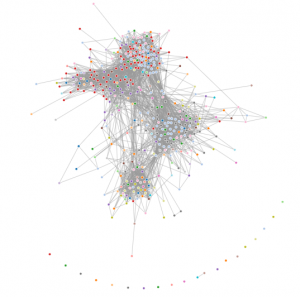
Using socilab.com I was able to gain insight into my social network data and analyze the connections I have through LinkedIn.

Key findings:

  •  When I first went to college, I took a specific program in Sporting Goods Business. This industry is very well connected and networking has been very important. The connections within that hub are very dense, where many of my contacts know each other. Most graduates of the program have left to work in the industry and have kept connected throughout the years, I was not surprised with this data.
  • Geographic clusters: By living in Montreal, Peterborough, Toronto, Ottawa and now Calgary, I have broadened my network throughout the country. Most of the dense clusters are collections of people I know from the specific jobs I had in each of those cities. 
  • Peripherals: Most of the individuals on the outside of my network are people I have met in courses, conferences, and in some cases are unknown to me. Friends and family are also scattered throughout the peripherals as many of them do not share career connections with me.