
Our group teamed up to examine Lynda.com video library. Lynda.com aims to be a platform that provides training in software, creative and business skills (Lynda.com, 2019) and varying skill levels needed to complete the courses.
I decided to examine the effects of cognitive load theory on this medium to help me to evaluate and better integrate Lynda.com resources into the learning environment as a “sort-of” flipped classroom, as a curated resource for assignments and projects, and suggest it as a resource to find information. In addition to this, the research can also help in creating my own videos.
My initial questions are (might change or become more focused):
What are the types and elements of cognitive load regarding video learning?
How can we make the videos better for learning to address the issues of cognitive load?
Does the design of the Lynda.com videos and courses follow the research on how to reduce cognitive load, promote active learning and engage students?
- Length – How does the length of videos and learning events impact learners’ experience?
- Style of the videos
- Different types of content in learning (declarative, procedural)
- Interactivity (such as questions, multiple choice questions, challenges)
- Balance of audio and visual element
I am also interested in how is learning assessed in Lynda.com and how effective is having Lynda.com tutorials/videos embedded within a learning experience? However, they might be better for another research.
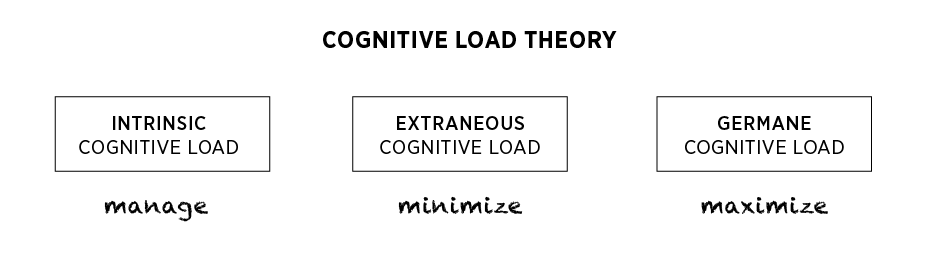
According to Mayer and Moreno (2003), meaningful learning requires that “the learner engage in substantial cognitive processing during learning, but the learner’s capacity for cognitive processing is severely limited” (p. 43). Bradford (2011) cites Mayer (2005) to define cognitive load: “the load imposed on working memory by information being presented” (p. 217) and also describes cognitive overload which can occur when “the degree of mental effort exceeds processing capabilities” (Bradford, 2011, p. 217). Kruger and Doherty (2016) described the components of cognitive load based on the cognitive load theory:
- intrinsic load, which is inherent to the subject,
- extraneous load, which are the facets of “the learning experience that impose cognitive effort and interfere with learning” (Kruger & Doherty, 2016, p. 20), and
- germane load, which is the cognitive activity that is required for learning to take place.
The main goal of instructional design in learning is to reduce the extraneous load to avoid cognitive overload and at the same time maximize the cognitive capacity of germane load to help the learners to reach the learning outcomes (Kruger & Doherty, 2016).
Illustration is created by the author.
References
Bradford, G. R. (2011). A relationship study of student satisfaction with learning online and cognitive load: Initial results. The Internet and Higher Education, 14(4), 217–226. https://doi.org/10.1016/J.IHEDUC.2011.05.001
Kruger, J.-L., & Doherty, S. (2016). Measuring cognitive load in the presence of educational video: Towards a multimodal methodology. Australasian Journal of Educational Technology. Retrieved from https://repository.nwu.ac.za/bitstream/handle/10394/24668/2016Measuring_cognitive.pdf?sequence=1
Lynda.com. (2019). About Us | lynda.com. Retrieved April 18, 2019, from https://www.lynda.com/aboutus/
Mayer, R. E., & Moreno, R. (2003). Nine ways to reduce cognitive load in multimedia learning. Educational Psychologist, 38(1), 43–52. https://doi.org/10.1207/S15326985EP3801_6