

In an attempt to map my current use of digital technology viewed in figure one, I researched several sources. These sources debated the difference between Digital Native and Digital Immigrants vs. Visitors and Residents typology. My personal life experiences define which research I supported.
I researched Marc Prensky’s Digital Natives, Digital Immigrants part-one, comparing the differences. These two terms were defined by computing competence and age. He referred to, Digital Natives as our students today are all “native speakers” of the digital language of computers, video games and the internet (Prensky, 2001). He indicated, those born after 1980 fall into his Digital Native category. His theory would classify my son as a Digital Native, who is born in 1992. It is just the contrary, my son is not computer literate, and he has no passion for being apart of social or professional digital platforms. He is a young man working in the trades industry, just completed his red seal. He purchased a hardcopy codes book to study for his final exam. Nothing he sets out to do is seen as a Digital Native. He believes in face-to-face relationships, where he is found delivering public speaking engagements for his community. Prensky also pointed out, those of us who were not born into the digital world (pre-1980) but have …become fascinated by and adopted many or most aspects of the new technology are, and always will be compared to them, Digital Immigrants (Prensky, 2001). Prensky highlights that Digital Immigrants will reach for a how-to manual vs. Google Search platform.
Dave White allowed me to see his research as a continuum of “Visitors’ and ‘Residents’ as a replacement for Prensky’s much-criticized Digital Natives and Digital Immigrants (White, Le Cornu, 2011). White indicates, “Individuals who most closely fit the Visitor approach give a number of reasons for not wanting a ‘digital identity’, which would persist in some form when they are not online (White, 2011). He also went on to define, their residency is an additional layer of interaction and activity. When Residents log off, an aspect of their persona remains (White, 2011). My son and I can be visitors regardless of our age, and we could develop transferable skill across diverse platforms to become computer literate, when having the desire and need to. I see Visitor as a subset of Resident, which will extend the technical skills required to grow confidence and abilities to maneuver through Resident platforms. After exploring Dave Whites video describing the visitor – resident typology, this provided me what to consider when plotting out my social media map.
Figure 1. My Visitors and Residents Typology Map
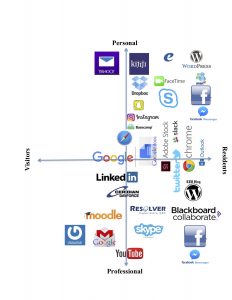
The development and expression of my visitors and residents conceptual map is a reflection of my current social and professional media toolbox. I am surprised with the outcome, and I would have never thought how large my social media toolbox has become. My conscious intention to duplicate some platforms for privacy and protection provides that wall between my personal and professional life. My most active digital identity is Skype, I have lived in four provinces, not allowing me the convenience to bond with my family, friends, past colleagues and cohorts.
References
Prensky, M. (2001). Digital natives, digital immigrants part 1. On the Horizon, 9(5), 1-6. doi:10.1108/10748120110424816
White, D. (2013). Just the mapping. [Video file]. Retrieved from https://www.youtube.com/watch?v=MSK1Iw1XtwQ
White, D., & Le Cornu, A. (2011). Visitors and residents: A new typology for online engagement. First Monday, 16(9). doi:http://dx.doi.org/10.5210/fm.v16i9.3171


Hi Rachelle!
I really liked your summary of Prensky’s 2001 article and comparison to the White, Le Cornu 2011 article. The Prensky article does make seem to make the labels a little too broad and segregated. As in your example, your son would technically fit Prensky’s definition of a native yet he doesn’t interact online.
It looks like a lot of the tools you use are very interactive, which is most likely why you identify more as a resident. I was surprised to see that even YouTube was closer to the middle. Adding video content is fantastic and I can see that coming in handy as we continue in the MALAT program.
Alastair, it is great hearing back from you. I do apologize for my delayed timeline to reply to you. This is due to my lack of experience to navigate WordPress, understanding how to accept to post you’re to respond you. Many times feel I fall into Prensky’s definition of a digital immigrant. I am on a learning curve right now, thank you for your patience. He highlights, “those of us who were not born into the digital world but have, at some later point in our lives, become fascinated by and adopted many of most aspects of the new technology are, and always will be compared to them, Digital Immigrants” (White, Le Cornu, 2011). As I read and connect with who each of our cohorts are, some have had opportunities to incorporate technology much earlier in there lives. I have not had many of these opportunities to work in a digital world, and my desire forges on to play catch-up to process how and why to utilize each new piece of digital technology.
My map may show a more substantial user and presence in a digital world, and this is only due to most recent events. I created much of my resident side through my last program at Royal Roads University. I looked at Linked In more seriously, knowing I was completing my International Hotel Management program and I needed to build my professional profile and contacts (who was my target market) seeking employment. My new employer imposes new digital technology I work through five or seven days a week (Depending what kind of fires I am putting out). YouTube is something our resort is playing with to market executive Chef and his incredible passion for food and community it grows in. I do classify myself very green, but very determined to explore, utilize with each day’s frustrations of high and low to will become increasingly more confident.
Definition
White, D., & Le Cornu, A. (2011). Visitors and Residents: A new typology for online engagement. First Monday, 16(9). pp. 1–10.
Hi Rachelle,
Thank you so much for sharing your perspective on Prensky’s and White’s views and relating that to your son. Your son is a very good example how one cannot categorize people. Another good example would be my husband. Although he was fighting to stay away from using a cell phone for the longest time, he cannot be categorized under the “digital immigrant”. He is very tech savvy and actually has enlightened my kids on a few things when it comes to technology. He is very comfortable with using CRMs, posting and commenting on fishing boards as well as tweeting to Jim Carrey.
I was very impressed with your use of technology and the number of apps and platforms that you use. I realized that I had forgotten a platform on my own mapping – Moodle! I noticed that you had a tool called “Resolver” on your mapping. Can you please enlighten me on how and when you use that one? I am not familiar with that platform/app.
Joyce, it is great hearing back from you. As I indicated above to Alastair, I also want to extend an apology to you. I do apologize for my delayed timeline to reply to you. This is due to my lack of experience to navigate WordPress, understanding how to accept a post and to respond. Joyce, what a great point you made about your husband picking up the cellphone technology much later than the norm and has not migrated into Prensky’s theory of what a Digital Immigrant is. Sounds like he can give me some twitter pointers. Having these theory’s available in today’s active and demanding global marketplace, if there are new positions to be filled, these perceptions and theory’s will employ millennia’s over those that fall into a Digital Immigrant category. Some theories can do more damage than good. This would bypass valuable talent, knowledge and skills that are also a fit for the job. As Catherine pointed out the value of participatory culture has no age (Native vs. Immigrant), knowing who is our target audience is, we can balance privacy and informal membership and still achieve strong support for creating a digital sharing environment (Cronin, 2017 Virtual Symposium).
When I updated my Linked In, I was conscious of the dates I was making public. Again, years that go back to the Digital Immigrant times may exclude me from consideration for employment. Being a lifelong learner will always provide a different dated perception of age, capability and employability.
Joyce, Resolver is a platform our resort is just starting to set up. We will be utilizing it for investigation for incidents and accidents, security, health and safety, as a reporting tool, WSIB, and is designed to back us if use for legal purposes. Our resort living community is still under constructions, we will have 3,000 residents, 800 room hotel, 50 retail outlets, 1,000 boat slip marina, 18 golf and much more. I can set-up Resolver to design internal training for each of our departments.
Reference
Cronin, C. (2017, April). Open culture, open education, open questions. Presented in the Virtual Symposium of the 2017 MALAT Program at Royal Roads University, Victoria, BC, Canada.