
The example I’ve chosen to explore is related the a particular trend that I’m particularly interested in. In interested in how businesses and organizations are able to take advantage of the possibilities of online learning. I live in the Northwest Territories, which is especially challenged by the need to serve a citizenry that is scattered across an immense territory. Being relatively underdeveloped, there is very little road access. The majority of the population is located in Yellowknife, while the rest of the population is dispersed among two dozen very small communities across the territories. In the majority of cases, access is provided only by air travel.
The case I have chosen is one that I have discussed with my colleague who who has worked closely with Elections NWT, who are responsible for managing the logistics of territorial elections every three years. As with all Canadians, every citizen in the territory must be provided an opportunity to vote. Therefore, Elections NWT had been beset with substantial costs in fulfilling their responsibility to train voting station officers. Candidates were often flown in to Yellowknife from remote communities, at exorbitant costs. However, Elections NWT has since potentially largely not only significantly reduced costs by now providing training online, but has also very much improved their ability to provide training.
This example is a representative case of what kind of leadership is required to recognize and seize opportunities of this kind. There is considerable discussion of the attributes of “admired” leaders. According to the study by Kouzes and Posner (2011), “forward-looking” was the second more admired attribute after “honest.” The remaining of the next ten or so attributes were mostly personal qualities, highlighting a distinction noted by Mahmood et al. (2012), who argue, “Management and leadership are two overlapping terms which confuse many people. Leadership and management are complementary for each other and they go hand in hand” (p. 513). Leadership is often defined in management terms, such as Northouse (2007), who stated that it can be understood as a process where influences towards accomplishing certain objectives or achieving a common goal. But the opportunity under consideration here is not managing an organization towards a decided task, but that of showing the leadership necessary to recognize the opportunities at hand. A leader, explains Winston (2004), is one who can ensure that the organization is evolving in the right direction (as cited Al-Haddad & Kotnour, 2015, p. 239). “The continually changing business environment,” add Al-Haddad and Kotnour (2015) “needs quick responses that only a leader can provide. And it is the leaders who have to make the right decisions at the right time to align the organization with the changing environment, and who motivate the people to work and implement the changes” (p. 239).
The key quality exemplified by Elections NWT was their openness to innovation, and their willingness to consider alternatives to the status quo. It would also have required an on-going effort to remain apprised of available technologies. It is a rare case for organizations to be aware of the affordances of elearning in particular, and to understand what advantages it can offer their organization. In this case, Elections NWT learned of these possibilities through contact with other government departments undergoing similar adjustments. Leaders have to be motivated to seek change, but they must also have the passion to see it through. Essentially, a leader has to be intrinsically motivated to want to improve their organization, and excited about looking for those opportunities that can help them accomplish such positive changes.
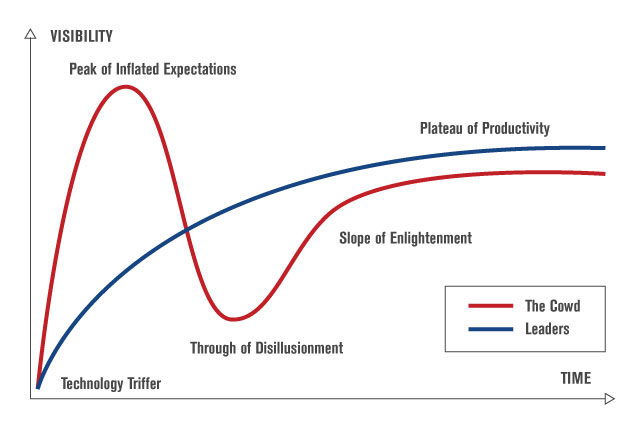
Therefore, a visual illustration which I feel speaks directly to this challenge is n adjustment to the Gartner Hype Cycle diagram. The chart shows the peaks and valleys from excessive exuberance to a pendulum swing to unwarranted pessimism, that typically accompanies expectations about the transformative possibilities of technology, until it is finally widely adopted. A leader in this day and age must have the stillness of mind to see through the whirlwind of hype. He or she mustn’t be anxious to adopt change simply because “everyone is doing it.” He or she has to have the sagacity to take the time to analyze the nature of available innovations, and calmly seek advice from experts in the field, to determine if an opportunity for change is appropriate. So, as much as the Hype Cycle represents a predictable outcome, a leader today must have the vision to see beyond the waves of popular sentiment, and anticipate the “plateau of productivity,” long before others do.
References
Al-Haddad, S., & Kotnour, T. (2015). Integrating the organizational change literature: a model for successful change. Journal of Organizational Change Management, 28(2), 234-262.
Kouzes, J., & Posner, B. (2011). The characteristics of admired leaders. In Credibility : How leaders gain and lose it, why people demand it. San Francisco, Calif.: Jossey-Bass.
Mahmood, Z., Basharat, M. and Bashir, Z. (2012), “Review of classical management theories”, International Journal of Social Sciences & Education, 2(1): 512-522.
Northouse, P.G. (2007), Leadership Theory and Practice, 4th ed., Sage Publications Inc., Thousand Oaks, CA.