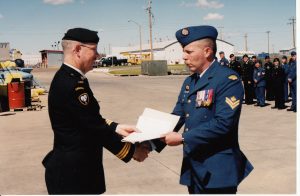
My approach to leadership is grounded in my experiences as a military member. Leading a section during Peacekeeper Operations had the most profound impact on my understanding of the term leadership. I took these lessons learned as a Section Commander with me to my subsequent careers to model the leadership attributes of care, personal integrity, fairness, and courage. Rarely have I seen a change in a work context significantly alter my perception of an effective leadership approach. I have seen leadership strategies in many contexts, (military, business, education, and the trades). I cannot prescribe to a specific theory that would determine success across disciplines as every leader I thought exemplary has had a different style. My leadership philosophy is derived from my military culture where personal integrity, competence, and care and consideration for others outperforms any other attribute or expressed theory. The one thing good leaders seem to share is the ability to build capacity in others. As articulated by Peter Senge, “the people in our lives that influenced us are in all kinds of roles” (Sarder, 2015). Leaders enable coach, mentor, and discipline to develop a trust relationship. Military leadership doctrine defines trust as an important part of a leader’s job and it is developed through one’s decisions, actions, and interactions. (Her Majesty the Queen in Right of Canada, 2005). It took considerable time for me to fully appreciate the importance of developing trust as a defining characteristic of my ability to lead. How does this impact my current work?
Digital technologies haven’t significantly changed how I lead in a classroom. They have however changed the nature of communications as my current students demand less formal multiple channels which have both aided and detracted my ability to disseminate information. Information is readily shared but requires continual scanning by the user and repetition from the sender. Sheninger (2014) explains “Digital leadership is about engaging all stakeholders in two-way communication.” Asynchronous digital communications have changed the game and one solution is an adaptive leadership style to respond to the pace of change afforded by the technology. Leaders need to “delegating responsibilities, and including followers in the analysis and decision-making process” (Khan, 2017). Flexibility is required to make use of a multitude of the plethora of technology choices to employ and support in the classroom. While somewhat inclusive adaptive leadership doesn’t quite go far enough in responding to the complexities of digital environments as it still maintains a clear separation between leader and followers.
Distributed leadership, however, is well suited to leading in a digital learning environment. The nature of the digital environment necessitates an alternative approach to leading it. The growth of digital learning networks and collaborative partnerships naturally mandate a distributed approach. Harris & Spillane (2008) point out “In the increasingly complex world of education the work of leadership will require diverse types of expertise and forms of leadership flexible enough to meet changing challenges and new demands. (p. 31). It makes good sense to distribute the leadership function across multiple stakeholders. In my context, the stakeholders are students, instructors, designers, and a traditional hierarchal educational staff structure. A distributed structure closely mimics social media elements in the way it behaves and governs, so I think it’s a natural fit. “Distributed leadership … is a way of getting under the skin of leadership practice, of seeing leadership practice differently and illuminating the possibilities for organizational transformation.”(Harris & Spillane 2008)
No one person can effectively lead a complex institution, and shared leadership responsibilities among the stakeholders is an effective, scalable strategy to meet the present and future challenges. Shared leadership allows for effective succession planning by developing leadership capacity at all levels. My appreciation for a Distributed leadership model is derived from my military experience and despite being an intensely hierarchal institution; it relies heavily on delegating authority. Like a digital learning environment, its complexity and disseminated nature required a flexible leadership tactic afforded by distributed leadership.
References
Harris, A., Spillane, J. (2008). Distributed leadership through the looking glass. Management in Education 22(1), 31–34. doi 10.1177/0892020607085623
Her Majesty the Queen in Right of Canada. (2005). Leadership in the Canadian Forces. Ottawa. Retrieved from http://publications.gc.ca/collections/collection_2013/dn-nd/D2-313-1-2005-eng.pdf
Khan, N. (2017). Adaptive or Transactional Leadership in Current Higher Education: A Brief Comparison. International Review of Research in Open and Distance Learning review of Research in Open and distributed Learning, 18(3), 178–182. Retrieved from http://www.irrodl.org/index.php/irrodl/article/view/3294/4150
Sarder, R. (Producer). (2015). What makes a great leader? [Video file] Retrieved from YouTube https://youtu.be/1aYaj2-GZqk
Sheninger, E. (2014). Pillars of digital leadership. International Centre for Leadership in Education.

February 8, 2020 at 1:09 pm
Hello Lorne, one thing i like about our blogs are the different and interesting perspectives about any given topic. I personally have not served in the military however, my mother works for department of defense and have spent a lot of time living amongst military personnel as neighbor and friends.
They say It’s a lot harder to teach someone traits like honesty, integrity and work ethic than it is to teach them technical skills. In 2016, Jeff Boss, executive coach and former Navy SEAL, summarized this idea of “skill without will” when he told Forbes, “The recipe for success looks like this: hire for character, train for competence, coach for performance. It’s simple, it’s effective, and you won’t go wrong.”
Your perspective and sentiments have a lot of commonality with Jeff Boss, executive coach and former Navy SEAL’s idea of leadership, especially from the military lens.
Though as a civilian I have never been a fan of hierarchy in any environment nevertheless, I understand its efficacy in the military world. I do agree and see the value of an aspect distributed leadership about delegation and empowering the people around you.
Tehreem.
February 9, 2020 at 9:16 am
Hi Lorne,
I enjoyed reading your post and the perspective you bring to thinking about leadership. Your role leading a Peacekeeping Operation would certainly develop or build on your leadership skills and experiences! I agree that “trust” is a foundational pillar of any leadership position, regardless of the context. You have many professional experiences/contexts to verify this observation.
You made the important point that digital learning environments have changed “the nature of communication” with you and your students. I remember in our Team E conversation, speaking to the importance of “communication” in any leadership role. Digital learning environments have changed the nature of communication amongst “leaders-followers”/instructors-students in dramatic ways. As you pointed out, some of this change has “aided and detracted” from how you, as an instructor, disseminate information. Is it the need to often repeat a similar message to students individually, through various email conversations that is one of the detractions for you? Is it occasional connectivity issues? Or the replacement of face-to-face interactions/communication by asynchronous modes of digital communication that are perhaps not as effective in a given context? I am curious as to how digital learning environments can detract from your communication with students. I can see (as I have started to identify above) some ways and I am just curious what those detractors have been for you, as an instructor today. On the positive side, I have certainly heard more from students than I would have otherwise, through asynchronous modes of communication (i.e. video recordings, emails, videoconference).
Distributed leadership models are indeed a natural fit for digital learning environments and the adaptive leadership theory. It seems the digital era has brought many incredible opportunities to learn and communicate, yet it seems the speed at which work-related requests, tasks, and initiatives can be disseminated (i.e. email, text) has sky-rocketed — and I see distributed leadership as a way to manage some of the Fast Communication about important things to get done — yesterday!
Great post. Thanks, Lorne.
Leigh
February 17, 2020 at 7:59 pm
Hi Lorne,
I enjoyed your thoughtful perspective on leadership models, and it connects to something I’ve been wondering about over the past while. I like the idea of distributed leadership models, but wonder how we can effectively implement them in classroom settings when the system is currently hierarchical in nature? As an instructor, I can create space for the students to have more input and agency, and even to choose their assignments (within a framework), but there is still a power imbalance implicit in the fact that I’m the one creating that culture, and that, at the end of the day I’ll be doing the grading. Just curious as to whether you’ve thought about what that distributed leadership can look like in the classroom on a practical, day-to-day level, and wondering whether I’m conflating ‘distributed’ with ‘democratic’ or some other non-hierarchical construct.