Monthly Archives: February 2020

Change Management in Digital Learning Environments

Change.  That word elicits emotions ranging from trepidation to exhilaration.  Change management theories can help leaders in digital learning environments guide their teams through changes, ensuring a successful implementation.  With the speed that technology is advancing, change is the norm rather than the exception. While there is no formula to enable a leader to manage change perfectly, there are tools available to help him or her when the need arises.

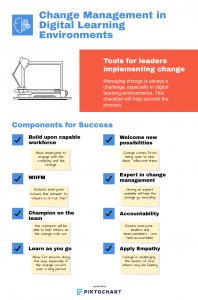
I had the opportunity to discuss change implementation in digital environments with three individuals who have experience with this field.  Two of these individuals work in government and one works in post-secondary.  These conversations contributed to the ideas behind the infographic (figure 1) regarding change management along with literature on the topic, and my experiences with change.

“A good room set-up can’t make the class succeed by itself, but a bad room set-up can make it fail” (Feldstein, 2017, para. 5).  While this quote does not directly address change in digital learning environments, it does connect to it.  Often change is for the best or required due to adjustments in surrounding variables; without a well-planned execution, no matter the value of the change, it can fail.  Digital environments come with added challenges since much, if not all, of the team is inaccessible face-to-face.  If the change is unsuccessful, the effortless choice is to blame the change without looking at each component.  If this occurs, it takes a strong reflective practice to discover what happened.  According to Catelli (2016), reflecting on events can help leaders learn about the people they have on their team, and how events affect their industry (p. 217).  Providing leaders with strong tools to use, including to encourage empathy and learning throughout the process as indicated in the infographic (figure 1), will help provide a good (figurative) room set-up, increasing the probability of successful implementation.

The importance of clear and frequent communication was a common theme in the conversations with those in my network (J. Brown, personal communication, February 21, 2020; K. Mart, personal communication, February 17, 2020; F. Peermohamed, personal communication, February 20, 2020), ensuring its place in my checklist.  Al-Haddad & Kotnour (2015) also believe that communication is key to creating an atmosphere so “content, people, and process [come together to] lead to successful change” (p.244).  By keeping communication open between levels of staff (i.e., top-down and bottom-up), the entire team remains informed regarding the impact of each step on the environment (F. Peermohamed, personal communication, February 20, 2020).  Communication also facilitates answering What’s in it for me? which helps staff members know more about the change, the benefit to them, their work, and their productivity.

Mart and Peermohamed discussed the value of the change model they use, Awareness, Desire, Knowledge, Ability, and Reinforcement (ADKAR) (K. Mart, personal communication, February 17, 2020; F. Peermohamed, personal communication, February 20, 2020).  As they explained this model, I realized that it has a lot in common with Theory O (Biech, 2007, para. 6) as each one focuses on participation between the organization, the leader of the change, and the staff members.  If used in a digital learning environment, these theories encourage team members to work with the change.  Weiner (2009) posits that when team members accept the change, regardless of the reason, they are more apt to accept the transformation.

The team on which Brown is a member does not use a change management theory (J. Brown, personal communication, February 18, 2020).  In listening to her describe what is taking place, I believe the leader applied systems theory (Biech, 2007, para. 3) to implement the digital change across two organizations; also, the team consists of members from both organizations, resulting in change for both systems.  Early in the project, the leader of the team engaged the members in an activity, in a face-to-face setting, which encouraged empathy throughout the project (J. Brown, personal communication, February 18, 2020).  Once the members returned to their home site, the activity connected them and provided the necessary tools to continue the work surrounding the change, following systems theory (Beich, 2007, p. 3).

Leading digital change is a challenging task.  In order to have a successfully implemented change, leaders need to have tools available throughout the process.  Based on my conversations with two leaders of digital change management and one member of an ongoing team experiencing digital change, teams, by nature of the knowledge, skills, and personalities of the members, have differing needs.  It is up to the leader to select and apply the best tools and approaches to ensure success.

Figure 1
References

Al-Haddad, S., & Kotnour, T. (2015). Integrating the organizational change literature: a model for successful change. Journal of Organizational Change Management, 28(2), 234-262. Retrieved from https://doi-org.ezproxy.royalroads.ca/10.1108/JOCM-11-2013-0215

Biech, E. (2007). Models for Change. In Thriving Through Change: A Leader’s Practical Guide to Change Mastery. Alexandria, VA: ASTD

Castelli, P. A. (2016). Reflective leadership review: A framework for improving organisational performance. The Journal of Management Development, 35(2), 217-236. doi: http://dx.doi.org.ezproxy.royalroads.ca/10.1108/JMD-08-2015-0112

Feldstein, M. (2017, May 28). A flexible, interoperable digital learning platform: Are we there yet? [Blog post]. Retrieved from https://eliterate.us/flexible-interoperable-digital-learning-platform-yet/

Weiner, B.J. (2009). A theory of organizational readiness for change. Implementation Science, 4(67). doi: 10.1186/1748-5908-4-67

Leading Change

Change is a constant in every setting.  Work.  Education.  Personal.  Change affects every aspect.  It each circumstance, someone is leading the change; in professional settings it is typically the leader (i.e., boss) or someone who feels passionately about the change (i.e., a team member).

The theories discussed in this week’s readings, specifically those mentioned by Biech (2007) can help lead the ever-changing environments.  Even though Biech published these theories in 2007, I think they still apply to what we have today.  Biech’s (2007) Complexity Theory specifically seems appropriate for our current environment since it address the interlocked nature of many realities converging in one situation.  I do not think that we need new theories since our environment is different than it was at the time of creation of the current theories.  It is our responsibility to find ways to implement the existing philosophies and apply them now.  The number of theories would become uncontrollable if we created a new one for every environmental change!

I do not have much leadership experience, but I have been on several teams with both good and bad outcomes for change implementation.  The idea of change readiness (Weiner, 2009, p. 4) as always intrigued me, but I did not know how to encourage that readiness on a team.  My current organization does not spend much time or effort on change readiness; as a result, the announcement of changes come as gospel.  It makes it much harder to accept changes when they appear in an instant rather than having some time to ask questions and become familiar with the new idea.  If I ever take on a leadership role, I would like to remember to implement readiness techniques when change is on the horizon, while understanding that it is not always possible, especially if I become a leader within my current organization.

As this program focuses on digital environments, I often find that I take face-to-face experience and imagine a digital equivalent.  When it comes to change management and leadership in the digital world, I think that it is that much more important than in the face-to-face world.  Communication is key when managing any change, when that change is happening in a digital environment it is critical.  Digital environments come with the complication of missing facial expressions and tone.  In order to manage change, leaders need to create an open environment where team members can discuss the upcoming change(s).

“Some of the most promising organizational changes … require collective, coordinated behavior change by many organizational members” (Weiner, 2009, p. 6).  This statement is true in all environments, digital or not.

References

Biech, E. (2007) Models for Change. In Thriving Through Change: A Leader’s Practical Guide to Change Mastery. Alexandria, VA: ASTD

Weiner, B. J. (2009). A theory of organizational readiness for change. Implementation Science, 4(67).

Attributes of a Leader

“Wisdom is the capacity to think through the consequences of decisions; reflection causes the activity of thought to occur” (Ackoff as cited in Castelli, 2016, p. 220).

Reflection is becoming more and more common in today’s society, as it allows individuals to consider events, lessons learned, and how the experience will affect future actions.  While reflection is particularly useful for students, we can all apply it as part of our day-to-day lives as lessons occur long after we leave formal educational settings.  I have found that leaders appreciate personnel who can apply a reflective practice, but what I have not seen as much are leaders who lead by example and implement reflection as part of their role.  As a team member, I appreciate it when a leader can look back on an event and consider what went well and what needs improvement.  Castelli (2016) defines reflective leadership as “the consistent practice of reflection, which involves conscious awareness of behaviours, situations and consequences with the goal of improving organizational performance” (p. 217); therefore, reflective leadership does not only affect the leader as a person, but it also has an impact on the organization.  After reading the assigned articles this week, I find that I can connect with the reflective leadership theory both as a non-leader (currently) and as a potential leader (future), in synchronous and asynchronous environments.  As changes are commonplace within digital environments, adopting a reflective practice can only help leaders to navigate the changes with those on the team.

Digital environments require strong leaders, though it seems that the assumption in society is that digital environments can make do with any strength of leader.  Leaders in digital environments have a much larger space in which to lead their teams and those spaces are continually changing (Sheninger, 2014, para. 6).  As these changes come, leaders must be able to manage those changes while still creating a positive environment for the learners or team members.  Fortunately, there are theories that can help.

The leaders I have admired the most are those who can take situations and find the best solution in the moment, while involving the team as much as possible.  I know that accomplishing that is not always feasible, but as a member of the team I feel valued when the leader takes the time to find out if I have any ideas.  In my experience, the only leaders who are able to take that step are those who are comfortable in their role and have a good relationship with the team.  These attributes are components of reflective leadership.

A recent activity asked me to rate attributes of leaders; here are the top five attributes I think a leader should have: competent, caring, honest, dependable, and fair minded.  As I read the articles, I realized that many leadership types can have these attributes which tells me that leadership theories and styles can blend depending on the leader and what he or she feels is important.  As I further consider the above listed attributes, I realize that most professionals have them.  That idea makes be wonder why everyone cannot make a good leader.  If one has the attributes of a strong leader, would that not automatically make them a strong leader?  Sadly, in my experience, the answer is no.

In order for leaders and followers to have the required relationship to make an organization run (either business or education), they need to have a shared goal.  Khan (2017) introduces the idea of transactional and adaptive leadership theories (p. 178).  I think that in a digital learning environment, it is best to follow the adaptive theory.  So much of online work relies on relationships and adaptive leadership allows leaders to utilize those on the team to keep the processes that are working and adopt changes for those that are not.  Khan states “[no] leadership theory can address all required actions in contemporary education institutions, but that adaptive leadership is flexible, takes into account current complexities, and is highly motivating for followers” (Khan, 2017, p. 182).  There is no all-powerful way to be a good leader.  Leadership is a work in process and the style or theory adopted by the individual can change depending on the team members or the set tasks.

References:

Castelli, P. (2016). Reflective leadership review: a framework for improving organisational performance. Journal of Management Development, 35(2), 217-236.

Khan, N. (2017). Adaptive or Transactional Leadership in Current Higher Education: A Brief Comparison. The International Review of Research in Open and Distributed Learning, 18(3).

Sheninger, E. (2014). Pillars of digital leadership. International Centre for Leadership in Education. Retrieved from http://leadered.com/pillars-of-digital-leadership/