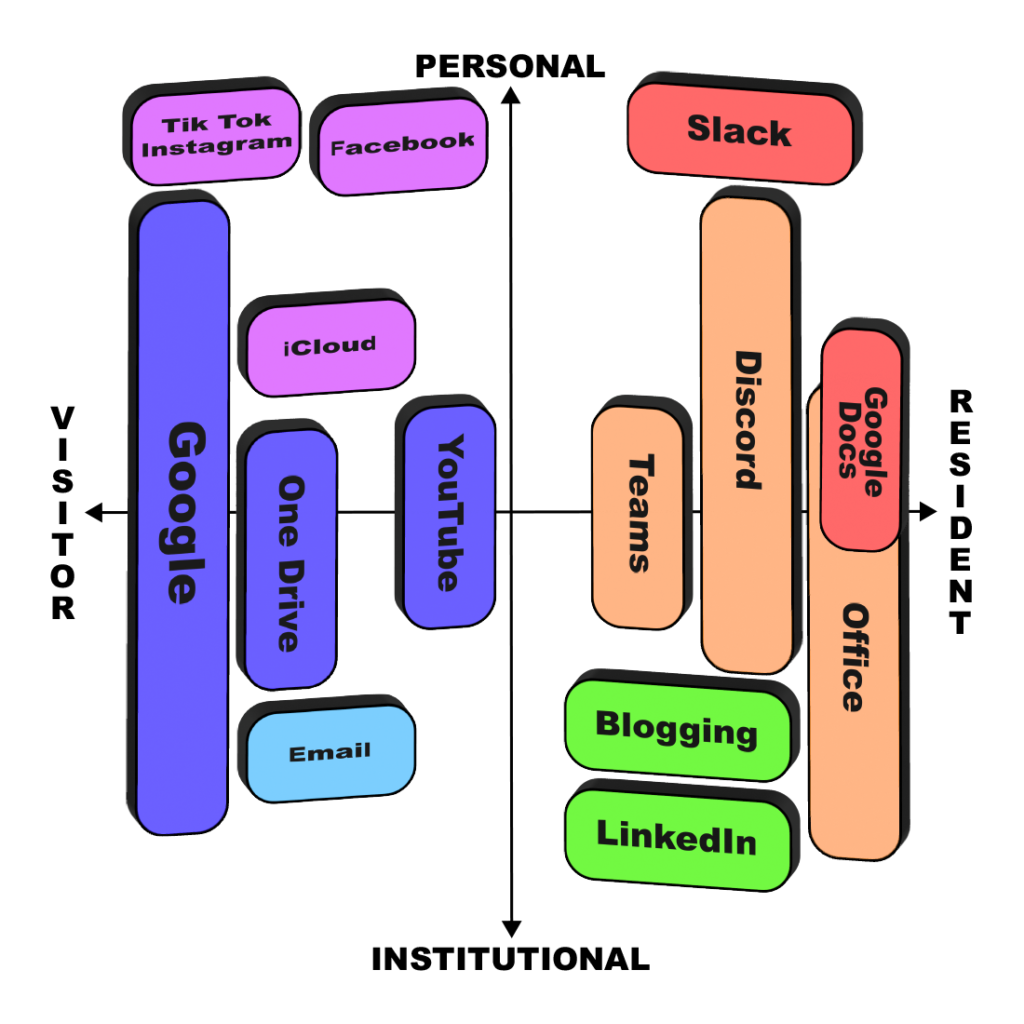
I was recently asked to develop a map that represents my digital presence in terms of visibility and motivation. The method that resulted in the grid you see above was presented to me in a video posted on YouTube by Dave White (2013). The grid represents a cross-section of continua. Those entries on the far right, labeled “resident”, represent the platforms upon which I’ve left some kind of evidence accessible to others… those on the far left, labeled “visitor” are those platforms I use frequently but have not added to the publicly available content. The vertical continuum, represents the difference between those platforms I use for my own motivations, labeled “personal”, and those I use either for work or my digital academic identity, labeled “institutional”.
After completing this activity I was surprised by the number of platforms upon which I create content quite frequently. I don’t really think of myself as someone who has much of a digital footprint. While I make use of social media quite often, I treat it more as a source of entertainment than as a method of interacting with people. However, I do see that if one were to make an effort to look for evidence of my interactions online, there would be a fairly significant footprint. With that in mind, I’m more motivated to consciously manage my identity online and to present a more consistent image to the public.
References
White, D. (2013, September 13). Just the mapping [Video]. YouTube. https://www.youtube.com/watch?v=MSK1Iw1XtwQ
It is an interesting topic about managing your footprint. Personally I shy away from having a footprint in public spaces, but I feel like this might change during the program. Do you think you have more of a digital footprint after going through the MALAT program, even outside of the MALAT blogs?
That’s an interesting question Heather. Certainly, if you include the blog, then yes. If we’re thinking outside the blog, I’m inclined to say no. I did try Twitter briefly as recommended by this program, but I really dislike it. I think the format of microblogging isn’t conducive to deep thinking and thoughtful communication. I’m probably slightly more visible on LinkedIn than I was previously, but I’m not super sure that would be different if I hadn’t pursued the MALAT. But, you’ve certainly got me thinking about it!
Hi Christopher, thanks for sharing! Are you comfortable with the footprint you currently have? Do you think that this program has shifted where some of technologies reside? Has the pandemic caused any major shifts? Thanks!
Hi Tim. Thanks for taking the time to read my post and share your thoughts. Yes, I think I’m pretty comfortable with it. I’ve long ago come to terms with the idea of digital surveillance and understand that everything I put on the internet is permanent, so am always conscious about what I decide to upload… so I’m fairly confident that what evidence of my existence online hopefully won’t come back to haunt me. We’ll see!
As far as the shifting of the positioning of some of my entries as a result of MALAT… yeah, probably. When I was responding to Heather above, I didn’t remember that it was Patrick, below, that introduced me to Discord at the beginning of the program. I’ve grown to really like the platform and have integrated it into lots of my personal and work practice. I’m a big fan. The pandemic too has forced a shift that’s required me to communicate with individuals online where I used to speak to them face-to-face. So, definitely a pretty big change.
Great questions! Thanks again for your input.
I would agree with that. The MALAT program has encouraged me to use my blog, but I don’t particularly like twitter. The shortness and immediacy of the messages on twitter would lead me to text the world my “at the moment” thoughts which I don’t always think need or should be shared. As such, I have not adopted twitter.
Agreed, my friend. Many of my “at the moment” thoughts are better off forgotten. I’m very frequently grateful that these platforms didn’t exist when I was a teenager and had not developed any kind of impulse control.
Hi Christopher.
Your map is really well done; what program did you use to create it?
I also see that “Discord” is both in your personal and professional space in more of a ‘resident’ area. I’m pretty new to chat platforms; how do you use Discord in your professional sector? Is it in place of, say, email? Does it function like a ‘casual’ business chat?
Hi Terry, that’s very kind of you to say. I used Adobe Illustrator to build it. They just released a new tool with the most recent update that allows you to make three-dimensional extrusions on a shape, so I thought I would give it a try. You can then also manipulate the shape’s rotation in 3D space, which is pretty neat. I like how it turned out.
As far as Discord is concerned, I’m a big fan. Like I mentioned in my response to Tim’s comment, it was introduced to me through this program and I immediately liked it. I use it in at least three different contexts. First, as you know, to communicate with classmates in the program as a community building space that enhances our learning. Second, as a source of entertainment, I interact with groups that I follow that have communities on the platform. And third, I introduced the platform as a communication tool for the program in which I taught until very recently. Communication during the pandemic was tricky and we needed a space to interact with students as a community builder. Discord is perfect for this as it has the powerful communication tools like Teams and Slack, but has a more casual culture to it that young people gravitate toward. I don’t teach in that program any longer, but they’re still using the platform. The question is whether or not they’ll continue to use it once face-to-face classes resume in September. That will be interesting.
If you’re interested… and I know you already have a ton of reading to do… I wrote a paper on identity development in a community of inquiry and Discord came up in that investigation. You can access that post here… https://malat-webspace.royalroads.ca/rru0162/category/lrnt526/
Interesting post and comments. As I read through the various digital presence maps, I have started to wonder if the “visitor vs resident” labels from White & Le Cornu’s (2011) typology might be replaced with “consumer vs creator?” It strikes me that, at least in some respects, almost everyone is an online resident–it is just that we play different and varying roles within that ecosystem depending on the context. To extend this slightly, we are all a kind of creator in that no matter what our activity, our searches are logged, our shopping patterns noted, our reactions to advertising and various other click-bait monitored, etc. While this may not be the kind of participatory web the readings focus on, it is still a kind of participatory input.
Really makes me think about a biological ecosystem and its various levels of inputs and consumption.
Hmm…need to think about that a little further.
References
White, D. S., & Cornu, A. L. (2011). Visitors and Residents: A new typology for online engagement. First Monday. https://doi.org/10.5210/fm.v16i9.3171
Yeah, I agree with that completely. As White and Le Cornu (2011) also mentioned in this article, the range between Visitor and Resident is a continuum, as presented in the graphic at the top of the page. I think it would be a rare find to meet someone who identifies as strictly Visitor or Resident. In practice, as you mentioned, the vast majority of people will find themselves somewhere on the continuum, and as White or Le Cornu went on to say, that they will likely shift positions depending on the context of the task at hand.
Consumer and Creator is another good set of labels… and this is definitely how I picture the concept in my mind (falling back again on my media background).
Finally, you make an interesting point about the data we leave behind when we interact with the internet. I agree that I don’t think this is what White and Le Cornu (2011) had in mind, but we absolutely do leave a trail of breadcrumbs behind. We could talk for hours about the positive and negative outcomes associated with the tracking of this data. For another day, perhaps.
White, D. S., & Le Cornu, A. (2011). Visitors and residents: A new typology for online engagement. First Monday, 16(9). https://firstmonday.org/article/view/3171/3049