

This infographic, created by Sandra Norum, Christopher Rowe, and myself, identifies some of the potential impacts DLE can have on teachers.
Please click on ‘+’ within the image to read more about each impact.
This infographic, created by Sandra Norum, Christopher Rowe, and myself, identifies some of the potential impacts DLE can have on teachers.
Please click on ‘+’ within the image to read more about each impact.
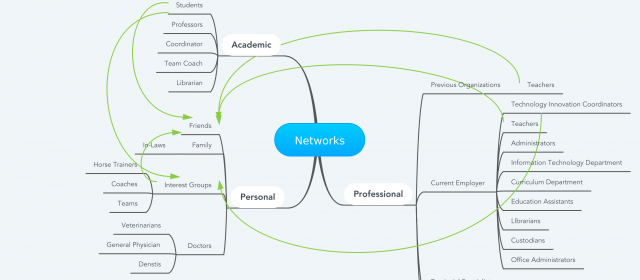
Figure 1– My Visual Network Map
This visual network map indicates my social connections in my personal, professional, and academic networks. My network includes digital and in-person groups as well as close and distant groups.
I used MindMeister to build my network map, Figure 1. I used Dron and Anderson’s (2016) definition of networks as unstructured, informal connections. They also define a group as a finite number of individuals defined by rules and purpose (Dron & Anderson, 2014). For this visual network, I identified groups of people through positions or titles rather than using names. I did this to protect identities as permissions were not granted. Groups are represented by the node and title. The connections within groups are represented by the black lines and the inter-group connections are represented by the green arrows. I situated myself in the center of the graph as that was the focus of the assignment and am the base of the connections represented.
There were some drawbacks to not representing individuals. Firstly, while members within a network are fluid, this is not represented in my visual network map, as individuals are grouped. Secondly, because I do not represent individuals, but groups, there is a seeming hierarchy of size and importance. Whereas, in actuality, many individuals are of far greater importance than groups. With more resources and time, it would be interesting to create a more microscopic version of this map. I would also be curious to see network maps represented over a span of time to demonstrate changes over that time.
References
Dron, J, & Anderson, T. (2014). Teaching Crowds. Athabasca University Press.
As I am simultaneously completing my final project for the MALAT program, I have approached this task as a reflection of my digital presence and identity. I will reflect on my original goal, the approach I took, the skills I acquired (or should have acquired), and an evaluation of my success.
At the outset of my journey in the MALAT program, I had grandiose plans of using the blog to build my digital presence in an academic sense. This goal aligns with Dron and Anderson’s (2014) idea of building a web of connections and learning from those within those connections. However, as the program persisted, my time decreased. Still today, there sits several drafts on my WordPress site waiting for me to complete and publish. Being able to share in academic, informal discussions online is still a goal, one I hope to develop once this program is complete. I find the ability to access various perspectives and experiences in the education field is not something to be squandered.
Some skills I have developed on this journey could be described as a tougher skin. In actuality, this is more of an appreciation of critical discourse and the ability to adjust my practice according to new, academically supported ideas (Dron & Anderson, 2014). Over the past two years, I have become more comfortable and less self-critical of sharing my ideas online. I also value the opportunity to build my digital capacity in various tools (Beetham, 2015). But, as we all know, the tools change and we need to keep learning.
As part of recognizing my growth, is also the recognition of success. Firstly, my evaluation of success depends on my personal goals. I value and feel I have met goals such as “social capital” (Tsiplakides, 2018; Dron & Anderson, 2014) and building a collective (Dron & Anderson, 2014). There are also professional goals, in my role within a BC School District I need to model the capabilities and value in a positive digital presence (Lowenthal et al., 2016). Therefore, I hope to transfer my RRU blog to a professional, public blog in order to continue the professional dialogue and community.
Beetham, H. (2015, Nov 10). Building capability for new digital leadership, pedagogy and efficiency [blog post].
Dron, J, & Anderson, T. (2014). Teaching Crowds. Athabasca University Press.
Lowenthal, P. R., Dunlap, J. C., & Stitson, P. (2016). Creating an intentional web presence: strategies for every educational technology professional. Techtrends : Linking Research and Practice to Improve Learninga Publication of the Association for Educational Communications & Technology, 60(4), 320–329. https://doi.org/10.1007/s11528-016-0056-1
Tsiplakides, I. (2018). Social Inclusion and Equity in Modern Information and Knowledge Societies. Journal of Sociology and Anthropology, 2(1), p.9-13. doi: 10.12691/jsa-2-1-2.
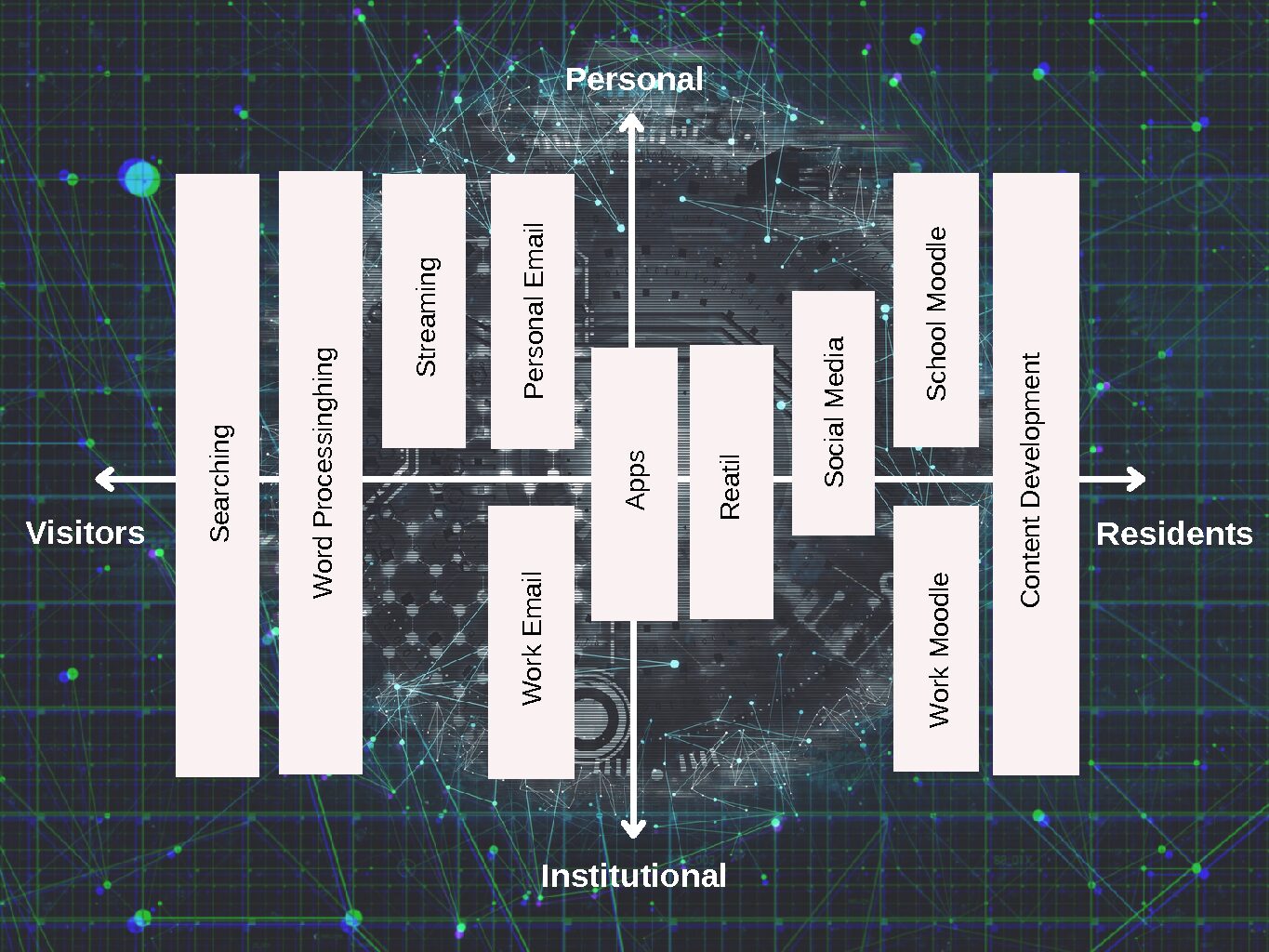
This map of my technology use follows White (2013) strategy for reflecting on the technologies Canva. White’s process asks that technologies are plotted on a graph. The x-axis marks where on the continuum the technology falls between “visitors” and “residents”. These terms are used by White to identify the degree to which our digital footprints remain after using the particular technology. The y-axis of the graph measures whether the technology is used in my personal or professional life. Together these present a visual of our technology.
For this process, I labeled the technology by its purpose and not by the specific tool or site. For example, I have a social media block. However, this block includes tools like Facebook, Snapchat, Discord, BaseCamp, Instagram, and Twitter. My reasoning for not identifying specific tools was that the specific tools I use change frequently. Additionally, I noticed that for most tools, I have separate accounts for my personal and professional tasks, except for social media. This is because I often use social media in my own time to follow trends and participate in informal conversations with fellow professionals.
White’s exercise in mapping our technology use is important in identifying how technologies are used personally and within an organization and reflecting on the footprint the use of each technology leaves behind.
White, D. (2013, September 13). Just the Mapping [Video]. Youtube. https://youtu.be/MSK1Iw1XtwQ
I enjoyed the opportunity to view several presentations at the MALAT Virtual Symposium. This Symposium provided an opportunity for me to reflect on the journey through the MALAT program, as well as to set new goals and directions for the future. The noteworthy points were the CANeLearn discussion about Online Learning, the interdisciplinary aspects of the field of educational technologies, and the discussion of pedagogy and the research process in a thesis project.
I was surprised by Crichton and LaBonte’s (2021) involvement with CANeLearn. Having been an Online instructor in K to 12 public schools for 8 years, I have encountered LaBonte during the annual DL Symposium and through Knowplace Moodle hosting site. In the process of the MALAT program, I have had to build silos around my professional and academic tasks in an effort to allocate time for each. However, hearing his discussion with Crichton and LaBonte acted as a reminder of the academic persuasion within the professional context.
The ideas that were intriguing to me were the interdisciplinary aspect of educational technologies and instructional design (Palahicky, Boyce, and Jones, 2022). This appealed to me when applying to this program and this presentation acted as a good reminder of the benefits of an interdisciplinary field. It is beneficial to be able to draw from a wide variety of disciplines as I have appreciated through this program.
Two points that I agreed with were MacKay’s (2022) approach to researching VR. I appreciated MacKay’s pedagogical focus on his research with VR and his empathetic understanding of the learners. I liked his critical questions about how learners express their experiences and believe this to be a relevant question for all educators. In BC this is additionally relevant as the reported order is moving towards more student-directed assessment, teachers need to be aware of limitations so as to support the students’ learning. I look forward to seeing MacKay’s final research.
In all, I appreciated the time to look back and admire all of the hard work of my peers and set new goals for future goals.
References
Crichton, S. (2021, April 15). Design Conversations with BC Educator: Lessons Learned During COVID-19 and more – CANeLearn [Symposium presentation]. RRU MALAT Digital Symposium.
MacKay, M. (2022, April 14). Phenomenological Analysis of Purposeful Pedagogy, Design, and Virtual Reality [Symposium presentation]. RRU MALAT Digital Symposium.
Meyers, M., Veletsianos, G., & DeVries, I. (2022, April 11). Instructional Design In & After COVID-19. https://youtu.be/FJKfV4QphYc
Palahicky, S., Boyce, C. & Jones, C. (2022, April 12). Top Trends in Instructional Design [Symposium presentation]. RRU MALAT Digital Symposium. https://youtu.be/Hv4v9f_g7Ws


Recent Comments