Visual Network Map
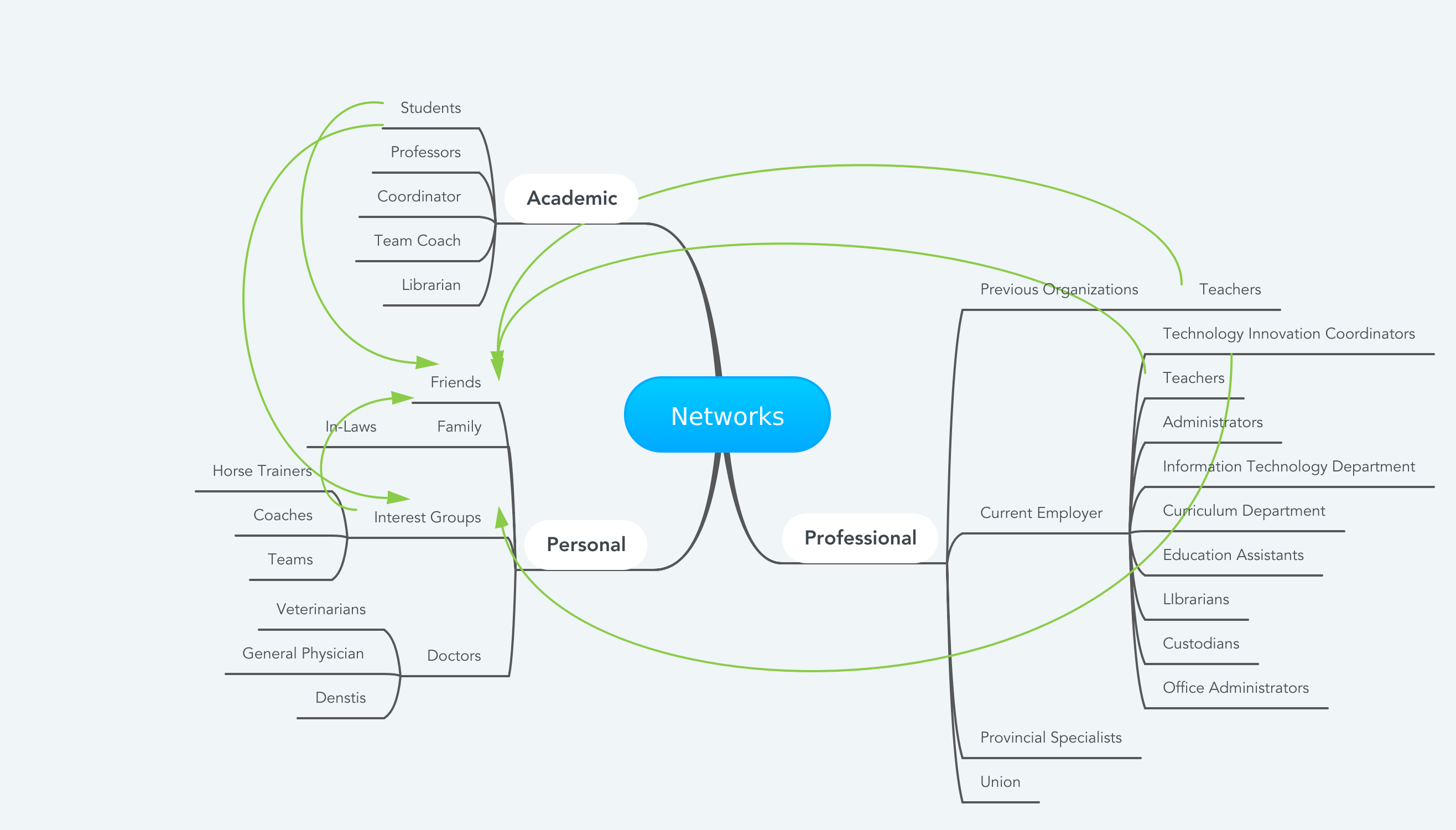
Figure 1– My Visual Network Map
This visual network map indicates my social connections in my personal, professional, and academic networks. My network includes digital and in-person groups as well as close and distant groups.
I used MindMeister to build my network map, Figure 1. I used Dron and Anderson’s (2016) definition of networks as unstructured, informal connections. They also define a group as a finite number of individuals defined by rules and purpose (Dron & Anderson, 2014). For this visual network, I identified groups of people through positions or titles rather than using names. I did this to protect identities as permissions were not granted. Groups are represented by the node and title. The connections within groups are represented by the black lines and the inter-group connections are represented by the green arrows. I situated myself in the center of the graph as that was the focus of the assignment and am the base of the connections represented.
There were some drawbacks to not representing individuals. Firstly, while members within a network are fluid, this is not represented in my visual network map, as individuals are grouped. Secondly, because I do not represent individuals, but groups, there is a seeming hierarchy of size and importance. Whereas, in actuality, many individuals are of far greater importance than groups. With more resources and time, it would be interesting to create a more microscopic version of this map. I would also be curious to see network maps represented over a span of time to demonstrate changes over that time.
References
Dron, J, & Anderson, T. (2014). Teaching Crowds. Athabasca University Press.
May 7, 2022
Great map and an enjoyable read. I think just listing groups on your networks is fine. It is the groups of people that make a network. Individuals are important, but a true network is not formed unless groups of people come together.
May 8, 2022
Thanks for your comment, Michael. I agree that the groups provide an overview. Where it was challenging is when I though of where particular individuals would be within this network map and I didn’t think it reflected appropriateness the significance of that person in my life, I guess that’s a different kind of map 🙂
May 8, 2022
A clear and concise visual of both personal and professional networks. I especially appreciate you illustrating the interconnectedness of your networks with the green arrows. Would you say your connections surprised you in any way? Perhaps in numbers or amount? I also liked your discussion about the drawbacks of not including identities of people.
May 9, 2022
I hadn’t considered using a mind-mapping tool to create my network map. The end result is very similar, and makes a lot of sense!
Mapping down to the individual level gets into privacy concerns, so I think some sort of aggregation of the data is inevitable in most research we’re going to do. I think you did a good job of representing your networks in a way that makes sense.
I do agree that the fluidity of the networks is something that is difficult to map without a very complex and layered data structure and interactive tools that allow the viewer to navigate through the data through various lenses and filters.