LRNT 521


Map of My Technology Use

Map of My Technology Use


Posted By on Apr 24, 2022

Map of My Technology Use

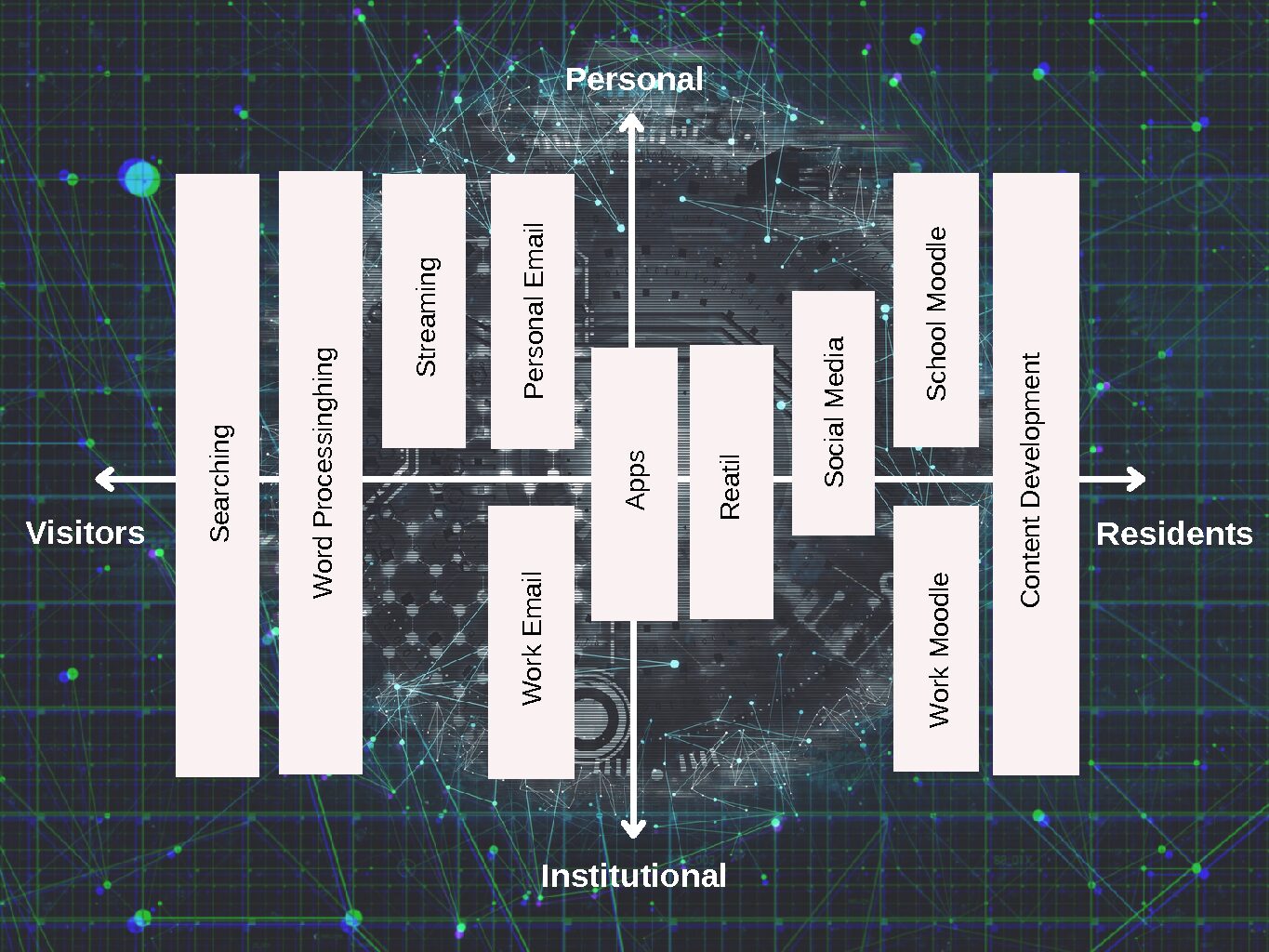
This map of my technology use follows White (2013) strategy for reflecting on the technologies Canva. White’s process asks that technologies are plotted on a graph. The x-axis marks where on the continuum the technology falls between “visitors” and “residents”. These terms are used by White to identify the degree to which our digital footprints remain after using the particular technology. The y-axis of the graph measures whether the technology is used in my personal or professional life. Together these present a visual of our technology.

For this process, I labeled the technology by its purpose and not by the specific tool or site. For example, I have a social media block. However, this block includes tools like Facebook, Snapchat, Discord, BaseCamp, Instagram, and Twitter. My reasoning for not identifying specific tools was that the specific tools I use change frequently. Additionally, I noticed that for most tools, I have separate accounts for my personal and professional tasks, except for social media. This is because I often use social media in my own time to follow trends and participate in informal conversations with fellow professionals. 

White’s exercise in mapping our technology use is important in identifying how technologies are used personally and within an organization and reflecting on the footprint the use of each technology leaves behind. 

References

White, D. (2013, September 13). Just the Mapping [Video]. Youtube. https://youtu.be/MSK1Iw1XtwQ

 

Read More
Looking Forward, Looking Backward

Looking Forward, Looking Backward


Posted By on Apr 17, 2022

Looking Forward, Looking Backward

I enjoyed the opportunity to view several presentations at the MALAT Virtual Symposium. This Symposium provided an opportunity for me to reflect on the journey through the MALAT program, as well as to set new goals and directions for the future. The noteworthy points were the CANeLearn discussion about Online Learning, the interdisciplinary aspects of the field of educational technologies, and the discussion of pedagogy and the research process in a thesis project.  

I was surprised by Crichton and LaBonte’s (2021) involvement with CANeLearn. Having been an Online instructor in K to 12 public schools for 8 years, I have encountered LaBonte during the annual DL Symposium and through Knowplace Moodle hosting site. In the process of the MALAT program, I have had to build silos around my professional and academic tasks in an effort to allocate time for each. However, hearing his discussion with Crichton and LaBonte acted as a reminder of the academic persuasion within the professional context. 

The ideas that were intriguing to me were the interdisciplinary aspect of educational technologies and instructional design (Palahicky, Boyce, and Jones, 2022). This appealed to me when applying to this program and this presentation acted as a good reminder of the benefits of an interdisciplinary field. It is beneficial to be able to draw from a wide variety of disciplines as I have appreciated through this program.

Two points that I agreed with were MacKay’s (2022) approach to researching VR. I appreciated MacKay’s pedagogical focus on his research with VR and his empathetic understanding of the learners. I liked his critical questions about how learners express their experiences and believe this to be a relevant question for all educators. In BC this is additionally relevant as the reported order is moving towards more student-directed assessment, teachers need to be aware of limitations so as to support the students’ learning. I look forward to seeing MacKay’s final research.

In all, I appreciated the time to look back and admire all of the hard work of my peers and set new goals for future goals. 

References

Crichton, S. (2021, April 15). Design Conversations with BC Educator: Lessons Learned During COVID-19 and more – CANeLearn [Symposium presentation]. RRU MALAT Digital Symposium.

MacKay, M. (2022, April 14). Phenomenological Analysis of Purposeful Pedagogy, Design, and Virtual Reality [Symposium presentation]. RRU MALAT Digital Symposium.  

Meyers, M., Veletsianos, G., & DeVries, I. (2022, April 11). Instructional Design In & After COVID-19.  https://youtu.be/FJKfV4QphYc

Palahicky, S., Boyce, C. & Jones, C. (2022, April 12). Top Trends in Instructional Design [Symposium presentation]. RRU MALAT Digital Symposium.  https://youtu.be/Hv4v9f_g7Ws

Read More