
In applying the Community of Inquiry (CoI) theoretical framework to analyze the use of video-based learning (VBL) for student well-being, my approach remained fluid. I have since identified two reasons for this which helped solidify my approach.
My first challenge to overcome is how CoI’s social presence tends to measure participation rather than an authentic and valued community involvement. Social presence does not include the finer consideration of complex learner emotions (Majewski et al., 2018) or processes, both of which are closely connected to mental well-being. In one article, Anderson (2018) accepts Shea and Bidjerano’s suggested fourth presence “learning presence” (2010, p. 1727) to account for these complex components of online learners.
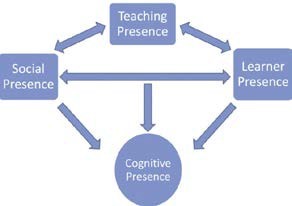
Image from Shea & Bidgerano, 2010
This fourth component assists in focusing on student well-being by accrediting the influence of learner’s emotions and self-efficacy. Thereby, increasing the value of the social, teacher, and cognitive presence within the community of inquirers.
Secondly, I struggled to focus on VBL alone as in my current context of a K to 12 BC Public Distributed Learning school, videos are not used in isolation. Equally challenging is the overlap in the research addressing social presence in online classes or computer-mediated communications alongside videos. As a result, my aim is to focus on design and instructor strategies for increasing learner and community presence in modes that are applicable to video.
My research through the past weeks has helped to form a more solid approach within a quickly changing field among complex learners.
References
Anderson, T. (2018). How communities of inquiry drive teaching and learning in the digital age. Teaching Online.ca https://teachonline.ca/tools-trends/how-communities-inquiry-drive-teaching-and-learning-digital-age.
Majeski, R. A., Stover, M., & Valais, T. (2018). The community of inquiry and emotional presence. Adult Learning, 29(2), 53–61. https://doi.org/10.1177/1045159518758696
Shea, P., & Bidjerano, T. (2010). Learning presence: Towards a theory of self-efficacy, self-regulation, and the development of a communities of inquiry in online and blended learning environments. Computers & Education, 55(4), 1721-1731. https://doi.org/10.1016/j.compedu.2010.07.017
Read More
Recent Comments