
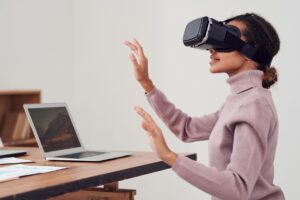
Photo by fauxels from Pexels.com
As a parent of a young child, there is nothing more important than working on issues related to the possible futures of education. For the sake of all children, it is imperative that we contemplate what kind of world they will inherit. If we understand what they are entering into, we can better prepare them for the skills they will need in the coming future.
It is a tragedy that while the world outside education changes faster and faster, most university students in Canada are not being set up to succeed. We are entering a world where the mass production, one-size-fits-all, factory model of schooling established more than 100 years ago has long been obsolete. There is not much value in sitting at a desk and doing what you are told, as a computer is increasingly capable of performing such tasks. Yet, despite the changes spurred by the COVID-19 pandemic, this approach to teaching and learning remains stubbornly the same in most Canadian post-secondary institutions: a single teacher delivering the same message to a large group of students, regardless of their individual process.
But, change is coming to higher education. It will be technological, and it will affect the buildings we know as colleges and universities. By 2030, there will be a new educational model suited to the 21st century that breaks the norm and extends education beyond the lecture hall. One focused on preparing graduates for success in the future workforce by imparting them with real-world skills using virtual reality (VR) technology.
As a new decade begins to unfold, what might the educational landscape of higher education look like in 2030? How has COVID-19 changed the trajectory of how students are educated? What will make VR in education beneficial today and in the future? And finally, what constraints does this technology currently pose?
References:
Bates, T. (2019, September 10). Chapter 8.7.b Virtual and augmented reality. Online Learning and Distance Education Resources. https://www.tonybates.ca/2019/09/10/chapter-8-7-b-virtual-and-augmented-reality/
Educause (2020, March 2). 2020 Educause Horizon Report, Teaching and Learning Edition. https://library.educause.edu/resources/2020/3/2020-educause-horizon-report-teaching-and-learning-edition
Educause (2021, April 26). 2021 Educause Horizon Report, Teaching and Learning Edition. https://library.educause.edu/resources/2021/4/2021-educause-horizon-report-teaching-and-learning-edition
Macgilchrist, F., Allert, H., & Bruch, A. (2020). Students and society in the 2020s. Three future ‘histories’ of education and technology. Learning, Media and Technology, 45(1), 76-89. https://doi.org/10.1080/17439884.2019.1656235
McMurtrie, B. (2019, May 27). Virtual reality comes to the classroom: The possibilities of creating new ways of learning are wide ranging, but so are the challenges. The Chronicle of Higher Education. https://www.chronicle.com/article/virtual-reality-comes-to-the-classroom/
Singh, S. S., & Maughan, T. (2014, June 18). The future of ed tech is here, it’s just not evenly distributed. Medium. https://medium.com/futures-exchange/the-future-of-ed-tech-is-here-its-just-not-evenly-distributed-210778a423d7
Thanks for these thoughts, Ashley. The last paragraph (i.e. the questions you post) are the actual start of the paper – the rest is background and you could summarize succinctly. I don’t yet have a clear sense of direction – which isn’t a problem necessarilly at this stage – but I would caution you to to keep the lessons that Weller shared with respect to earlier hopes of technology changing education in mind. I look forward to reading this work!
Hello Ashley.
I enjoyed reading your post, as always. I too think that we are headed for some big changes in post secondary. How do you feel about these changes? Are you realist? Optimist? Pessimist? Or both? I hope that the factory model of school isn’t our future but in many ways I feel it is. Perhaps with AI we have a chance for more individualized learning. Your blog post had me remembering my undergrad from so long ago when was having a conversation with one of my professors in the Drama Department and he always called the University of Calgary ” the factory”. To some degree he was right. When I was doing my undergrad, I would sit in huge lecture halls and never talk to the person next to me. Lecture, text book, quiz, repeat. Doing my masters, I have been able to make mean very meaningful connections with people, like yourself. I wonder if we can’t have hybrid models and more problem based learning even for undergrad programs. Would it be too expensive? So many questions I have. I am excited to read more Ashley! Sorry for the long post… I had a huge cup of coffee. Sam
Hi Ashley, you make some great points for the future of education. I am curious to know if you are considering a specific demographic group of learners to focus on and if so, what country and or region/community or ethnic group are you considering?
– Myrna