
I see my research question as an object on my floor. I am hovering above it and I see hundreds of pieces of silly string sprayed all over; different colours, different lengths, all intertwined in no particular pattern. The strings representing my research question and sub questions and possible theoretical frameworks.
My assignment one submission did not go as well as hoped so now I find myself frantically hovering moving around and around, zooming in and out of this mess on my floor. There are so many possibilities for a theoretical framework. Professor Deborah Zornes says the theoretical framework is not the main part of this. (Zones, 2022) and there was caution around how to develop a framework. Talk about agony. For someone who struggles with depression, anxiety, and attention deficit this combination (Assignment 1 not going well, crazy research question and sub questions and at least one gazillion theoretical frameworks to choose from) was not setting me up for success. Listening to my colleagues during our zoom meeting, use words I have never heard of and other gobbly goop sent me into a further spiral. And this is where I get into trouble. I start to search for a framework and go off in a myriad of directions – all interesting, some – helpful, none – final.
Myriad of Directions – Desperate for feedback!
As you can see, I am struggling with choosing a framework. Your feedback would be most welcome!
My ARP is about ‘how could’ so I thought of the appropriate framework being some sort of implementation framework. “For intermediaries and practitioners, they can provide shared language to familiarize stakeholders with implementation and function as practical tools for planning, executing, and evaluating real-world implementation efforts” (Dickson, Moullin & Stadnick, 2020 p. 2).
I came up with a list:
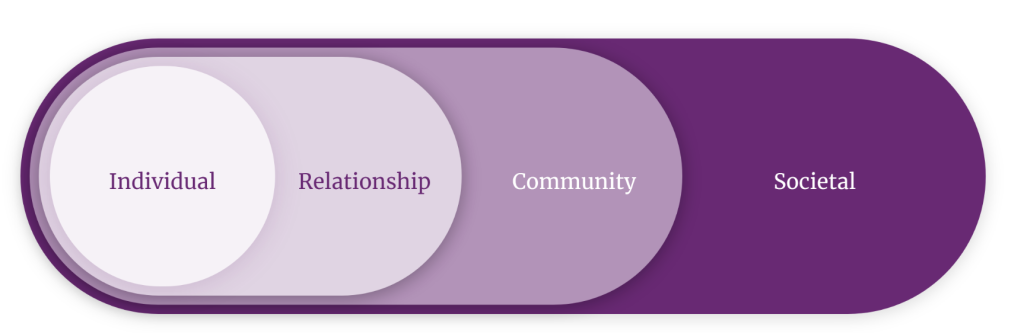
1. The Social-Ecological model. “This model considers the complex interplay between individual, relationship, community, and societal factors. It allows us to understand the range of factors that put people at risk for violence or protect them from experiencing or perpetrating violence. The overlapping rings in the model illustrate how factors at one level influence factors at another level” (Centers for Disease Control. n.d.). I like this framework because it seems to work well with the scope, audience, and stakeholders which may be part of the research paper.
2. Programme Theory of Change: “The theory of change narrative is that people involved in our intervention take action to help survivors of violence make informed choices, and to increase community awareness of violence against women and girls and the possibility of change” (Wellcome Open Research, 2019). I like this framework because it talks about intervention, informed choices, awareness, and change, which seem to be strong trajectory for online resources.
3. The Transtheoretical Model: “Behavioural change progresses through a series of stages (precontemplation, contemplation, preparation, action, and maintenance) where movement from stage to stage is dependent upon decisional balance (the pros and cons that influence the decision)” (Annan, Astroth, Cross-Poline, et al 2003). I like this framework because of the stages it moves through. The maintenance piece resonates with me. However, the pros and con’s part leave me wondering about the self-efficacy and how young women and girls may need more support around the decision piece – should I stay, or should I go?
4. Health Belief Model: “Takes into account individual perceptions, modifying factors and the likelihood of an action occurring. For individual perception, it examines both perceived susceptibility and perceived severity. When looking at modifying factors, this includes individual demographics, perceived threat, and cues to action. Likelihood of action accounts for perceived benefits compared to perceived barriers and self-efficacy” (OER Services. N.d. Chapter 7). I like this framework because of the connection to perceptions and how to support action as the outcome. However, I fear it may take me down a more clinical path?
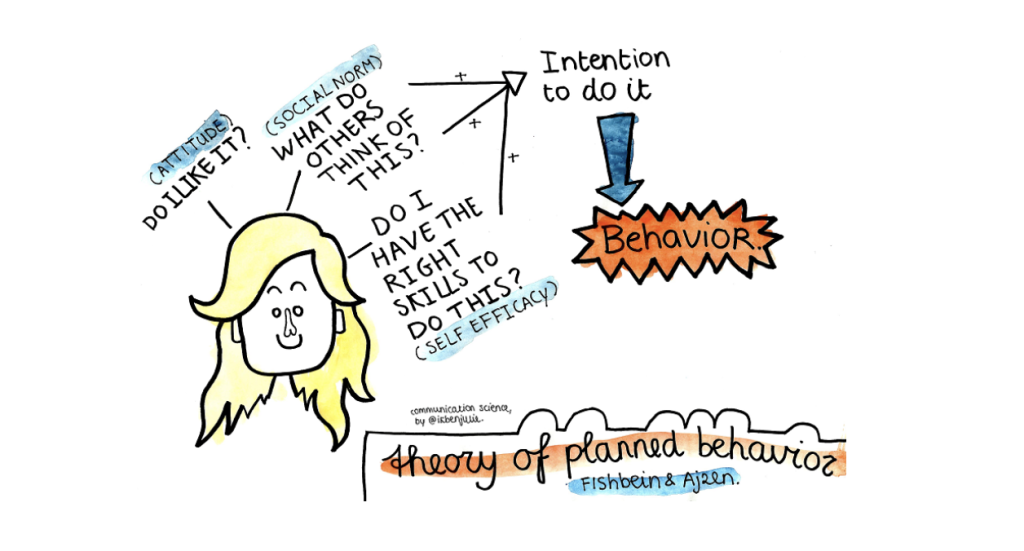
5. Theory of Planned Behaviour: “Uses a person’s personal attitude and opinion in combination with their perceived control of the behaviour and societies’ subjective norms to influence their behavioural intention which will lead to the behaviour or action. (OER Services n.d. Chapter 9). I like this fame work because it feels more organic. It feels like there would be opportunities here to look at the overarching question and sub questions in a concrete way. An example would be – I should do X, X is good for me, X is supported by stakeholders, I can do X it is in my control.
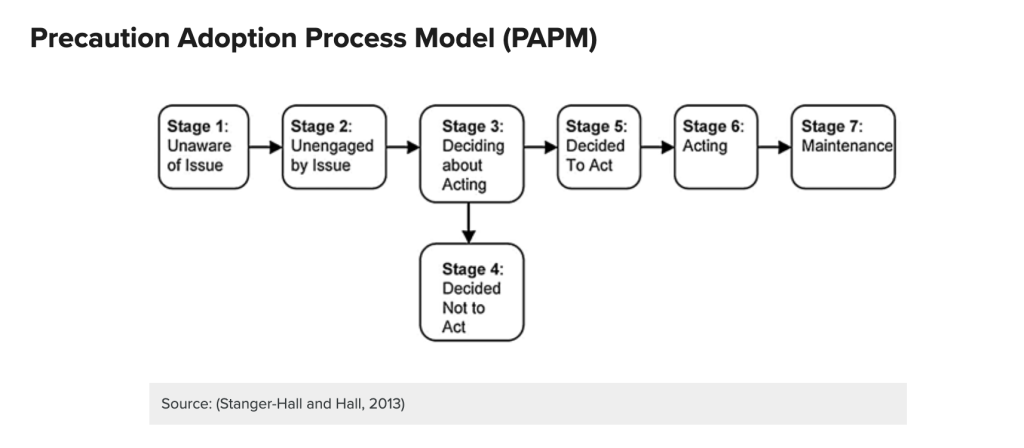
6. Precaution Adoption Process Model: PAPM is a psychologically focused model that is most useful in describing how a person comes to a new decision, and how that person can take the decision and make it become an action. (OER Services, n.d. Chapter 11). This framework resonates with me because of the process and how an individual could go back to stage 3 and move forward at any time. This feels like an acceptance stage or understanding stage is built in – where a young woman may become informed but is not ready to act yet.
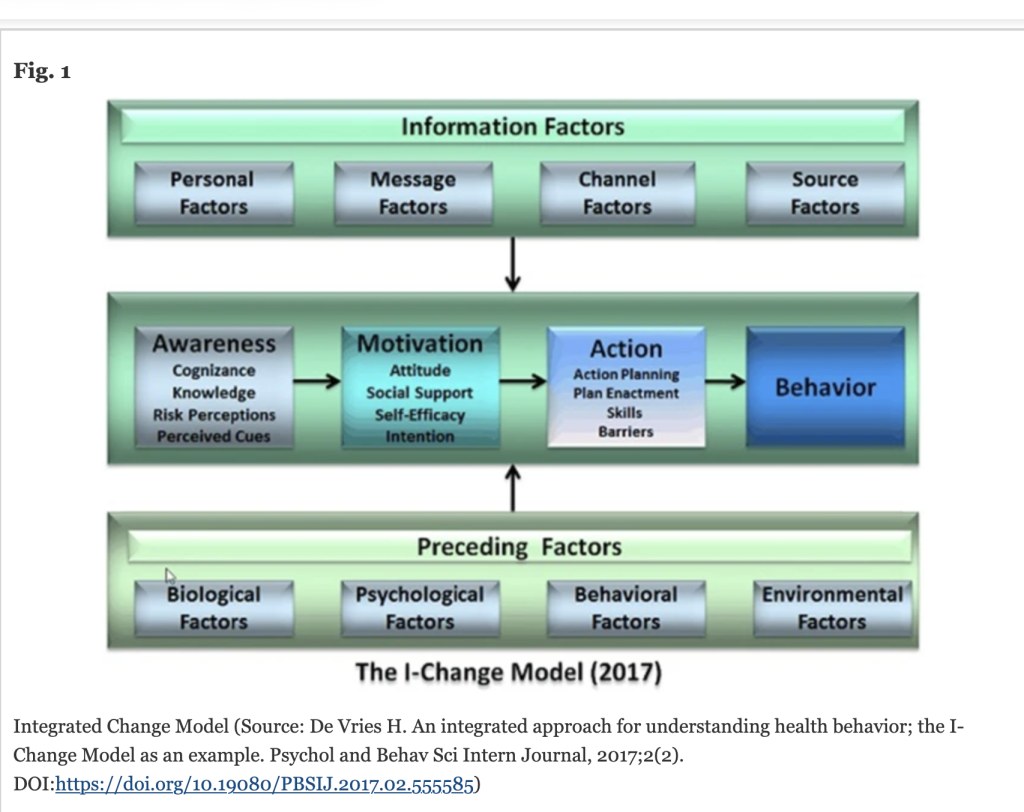
7. The I-Change Model (and attachment theory) (Araujo dos Santos, de Oliveera Prada, de Silva Meneses et al 2020). This framework offers opportunities to look at various factors that could impact the research over a course of a wider look at ADV. However, I fear it would simply be too much for me to work with and not enough time or ability to focus to use this framework and give it justice.
8 & 9 I will be using – for sure. I think.
8. Design Theory for digital platforms supporting online communities (DPsOC). Considering the increasing importance of online communities and the crucial role of digital platforms in enabling and sustaining them, organizations need to identify effective design principles for digital platforms supporting online communities (DPsOC). (Lee, Resca & Spagnoletti, 2015). Designing the resource is a key part of my ARP and this framework is applicable for that part of the ARP.
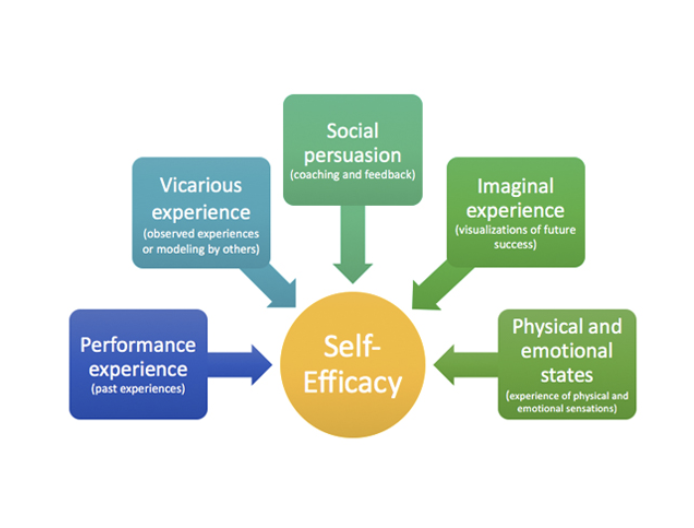
9. All with Self-Efficacy in mind: This refers to the level of a person’s confidence in his or her ability to successfully perform a behaviour. (OER, n.d. Chapter 8). Self-Efficacy is critical to my target audience. Young women and girls need to feel empowered and safe enough to be willing to engage with the content and perhaps take action.
References:
Addo-Lartey, A., Dako-gyeke, P., Hormuvo, R., Ogum Alangea, D. (2022, May 2). PLOS Global Public Health. Using the Theoretical Framework of Acceptability for qualitative assessment of the “COMBAT” VAW intervention in Ghana. https://doi.org/10.1371/journal.pgph.0000269
Annan, S., Astroth, D., Cross-Poline, G., Stach, D., Tillis, t., Wolfe, P. ( 2003).The transtheoretical model applied to an oral self-care behavioural change: development and testing of instruments for stages of change and decisional balance. J Dent Hyg. 2003 Winter;77(1):16-25. PMID: 12704966. https://pubmed.ncbi.nlm.nih.gov/12704966/
Araujo dos Santos, de Oliveera Prada, de Silva Meneses et al (2020, March 26). BMC Public Health. Dating SOS: a systematic and theory-based development of a web-based tailored intervention to prevent dating violence among Brazilian youth. BMC Public Health 20, 391 https://doi.org/10.1186/s12889-020-08487-x
Centers for Disease Control. Violence Prevention. OER Services.(n.d) The Social-Ecological Model. https://www.cdc.gov/violenceprevention/about/social-ecologicalmodel.html
Centers for Disease Control. OER Services. (n.d.) Models and Mechanisms of Public Health. Chapters 7, 8, 9 & 11 https://courses.lumenlearning.com/suny-buffalo-environmentalhealth/
Grant, C. Osanloo, A. (n.d) Administrative Issues Journal: Connecting Education. Practice, and Research. UNDERSTANDING, SELECTING, AND INTEGRATING A THEORETICAL FRAMEWORK IN DISSERTATION RESEARCH: CREATING THE BLUEPRINT FOR YOUR “HOUSE” Vol 4, Issue 2. https://files.eric.ed.gov/fulltext/EJ1058505.pdf
Lee, G., Resca, R., Spagnoletti, A. (2015, February 10). A design theory for digital platforms supporting online communities: a multiple case study. J Inf Technol 30, 364–380 (2015). https://doi.org/10.1057/jit.2014.37
Moullin, J.C., Dickson, K.S., Stadnick, N., et al. (2020). Ten recommendations for using implementation frameworks in research and practice. Implement Sci Commun 1, 42 https://doi.org/10.1186/s43058-020-00023-7
Wellcome Open Research. (2019, August 21). A theory of change for community interventions to prevent domestic violence against women and girls in Mumbai, India. 4: 54. doi: 10.12688/wellcomeopenres.15128.2
Zones, D (2022, November 23). LRNT622 [LRNTECH-MA 2021-1 OL] Oct 31, 2022 – Advanced Research: Applied Research Project or Digital Learning Research Consulting Project Proposal. DASHBOARD MY COURSES LRNT622 [LRNTECH-MA 2021-1 OL] ZOOM MEETING ROOM FOR LRNT 622. Video. 00:36:36). https://royalroads.zoom.us/rec/play/yVeMHU2HGEobrDAdzm-f5cP3e5NewyJSvy3IfZ_2GNn8zrSFAgLuhA06Nt57amR-niWG3b9uXHS-0a6Z.xPm1fnJNJCkeR0ec