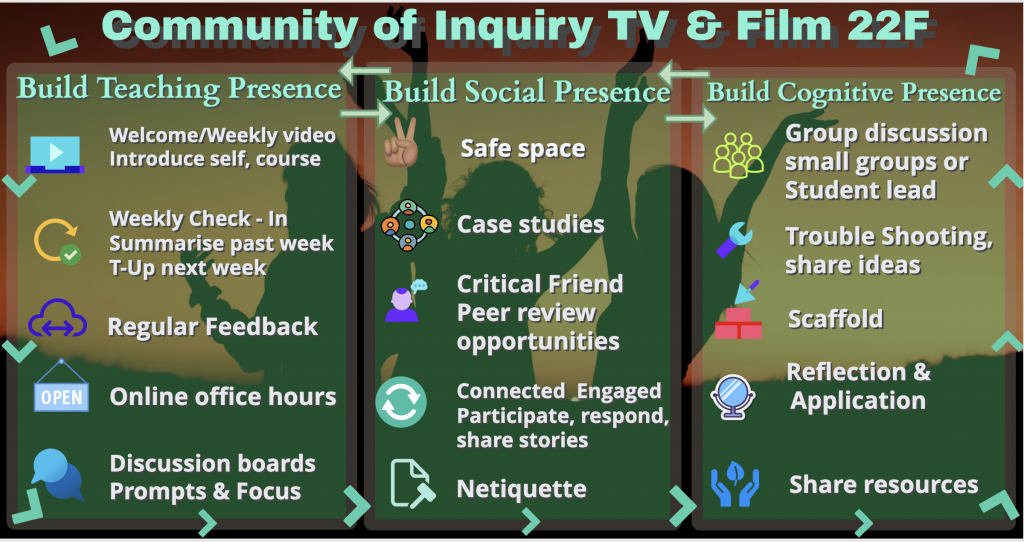
It is felt that creating a Community of Inquiry (COI) lays the foundation for a positive educational experience for students (and possibly faculty as well). Bird, Butler & Naylor (2021) found, for students, the relationship they had with faculty, along with feeling supported, impacted the quality of the educational experience students had. “An important pedagogical and policy implication of our research is how prevalent the themes of personal relationships, support and quality of teaching are to students” (Bird, Butler & Naylor 2021, pg. 861). The COI model calls for three presences, which, as we know through our readings are teaching, social and cognitive (Cleveland-Innes, Garrison, Vaughan 2013). In my context and experience as a TV & Film Professor at Fanshawe College in London, I would agree that creating a working COI does support more positive learning outcomes and a more positive learning experience. Keeping the aforementioned in mind, I chose to create an infographic which underscores the cyclical journey of teaching and learning in TV & Film and what strategies would work or have worked.
Let me first discuss the teaching presence. Reflecting on the writings of Bull (2013) and Boettcher (n.d), and what I have done in the past, there are five strategies for your consideration, dear reader. Embracing the concept of being a tour guide (Bull 2013), to introduce myself, my teaching and learning values and how to navigate through course content, I post an introductory video. To be present and guide learning and to aim for a positive course vibe (Bull 2013) at the end of each week, I send an email summarising the work we did and T-Up the work for the next week. I congratulate students on their learning and explain how this week’s learning leads us to next week’s content. If required, I post feedback to the appropriate platform. Sometimes that is to the student directly, other times the feedback could be part of our discussion board. In my welcome video, I go through my expectations around communicating with me and as part of that I explain that since I am not full time, I do not have an office or extension. Therefore, email is my go-to communication platform and if students want to meet with me, we can organise a zoom call during my digital office hours. I pop into our discussion boards a few times a week to comment on student postings, to answer any questions and to add prompts to focus the discussion if need be. My teaching presence is an ebb and flow experience which includes social presence and cognitive presence.
Regarding social presence, one of my key concerns is to create a safe space for students to post questions, comments, and concerns (Cleveland-Innes, Garrison & Vaughan n.d.). Some of our discussion boards are for specific projects. In that case, students may include resources or share problem solving ideas. We go through the discussion rules (netiquette) as a group. I ask for what students want to see and if there is anything new, I add that to a list, I post online. I do this in either week 1 or 2 and remind students as needed or issue warnings as required. In keeping with Boettcher’s best practices (2013), I host a mix of individual, small group, and large group activities. An example would be our case studies. We look at industry examples of whatever project is on tap. We then break into small groups and reflect on question prompts I give students. We come back as a larger group and share our findings. Students then complete their individual assignment including methods/ideas we spoke about in class. Along with having teacher presence and social presence, students are then challenged to reflect on their learning and mix and match practical and theoretical learnings and demonstrate that they are moving in an upwardly trajectory from one assignment to the next: scaffolding. Scaffolding is part of establishing a cognitive presence.
Expanding on cognitive presence, as I strive to create a positive learning experience where students share and support one another, it is important that students continue to develop new skills and expand the skills they arrive with at the start of each project. In my case, I use a flipped learning model where students watch lectures and come to class ready to discuss or demonstrate content. Students also review feedback from myself and from their colleagues and discuss comments, concerns, or suggestion, either on a discussion board or in an assessment meeting with me. Students are also asked to reflect on the lecture or class and comment on how they will use the new information. Students are also encouraged to post solutions to problems they have encountered in pre-production, production, or post-production. An example would be you used xyz in your product shot, what will you do differently or what will try with your instructional video? Or many of you struggled with timing around your shoots, have you ever considered using day-for-night or night-for-day shooting and editing? Students are encouraged to work with different crews to continue to challenge their production habits and to learn from another. Students are also called upon to reflect on the rubric and share their thoughts with me as we assess their work together.
The effort and activity around the design, facilitation, and direction of cognitive and social processes in learning communities created to foster inquiry, for the purpose of realizing personally meaningful and educationally worthwhile learning. (Cleveland-Innes, Garrison, Vaughan 2013)
Lastly, my infographic has arrows indicating the COI and the three presences are continuous activities/strategies throughout the teaching/learning the students and I are engaged in. The arrows between the presences indicate the interactivity or connectivity between the presences. Overall, then, my hope is to create a teaching/learning experience that challenges students to have fun, perhaps experience joy, experiment, support each other and create productions they are proud of. My email signature quote (for Fanshawe) may wrap my approach and intention up nicely “My mission in life is not merely to survive, but to thrive; and to do so with some passion, some compassion, some humor, and some style” (Angelou 2014).
References
Angelou, M (2014, May 28). BBC News. Maya Angelou: In her own words. https://www.bbc.com/news/world-us-canada-27610770
Bird, F., Butler, E., Naylor R. (2021, January 30). Academic expectations among university students and staff: addressing the role of psychological contracts and social norms. High Educ 82, 847-863. https://doi.org/10.1007/s10734-020-00668-2
Boettcher, J. (n.d.). Ten Best Practices for Teaching Online – Designing for Learning. http://designingforlearning.info/writing/ten-best-practices-for-teaching-online/
Bull, B. (2013, June 3). Eight Roles of an Effective Online Teacher. Faculty Focus | Higher Ed Teaching & Learning. https://www.facultyfocus.com/articles/online-education/online-course-delivery-and-instruction/eight-roles-of-an-effective-online-teacher/
Lalonde, C. (2020, August 22). Facilitation in a Community of Inquiry. https://www.youtube.com/watch?v=Nv1bUZv5PLs
Garrison, D. R., Anderson, T., & Archer, W. (1999). Critical Inquiry in a Text-Based Environment: Computer Conferencing in Higher Education. The Internet and Higher Education, 2(2–3), 87–105. https://doi.org/10.1016/S1096-7516(00)00016-6
Vaughan, N. D., Cleveland-Innes, M., & Garrison, D. R. (2013). Teaching in blended learning environments: Creating and sustaining communities of inquiry. AU Press. https://read.aupress.ca/read/teaching-in-blended-learning-environments/section/43261c4a-6d4c-44cf-8c7f-60bc306eb03a
Hi Katia,
I like how visual you made your infographic. It is very easy for the user to see what strategies are highlighted and the significance they hold to your specific industry of film. I really like how relevant you made it to your industry and how the arrows represent the continuity and flow of the three presences. I noticed that you included sharing resources in your visual under cognitive presence. I wonder if this is both teachers and students sharing resources or just teachers providing resources for learners? In teaching and learning in an educational setting, teachers often share resources with one another to build on their learning experiences. This often includes sharing resources with the instructor/facilitator of the course. Is this a simial experience in the film industry?
Thanks for sharing!
Hello London;
Yes sharing resources goes both ways; student to teacher, teacher to student. An example would be asking my students to post a favourite commercial. Students would view each others’ posts and comment. Within that sharing, students will hopefully get ideas that they may then wish to apply to their commercial production. In my context, there is not a lot of sharing between faculty which is a definitive weak spot in our faculty school. Simial experience – I’m not sure what you mean? Do you mean seminal? If it is the latter, then no, again, due to the lack of sharing amoungst faculty members.
Hi Katia,
Thank you for sharing strategies that have worked in your field. I like the approach you took of using arrows in your infographic to show the continuous flow between the three presences and their connectivity to one another. I’m curious to know what are your strategies for creating a safe space for your learners and if synchronous sessions are part of your course?
Great question. At the beginning of each term, I go through course netiquette and at the start of each synchronous session, I remind students of the expectations around how to treat one another and how to treat me. I do plan my sessions and share that with students so we are all aware of how the session will go and, again, the expectations therein. Seems to work.
Hi Katia,
I learned how to do infographics from you in our first course and I always been impressed on how you bring context and your uniqueness into them. I am not disappointed once again! Given my interest in collaboration, you gave me some great ideas especially when building a social presence. Small things such as netiquette bring huge impact on how a group will work together with a set of norms. The simplicity of your infographic with key actions makes it impactful and realistic to implement. Great post!
Thank you Stephanie. The infographic was not as well received as I had hoped, however, it does accurately reflect my thoughts, reflections and context. I appreciate your comments around social presence which is something I do work on – each year learning from my students and tweaking my practices.