October 14 – 15th – REFLECTION ACTIVITY. Open Educational Practices for Online Facilitation: Are Open Educational Practices Changing the Role of the Online Facilitator?
My contextual relationship with Open Educational Practices would be a complex one. Cronin (2017) eludes to my issue when she notes “Openness in education attracts considerable attention and debate”. The debate, in my case, would be around ownership. I teach in TV & Film; industries where copyright is might. Reflecting on how OEP poses some interesting questions for me; would my colleagues/institution be interested in sharing resources, including curriculum development? Would they share media, source materials, outlines and rubrics?
Moving away from the departmental aspect of OEP, I would still need time to reflect on how I would use open practices in my context. As I read this course content, I found myself nodding in agreement while at the same time, questioning how I would apply OERs and OEP. What would that look like for me? What would be included? What would I do – what would be applicable and appropriate? I’m not sure. From a user point of view, I would be able to access resources that fit my context. As a partner, what would I share back? Would I have to ask for permission? Who owns my work (as a Prof)?
Moving away from a resource use point of view – are there OEP I can implement now? Can I use a platform like mattersmost or padlet? What would that look like? Would I be solely responsible for curating these resources? How much time would that take? Would having students curate their own website work in my context? Or a variation on that theme – somehow publicly sharing their work/productions? What about social media, blogging et al? What about digital literacy and its application to film and television – is there a role for OEP there?
This week then, I delved into OEP from a few angles, as a student (MALAT), as faculty (TV & Film) and how social justice could be considered (free and open education, resources – for all). As a student there are many opportunities to use OERs in my work with MALAT and my ARP. As a Prof, I still need to reflect on OEP in my context, however, there are first steps that I realise I have already taken. These would include steps like using already existing discussion boards like Discord which is free and a majority of students already have a profile; through YouTube, I share my content freely and openly; on discussion boards students share items like their favourite commercial; and, using the Critical Friend Model. For me, next steps would be to reflect on Cronin’s four levels of openness and find out what resonates with me and what makes sense to experiment with and possibly share my efforts with colleagues.
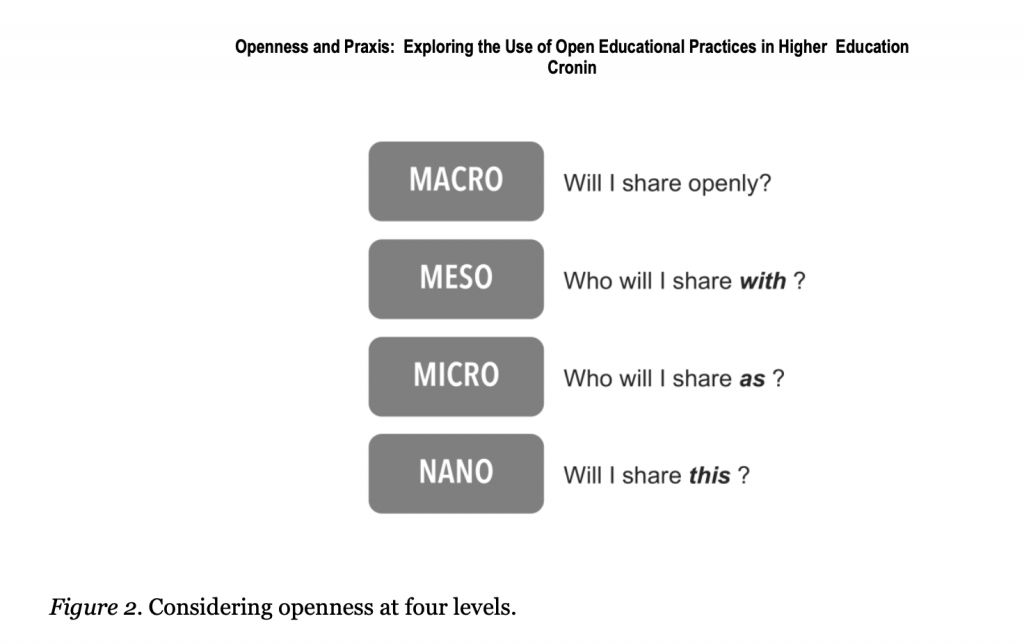
Lastly, I look at OEP as a part of a larger whole which has many moving parts. Cronin (2017) touches on four interpretations of openness beginning with open/free admission and no more entry requirements. Free and open education for all – imagine being part of that?!
References
Cronin, C. (2017, August 5). nternational Review of Research in Open and Distributed Learning. Openness and Praxis: Exploring the Use of Open Educational Practices in Higher Education. Vol.18 No. 5.
DOI : https://doi.org/10.19173/irrodl.v18i5.3096