
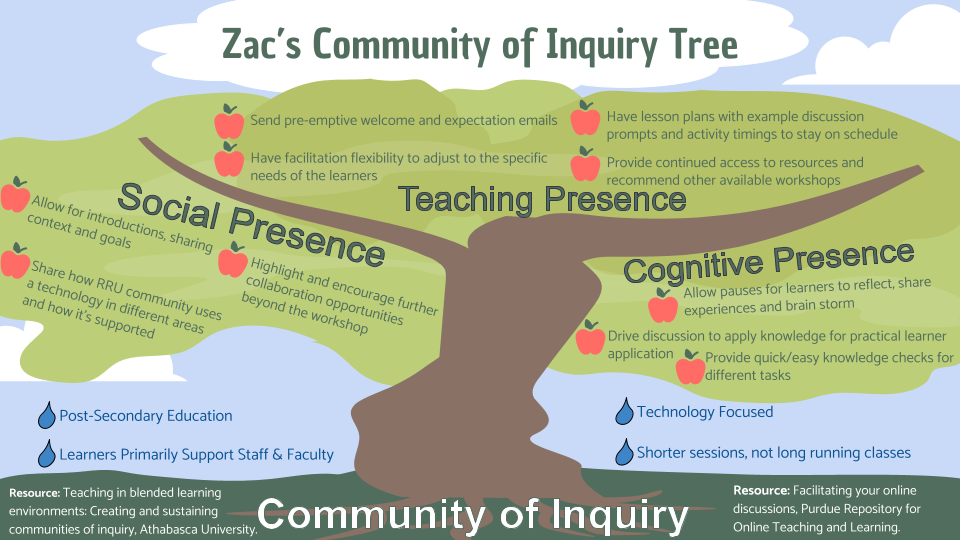
I created this infographic applying the community of inquiry framework to my context of facilitating educational technology workshops at Royal Roads University (RRU). Starting near the ground level, the water droplets provide the context of me in this particular role. I think many of us could have multiple trees and varying degrees of raindrops for our teaching and learning experiences. These water droplets of context feed into the roots and framework of the tree, the community of inquiry (COI).
Up the trunk and amongst the leaves and branches, the three pillars of COI appear, teaching, social and cognitive presence. Teaching presence holds the center of tree as it’s closest and most directly controlled by the facilitator, with social and cognitive presence connected at each side. All of presences share reliance on the water, roots, and leaves of the tree and removing any part would likely kill the tree.
This tree then produces apples which contain juicy strategies and considerations I can use a facilitator to help nurture the COI tree. From Richard et. al (2018) some apple examples of facilitator strategies for my context emerged :
- Setting clear expectations to allow learners to know exactly what is and isn’t covered,
- Making good use of time, in my context was slightly different than suggested by Richard et. al (2018) as I generally have limited time with learners and must ensure to cover all the learning outcomes
- Having meaningful discussions by having flexibility in facilitation to apply knowledge to their context and goals
Additionally Vaughan et al (2013) provided other insights that made excellent apples for my context including:
- searching, discussing, finding pratictical problems and applications of the knowledge
- encouraging a sustained community beyond the workshop for further support, collaboration and shared purpose
- Allowing for timely reflection and the ability to share further
I hope my COI tree continues to grow and I can plant more until I have a whole vineyard of COI trees for my different teaching and learning experiences. Thanks for reading my post and how many COI trees do you have?
References
Richardson, J., Caskurlu, S., & Ashby, I. (2018). Facilitating your online discussions, Purdue Repository for Online Teaching and Learning.
Vaughan, N. D., Cleveland-Innes, M., & Garrison, D. R. (2013). Teaching in blended learning environments: Creating and sustaining communities of inquiry. Athabasca University Press.
Thanks for this Zac! I love the concept of the “presences” being branches and being fed by the foundational information. I wonder if we could each have orchards of different types of trees, depending on what we’re facilitating? For example, a post-secondary “apple” tree and a safety “peach” tree and so on? I got thinking about how different classrooms have different personalities as we assemble groups of people and how CoI would likely be similar.
I enjoy this imagery, especially when you say without the sum of all presences, our COI tree would likely not survive. I feel that really underscores the readings to date and how all three presences are required (when done well) to support our users (students in my context) toward successful outcomes. I hope your COI tree grows! One of your droplets – shorter sessions – is a particular challenge for me. I have four x two hour classes – same content, four sections. I also have one four hour class. Trying to keep things fresh and moving forward can be difficult. I try to be creative by having in class discussions, sharing findings and resources, mini case studies, and taking breaks – literally – standing up and stretching. My 4pm-6pm classes are definitely the most challenging – for me and I’m sure for the students as well.
Hi Zac, I want to compliment your creativity on your CoI Tree, I really liked how you represented the external factors and resources such as water and soil that are important foundational elements to grow a strong and healthy tree. I also liked very much how you represented the three presences as branches and your strategies as apples. Working in the private sector I wonder how I can implement some of the strategies you suggest in my context. As Corie suggests in her comment, we may all “have orchards of different types of trees” with our own different scenarios but similar in nature. Thank you for your post, well done!