
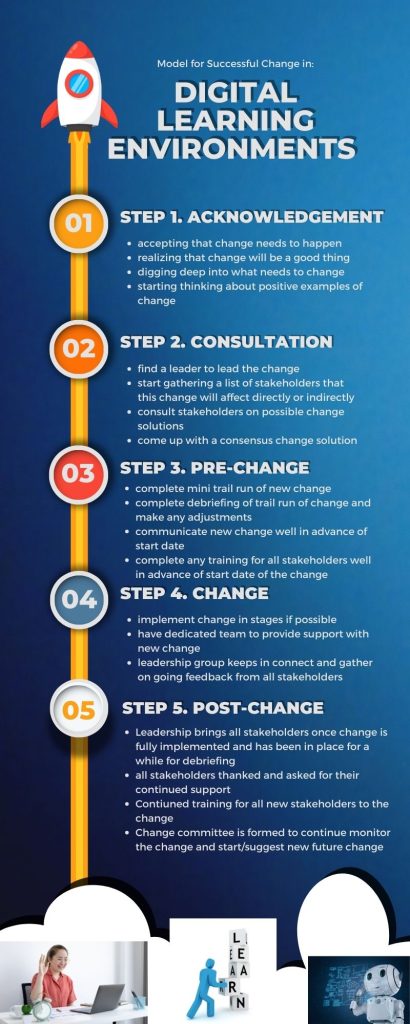
Large organizations have to be prepared for Change. Educational institutions are responsible for training the future of tomorrow need to be leaders in Change. As things like technology advance, Education institutions must implement Change like new digital learning environments such as learning management systems (LMS). There is a straightforward model that educational institutions need to use to implement these changes within their organizations successfully. This author has looked at several articles and research on change management, listened to recordings of leaders in education on change management, and interviewed a colleague about their experience with change management. With this knowledge, this author developed a model for implementing successful Change in digital learning environments. The model has five components: Acknowledgement, Consultation, Pre-Change, Change, and Post-Change. It starts with that Acknowledgement.
The first step in the model for successful Change in digital learning environments is Acknowledgment. This step gets the ball rolling, helping start that potential change. It will establish why change is needed (Biech, 2007). Now we can start to move forward in addressing this need for Change, like when we discovered the tool we were using for online learning does not have a caption tool that some of our students need to learn. This part of the model creates awareness of what might need to change. We must be aware of what is happening in changing fields, such as changing technologies, changing pedagogy, and implementing different ideas and practices (Harrison, n.d.-a). We will reflect and might come across a different tool to use as our digital learning environment, like Moodle instead of D2L. Now we can move on to the second step in the model.
The second step in the model for successful Change in digital learning environments is Consultation. This part of the model, it’s all about bringing everyone together. All the stakeholders within the institution brainstorm together about of path for Change. Having all stakeholders involved at the beginning allows for a potentially good solution for the Change. With all Stakeholders taking part from the beginning, it will increase the chances of successfully implementing the Change. As one author noted, its employees’ perception of the organization’s readiness leads to successful Change because it leads to employees’ commitment and involvement in the Change (Weiner, 2009). When everyone feels part of the process of Change, like when a course for new faculty was in the process of thinking about Change. They ask their previous faculty who took the course for their feedback and what changes to make. This author has heard people say how much they appreciated being asked for input into Change; some even feel the need to become leaders in that Change. Before moving on to the next part of the model, the stakeholders determine what this change will look like. Is it a new Learning Management System (LMS) or the same LMS with new or different components added? This puts everyone on the same page as well as everyone working toward the success of the Change. One author noted that Lewin’s model success depended on having change makers working on a common goal and implementing Change (Kritsonis, 2005). In speaking with colleagues recently involved in two different Changes within the same institution, one was successful, and the other wasn’t. The only difference in both implementations was only one had a consultation with only leaders from all stakeholders, and the other involved consultation with reps from all levels of each staler holding group. The one that involved consultation from all levels was the successful Change. Now we can move on to the third step in the model.
The third step in the model for successful Change in digital learning environments is the Pre-Change. In this step, small bites of the Change are implemented while being overseen and making any improvements to how the Change is rolled out. This then leads to early communication of the official rollout of the complete Change and the training needed for all involved. Evidence will show that leads to the tremendous success of the Change. As one author noted, change leaders must express comprehensive aspirations well (Al-Haddad et al., 2015). Communication was used in a recent change that this author was a part of going. The Change was a new standard operating procedure (SOP) for the shop lab. It was communicated early that everyone agreed that a change needed to be made to keep our labs running correctly. Another communication went out on what should be in this SOP. Once a final SOP was created, another communication let everyone know there was a new SOP and when it would be implemented. In the end, the implementation went pretty smoothly due to ongoing communication. Now we can move on to the fourth step in the model.
The fourth step in the model for successful Change in digital learning environments is Change. This step in the model fully implementing the Change is rolled out in stages if possible. A team is dedicated to supporting this Change when rolled out to assist anyone needing help. While this happens, the main leadership group, as with reps from all stakeholders, stays in consistent contact while implementing the Change. This step provides constant overview and control of the implementation of the Change and ensures its chances at success. One author noted when discussing Pettigrew’s model that managing the change transition is one of the three factors managers must address during the change process (Hussain et al., 2018). In his interview, Flinn mentioned the importance of supporting individuals in his institution when implementing or even thinking of Change (88888). During a rollout of new virtual systems used for pandemic teaching, this author’s institution had a team working to support teachers and students using this new system. Deans met with faculty heads to provide updates and gather feedback through the implementation. This information is shared with the leadership overseeing the Change. This led to a successful system rollout in a relatively short time frame. Now we can move on to the fifth step in the model.
The fifth step in the model for successful Change in digital learning environments is the Post-Change. At this step of the model, the entire leadership group and all stakeholders are brought together once the implementation is complete and up and running for a while. The purpose is to get everyone’s feedback on how the process of Change was handled, what went well, and what we could do better next time. This is also the time to ensure everyone is thanked for their involvement and success in the Change. Everyone should be encouraged to bring ideas of possible Change forward. To help in this, it suggests that a Change Committee is formed for future changes. The promotion of potential is welcome and helps the success of Change. As Flinn mentions in his interview, individuals are sometimes quietly doing great things, so it is essential to get out and see what people are doing (Harrison, n.d.-a). This is similar to having a committee, keeping those eyes open to Change, and having a chance to bring it to our institutions. It might simply as has a quarterly meeting with reps from all organizational stakeholders or at this author’s institution, where they have a committee named Innovate DC and a website for employees to submit ideas for Change. Now the five steps of the model ensure a successful change.
This author’s model for successful Change in the digital learning environment will ensure a successful change. They include the five steps of Acknowledgement, consultation, Pre-Change, Change, and Post-Change. Each of the parts comes from research of many different change models. If there is to be a chance of successful Change in digital education, there needs to be a plan or model.
References
Al-Haddad, S., & Kotnour, T. (2015). Integrating the organizational change literature: a model for successful change. Journal of organizational change management, 28(2), 234-262.
Biech, E. (2007). Thriving through change: A leader’s practical guide to change mastery. American Society for Training and Development.
Harrison, M. (n.d.-a). Voices of Leadership – Chad Flynn, Post Secondary. Royal Roads University – MALAT LRNT 525 Course Site. Retrieved February 18, 2023, from https://malat-coursesite.royalroads.ca/lrnt525/schedule/voices/
Hussain, S. T., Lei, S., Akram, T., Haider, M. J., Hussain, S. H., & Ali, M. (2018). Kurt Lewin’s change model: A critical review of the role of leadership and employee involvement in organizational change. Journal of Innovation & Knowledge, 3(3), 123-127.
Kritsonis, A. (2005). Comparison of change theories. International journal of scholarly academic intellectual diversity, 8(1), 1-7.
Weiner, B. J. (2009). A theory of organizational readiness for change. Implementation Science, 4(1), 1-9.