
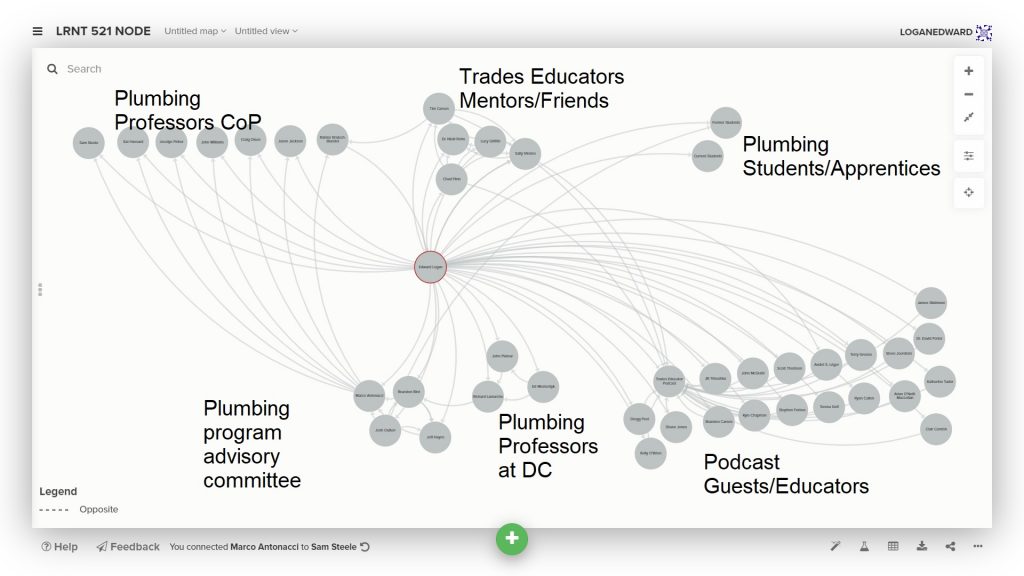
This past week in my LTRN 521, I was tasked to look at my own networks. I ended up mapping out many different networks. All my networks seemed to center around professionals. My networks can be broken down into six smaller groups: Plumbing Professors at Durham College, Plumbing Program Advisory Committee, Plumbing Professors Community of Practice, Trades Educator Mentors/Friends, Students/Apprentices and Podcast Guests/Educators. Each of the networks brings something unique to my practice.
As Anderson and Garrison mentioned, digital learning environments can be “teacher-teacher” (1998). Many of my relationships are just that. They provided us all a time to reflect on my own practice. Veletsianos shares how the environments can be in groups, networks and communities (2016). Of all my interactions, one is a group (Plumbing students/apprentices) and the other five are communities. As stated by Mott, groups usually use a LMS (2010). I use D2L with my student/apprentice group. My remaining interactions are more like communities. As pointed out by Veletsianos, Barab and Duffy stated “identified four defining characteristics of communities (1) have shared histories and cultures, (2) have shared goals and practices, (3) are part of something larger than the individuals participating in them, and (4) reproduce, with member roles in the community shifting, evolving, maturing, and changing” (2000). My five communities have all four of those characteristics. Though I would say that my five communities are “communities of practice” (1991 and 1998). They are CoP because as stated by Wenger, it’s used as a professional practice (1998).
As I look to the future, I look forward to continuing to grow my networks, groups and communities. Through the use of digital platforms, I will be able to accomplish just that. My time in the MALAT program will help me create a brand new network and community and understand how this can play a part in my practice.
Anderson, T., & Garrison, D. R. (1998). Learning in a networked world: New roles and responsibilities. In Distance Learners in Higher Education: Institutional responses for quality outcomes. Madison, Wi.: Atwood.
Barab, S. A., & Duffy, T. (2000). From practice fields to communities of practice. Theoretical foundations of learning environments, 1(1), 25-55.
Lave, J., & Wenger, E. (1991). Situated learning: Legitimate peripheral participation. Cambridge university press.
Mott, J. (2010). Envisioning the post-LMS era: The open learning network. Educause Quarterly, 33(1), 1-9.
Veletsianos, G. (2016). Digital learning environments. Wiley Handbook of Learning Technology, 242.
Wenger, E. (1998). Communities of practice: Learning as a social system. Systems thinker, 9(5), 2-3.
This is really great work, Edward. You seem to be adapting to the academic style of writing extremely well!
It’s interesting to see how individuals in your network have multiple functions and connect to different groupings. Were there any patterns or relationships revealed in your map that surprised you?
Thanks for the kind words. I think the surprising thing is that more individuals in my networks don’t know each other. I seem to reconnect with people in different groups. It most likely because we seem to be like minded individuals. I could easily added more groups or communities but time was limited. I look forward to adding my MALAT cohort to this visual in the near future.