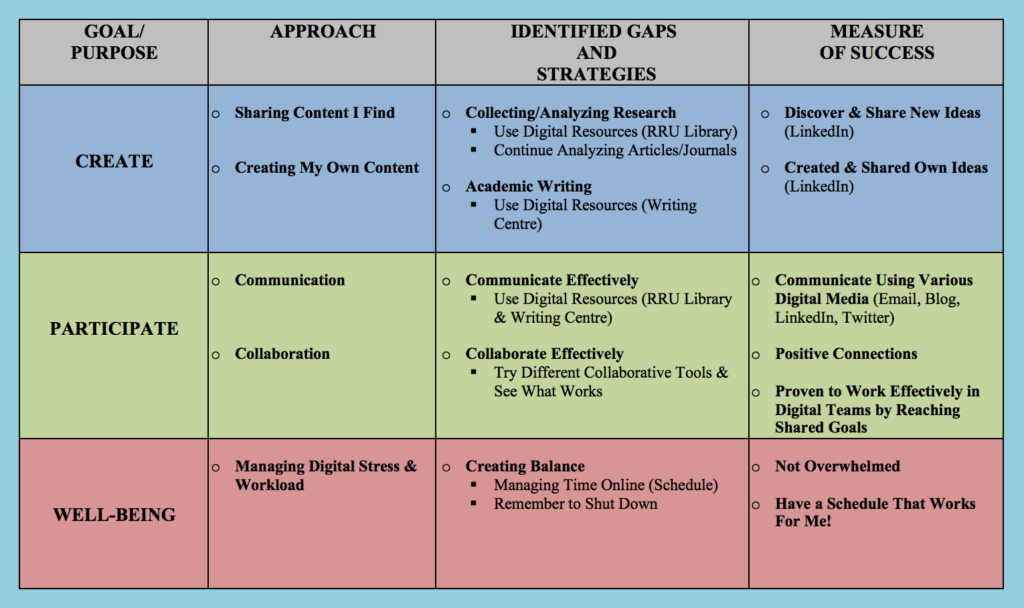
Analyzing the literature provided on digital presence and digital identity has allowed me to take a step back and evaluate how I utilize my digital space. Several years ago, I made the decision to remove myself from social media, specifically, Instagram, Facebook and Twitter. These spaces were initially communities where I enjoyed sharing and connecting with friends, family and acquaintances but eventually they had a negative impact on my mental health. I have since joined Twitter again and spend most of my time on there following sports news. With the shift in our extremely digital society, I can certainly appreciate the importance of sharing, learning and communicating digitally; which is why I’ve designed what I see as a very transformative DIDP plan.
Helen Beetham (2015) shared six elements of digital capabilities. After exploring the six elements, I decided to focus on “Digital Creation, Innovation & Scholarship”, “Digital Communication, Collaboration & Participation” and “Digital Identity & Well-Being”, as I believe they are the most essential aspects to an effective digital presence and are the areas that I’ve struggled with most. I broke down these elements of digital capabilities into my three goals, which are to create, to participate and to keep in mind my well-being. I hope these goals will allow me to discover & share new ideas, create my own content, create positive connections, reach shared goals through collaborating with my cohort and most importantly to remember to have a work-life balance.
Create
Part of my digital presence plan is to share and create. Based on the theory of White and LeCornu (2011), I would be considered a “visitor” on both Twitter and LinkedIn, but I’m motivated that I will become more of a “resident” on those platforms within my professional networks throughout the MALAT program. I will approach this by sharing information that my colleagues, cohort and overall network may find valuable and to begin to create and share my own content. Although I’m not confident in my capabilities in collecting or analyzing research and in my academic writing, I will use the resources available to me including the library and writing centre at RRU to enhance the quality of the work I share online.
Participate
Communication and Collaboration are the two main factors to what makes an effective digital community. It has been said that “when you participate, you become an active citizen rather than simply a passive consumer of what is sold to you, what is taught to you, and what your government wants you to believe” (Rheingold, 2010). I no longer want to be “passive” in my involvement with the digital world. I know that my commitment to improving my academic writing will allow me to communicate effectively and with confidence. I trust that continuing to work with my cohort and various collaborative tools will help me effectively collaborate over the next two years and beyond.
Well-Being
What I consider to be the most important goal of the three is my Well-Being. It was never a priority when I first entered the digital world but I’m going to make sure it’s my main focus. Creating balance will allow me to be more effective when I’m online and give me the opportunity to shut down when needed. To achieve this, my plan is to create a schedule that allows me to step away from my phone and laptop, ensuring that I manage my “digital stress and workload” (Beetham, 2015).
I have no doubt that this will be a long journey in growing my digital presence. I believe that just contributing to my digital networks and learning from the tools available to me, will help me build a stronger digital identity.
References
Beetham, H. (2015, Nov 10). Building capability for new digital leadership, pedagogy and efficiency. Jisc. https://digitalcapability.jiscinvolve.org/wp/2015/11/10/framing-digital-capabilities-for-staff-deliverables/
Rheingold, H. (2010). Attention, and other 21st century social media literacies. Educause Review, 45(5), 14. https://er.educause.edu/articles/2010/10/attention-and-other-21stcentury-social-media-literacies
White, D. S., & LeCornu, A. (2011). Visitors and residents: A new typology for online engagement. First Monday, 16(9). https://firstmonday.org/article/view/3171/3049
May 1, 2022 at 1:58 pm
Hi Giulia,
I appreciate the summary chart that captures your balanced and good plan. You made this assignment look easy!
Why have you selected to participate on Twitter and LinkedIn? Why communicate and collaborate with these specific forums?
May 1, 2022 at 4:41 pm
Hi Jessica,
Thank you for reading my DIDP plan! I chose to participate on Twitter and LinkedIn because they are platforms I’m familiar with. Evolving from a “visitor” to a “resident” is going to a challenge in itself, so I figured this will help with the transition.
May 1, 2022 at 5:00 pm
Hi Giulia,
I also focused on Beetham’s (2015) six elements of digital capabilities on my DIDP plan. I think they aligned with my perspectives of successful and practical digital presence and identity. Maintaining well-being and work-life balance is challenging yet very important. This is one of those ‘easy to say hard to do’ things for me. I admire you for sharing your DIDP after your negative experience before. Good luck on your plan and I hope you get the support you need.
May 2, 2022 at 3:06 pm
Thank you Megan!
May 1, 2022 at 7:49 pm
Hey Giulia,
I really liked how you created the chart table, what a great idea. Well done.
Michal
May 2, 2022 at 3:07 pm
Thank you Michal! I need something visual to refer to and I’m hoping that will keep me on track!
May 2, 2022 at 4:26 am
Hi Giuliana,
Thank you for sharing! Seems like you have the same mindset as me when it comes to your digital identity. Nice to know I am not the only one. What I love about this cohort is that it seems like we have a ton of people that we can learn from – and I am confident that you will achieve your goals!
May 2, 2022 at 3:08 pm
Thank you Jess! I’m definitely not confident going into this but I’m sure I will get more comfortable the more I share!
May 2, 2022 at 9:09 am
Giulia, Thank you for sharing your plan. It was very well put together. I really appreciate the fact that you are re-entering the digital place, especially after it having a negative effect on your mental health. What part of your plan do you believe will be the hardest to implement? What are you most looking forward to gaining from your increased digital presence?
May 2, 2022 at 3:12 pm
Thank you Edward! I definitely see the biggest challenge being the ability to share. It isn’t something that I’m very confident in but I’m sure with the more I contribute, the more I’ll feel confident.
May 2, 2022 at 3:09 pm
Hi Giulia. This is a clear and mapped out plan. Well-done!
As I see what you have done here, I want to revisit my plan that focuses on digital capabilities as part of increasing my digital presence. I like that you created a framework that supports your action plan with clear directives. I LOVE a framework. I may take this idea and run with a theory of change model. I have been holding firm on not expanding too much as part of my plan, and I will stick to that, but after seeing your visual, I have a better idea of how I can cultivate without a negative impact on my mental health. Thank you for the inspiration. You have officially made a positive connection!
Are there any considerations that did not make it to the chart? If you find heading back into the realm of social media does not suit your wellness goals, how will you manage that?
During our Zoom session, Tik Tok came up and I feel it could be a dark hole of distraction; however, based on the benefits your students have found with it, is it something you would consider going on? I am Tik Tok curious I have to admit.