
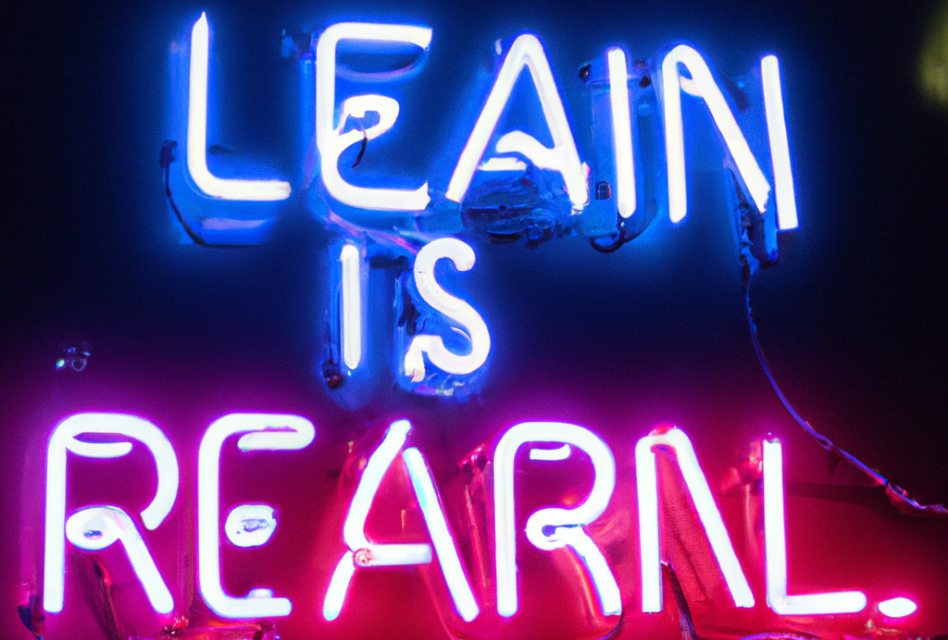
The public availability of AI chatbots has been one of the most talked-about innovations to emerge in the closing months of 2022. Considerable discussion and thought on the subject has been playing out on social media, in blogs, and in the media, among learning scholars, tech writers, and within our cohort. It is a new technology worthy of examination, as it does have impacts on learning, exposes new dimensions of our reliance on and use of technology, and prompts consideration of risks and usability issues, as well as presenting some interesting opportunities for how the technology can be used in productive ways.
A few weeks ago, our chat channel lit up with links and discussions around DALL•E and ChatGPT, both tools released in public form by OpenAI, a company whose stated mission is “to ensure that artificial general intelligence (AGI)—by which we mean highly autonomous systems that outperform humans at most economically valuable work—benefits all of humanity” (About OpenAI, n.d.). Jess posted some of her experiments using DALL•E and ChatGPT for some of her consulting work. I posted an article about Professor Ethan Mollick’s experiments with ChatGPT and exploring its implications (Mollick, 2022). A few of us wondered whether the chatbot could write our essays for us. It couldn’t – but it provided seeds of thinking and discussion that led to this blog post.
The Organisation for Economic Co-operation and Development (OECD) defines innovation broadly as “the implementation of a new or significantly improved product (good or service), or process, a new marketing method, or a new organisational method in business practices, workplace organisation or external relations” (OECD, 2005, para. 146). In learning, innovation could apply to an instructional design model, a learning technology, a theoretical framework, or any number of different elements that impact the “product” of knowledge transfer or skill acquisition.
“Used ethically and responsibly, AI tools can be used to promote thoughtful discourse, help generate new ideas, and ultimately spend time on the more human activities such as empathy and unstructured creative thought, leaving the more mechanical, process-driven work to the machines.”
By this definition, AI text and image generators qualify as innovations, as they offer new methods by which users can collect, create, or aggregate existing data into something “new.” In learning contexts, these technologies are new, and seem to be rapidly diffusing into mainstream availability. Mollick (2022) points out examples of how ChatGPT can be used by instructors to generate lesson plans, assignments, even lecture materials, and for summarizing research. While it can also write reasonably well, it does not produce content that is particularly novel or interesting. However, as a tool to break out of a writer’s block, or to build a starting framework for writing, it can generate content that can be a useful starting point.
I have colleagues who have enthusiastically embraced DALL•E as an option for their students to use in sourcing visual material for interaction design projects. Where previously they would sometimes spend hours sifting through royalty-free stock image libraries for photographs or illustrations that fit the tone and messaging for a project they are working on, students can instead spend much less time directing DALL•E (or other AI image generators) to generate the image content they want in a visual style that is consistent with their communication goals. Students are being taught to use these tools as a way to work more efficiently and to focus their efforts on work that is more important, more difficult, and more valuable – the empathy-driven parts of the design process.
Using these tools does require a certain amount of skill in order to adjust parameters, to iterate productively, and to get high-quality results. These tools are not without risks or controversy. AI art generators “learn” different visual styles and content by being fed source material which includes copyrighted works by living and working photographers and illustrators. However, the images generated can also avoid ethical entanglements of real human subjects being used in project work where they might potentially be seen as exploitation (Maimann, 2022). Of course, another risk is academic integrity. This new form of plagiarism poses challenges for both students and for educators (Rosenblatt, 2022). Tools to detect AI-generated content have already begun to emerge, giving educators an additional way to verify the originality of submitted content.
With these technologies being so new, their value is still difficult to fully ascertain. But if they are included in the academic tool kit, and students are taught to use the tools ethically and responsibly, the risks can be minimized and they can be used to promote thoughtful discourse, help generate new ideas, and ultimately spend time on the more human activities such as empathy and unstructured creative thought, leaving the more mechanical, process-driven work to the machines. The rapid emergence of these technologies, and the pace at which they are growing and improving, means we cannot be complacent in how we approach them in both teaching and learning activities.
References
About OpenAI. (n.d.). Retrieved 30 December 2022, from https://openai.com/about/
Maimann, K. (2022, December 31). AI-generated images raise money for charity. What’s wrong? The Toronto Star. https://www.thestar.com/news/canada/2022/12/31/this-image-is-raising-money-for-a-toronto-charity-the-only-problem-its-not-real.html
Mollick, E. (2022, December 6). The Mechanical Professor. One Useful Thing. https://oneusefulthing.substack.com/p/the-mechanical-professor
OECD. (2005). Oslo Manual: Guidelines for Collecting and Interpreting Innovation Data, 3rd Edition. https://read.oecd-ilibrary.org/science-and-technology/oslo-manual_9789264013100-en
Rosenblatt, K. (2022, December 7). ChatGPT can generate an essay. But could it generate an “A”? NBC News. https://www.nbcnews.com/tech/chatgpt-can-generate-essay-generate-rcna60362


Fantastic blog post, Darren. I found it interesting that some of your colleagues are letting students use AI for idea generation or to generate images based on a design theme. In my speculative futures essay, I posited the concept of students using AI to get started on a graphic design assignment, but this prediction was for something that might happen by 2030; crazy to think this is instead happening now.
Do you think future students will need baseline skills in a field such as graphic design? With these new AI tools, how can instructors ensure students learn baseline skills, or should they even worry about that and instead focus on teaching students how to use these new AI tools most effectively?
Thanks, Michael. My colleagues are not only allowing use of AI, but encouraging it! Apparently ChatGPT also writes decent code as well.
I had a similar experience with my speculative futures piece, where I was envisioning AI avatars that could read from a text-based script. Within a couple of weeks, I learned about a company called Synthesia, which does pretty much exactly that.
I think we do still need to teach things like composition, colour theory, semiotics, etc. as part of baseline design education. Part of using AI technologies to “execute” ideas is also having the skills to be able to evaluate whether the output is good or not, and to provide direction to make it better. When Furniture Bank used AI to generate images for its recent campaign, they hired an experienced creative director who was familiar with the technology to guide the AI to produce a series of images that all matched what their communication goals are, but also had a cohesive look for a campaign.
The advantage is that students can learn to “direct” an AI the way they might direct a photographer, illustrator, or videographer to get a particular result, which is a skill most don’t get the opportunity to even start to learn until they’ve been practicing in the field for a couple of years.
As with any technology, we have to remember “garbage in, garbage out.” If the AI is fed a poor quality brief, or the output is is not sufficiently evaluated for quality, we’ll end up with a lot of terrible stuff like the image at the top of this post.
Hi Darren,
Thank you for the enjoyable and informative read, and in particular, I enjoyed your closing sentence in the fifth paragraph:
“Students are being taught to use these tools as a way to work more efficiently and to focus their efforts on work that is more important, more difficult, and more valuable – the empathy-driven parts of the design process.”
To me, AI is a more-sophisticated version of time-saving tools and technologies that have become commonplace, such as templates, writing prompts, form letters, automatic replies, speech-to-text, predictive text, and numerous others through time. All these have gained wide acceptance and have saved their users countless hours that have then been applied elsewhere. It will be interesting to see AI’s effects on humans and humankind over the next five to 10 years and whether AI will be applauded or condemned.
Your article helped me see how I could possibly use AI for a course I am putting together for friends on the topic of overcoming limiting beliefs as they relate to completing a 50-kilometer trail walk or run. In most cases, my learners have the physical ability to complete the distance, but not the mental belief and in most cases, the disbeliefs revolve around a sense of “What if I fail?”. I believe reflection is a great tool for uncovering insights and for helping us move out of stuck positions. But I also realize that not everyone is comfortable writing their thoughts or speaking them. Perhaps AI can supplement the reflection process by serving as a teaching assistant, a guide, or a facilitator, much like journal prompts or map directions are used to move us from one point to another.
Thanks again for the read, which proved to be a great learning opportunity for me.
Bart
That is fantastic, Bart! Thank you for the feedback. I cannot recall the last time I saw a technology go from zero-to-EVERYBODY-IS-TALKING-ABOUT-IT in such a short time.
I’d love to hear about the course you’re putting together. AI as counsellor, confidante, and coach? Very interesting, indeed!