
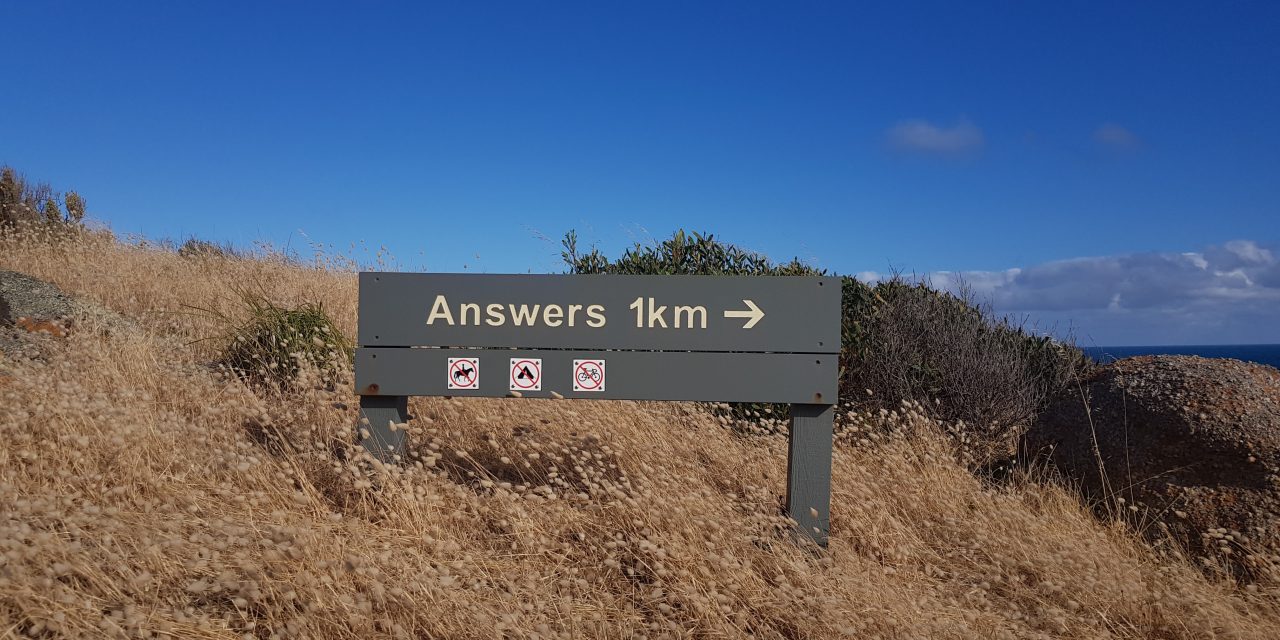
Photo by Hadija Saidi on Unsplash
Our cohort had the opportunity to engage in an open asynchronous Question and Answer session with Dr. George Veletsianos – Professor at Royal Roads University and Canada Research Chair in Innovative Learning and Technology – as we reached the conclusion of our course, Introduction to Research: Critical Reading and Writing.
Each team asked two to three questions, which covered a lot of ground with surprisingly little overlap. We touched on a range of subjects, including how to affect change at all levels of learning, emerging trends, and lessons learned through a career of research. Dr. Veletsianos offered thoughtful answers and candid insights. A few of the key themes that stood out for me are summarized here.
Affecting change
One of the key messages here is that to affect change, we must be seen as a trusted advisor, a partner, and collaborator with the organizations and teams with which we will be working to facilitate change in learning, whether that is in classrooms, administration, policy, or other organization-based learning environments.
“No person can institute or foster change by themselves, I believe.”
Dr. George Veletsianos (2022a)
This builds on key learnings from our course Digital Learning Environments, Networks, Communities. Our networks – our communities, both digital and physical – play an important role in developing those relationships and having the ear of key decision-makers responsible for envisioning, designing, and implementing change in the learning space.
I also appreciate Dr. Veletisanos’ belief in the power of storytelling (Veletsianos, 2020a), and the ability to weave together a compelling narrative, and guide people on a journey through an idea as a valuable skill to develop.
The importance of research in learning
The pandemic has been a catalyst for change in many areas, including working and learning remotely. While these activities were possible before the pandemic, they were thrust into mainstream awareness by an extraordinary set of circumstances. Of course, the emergency remote teaching experience has been widely critiqued, and it is important that we make that distinction: What most people experienced during the pandemic was not best-practices-based remote learning. It was rapidly implemented, do-the-best-we-can-on-short-notice remote learning (Hodges et al., 2020).
I appreciate Dr. Veletsianos’ emphasis on the research into remote and blended learning that was being done long before the pandemic, and that much of the criticism of what teachers and learners experienced over the last two years comes from outside of the world of learning (Veletsianos, 2022b). There will be a need for fact-checking and balancing new findings against existing research on the remote learning experience.
Exploring different research methods
It is reassuring to hear that the different research methods we are learning are not just abstract ideas that apply only in the world of academia. No single research approach works in every situation, and having exposure to a variety of different research methodologies will help us to choose the most appropriate one for our research objectives (Veletsianos, 2022c) as we move forward not only through our studies, but in our post-MALAT work as well. We will need to continually challenge ourselves to assess and evaluate available research and our own methodologies to ensure that we are making the best research decisions possible.
Emerging trends in EdTech
I think the most exciting part of Dr. Veletsianos’ response here is the possibility of a radical re-imagining of what education could look like (Veletsianos, 2020d). Our current learning systems go back hundreds, even thousands of years. Are the systems of K-12 and models of higher learning – which were designed in (and for) a different time, when society had dramatically different needs and modes of communicating – still effective and relevant today? New technological capabilities have slowly been incorporated into these old systems, but what would learning look like if we started with a blank slate? That kind of change is exciting to imagine.
Reading broadly
This part of the Q&A resonates strongly with me. Over the course of my career, I have developed a philosophy of creativity built strongly on collaborative thinking and by pushing outside of the “comfort zone” of what we already know. The cognitive processes of creativity and the different ways new ideas may be formed are areas of deep interest for me, and subjects I hope to incorporate into my research.
“Reading broadly … allows you to make connections between different topics that might be fruitful in some way.”
Dr. George Veletsianos (2020e)
The idea of “reading broadly” (Veletsianos, 2020e) supports and reinforces the idea that discomfort and the unknown play important roles in creative thinking. This kind of integrative thinking is identified by Tim Brown (2008) in his pioneering work on Design Thinking. Where Brown’s work is focused primarily on the business sector, Wilson and Zamberlan (2015) expand this kind of thinking into other design disciplines, many of which are new and emerging.
While it is important to learn as much as we can in areas that are of interest to us, we should also make a habit of exploring ideas that may be tangentially related to our primary area(s) of focus and see whether these different paths of inquiry can be incorporated into our work, adding greater depth of thought or introducing new ideas that may cause friction with views we already hold.
Friction creates heat. It creates electricity. That’s where the sparks of new ideas are formed.
References
Brown, T. (2008). Design thinking. Harvard Business Review, 86(6), 84–92.
Hodges, C., Moore, S., Lockee, B., Trust, T., & Bond, A. (2020, March 27). The difference between emergency remote teaching and online learning. Educause Review. https://er.educause.edu/articles/2020/3/the-difference-between-emergency-remote-teaching-and-online-learning
Veletsianos, G. (Host). (2020a). Response to team one question 1a [Audio recording]. https://www.dropbox.com/s/nixczg5texj1fba/team1.mp3
Veletsianos, G. (Host). (2020b). Response to team two question 2 [Audio recording]. https://www.dropbox.com/s/50f3rb56d9k07la/team2.mp3
Veletsianos, G. (Host). (2020c). Response to team three question 1 [Audio recording]. https://www.dropbox.com/s/s16oclir5605hgp/team3.mp3
Veletsianos, G. (Host). (2020d). Response to team four question 2 [Audio recording]. https://www.dropbox.com/s/n54h2hgtnmliezz/team4.mp3
Veletsianos, G. (Host). (2020e). Response to team five question 1 [Audio recording]. https://www.dropbox.com/s/728rygem4qdftmn/team5.mp3
Wilson, S., & Zamberlan, L. (2015). Design for an unknown future: Amplified roles for collaboration, new design knowledge, and creativity. Design Issues, 31(2), 3–15. https://doi.org/10.1162/DESI_A_00318


Enjoyed your thoughtful post, Darren. You have some good insights on each of the questions that George addressed…not the least of which is the metaphor about sparking change and creativity.