
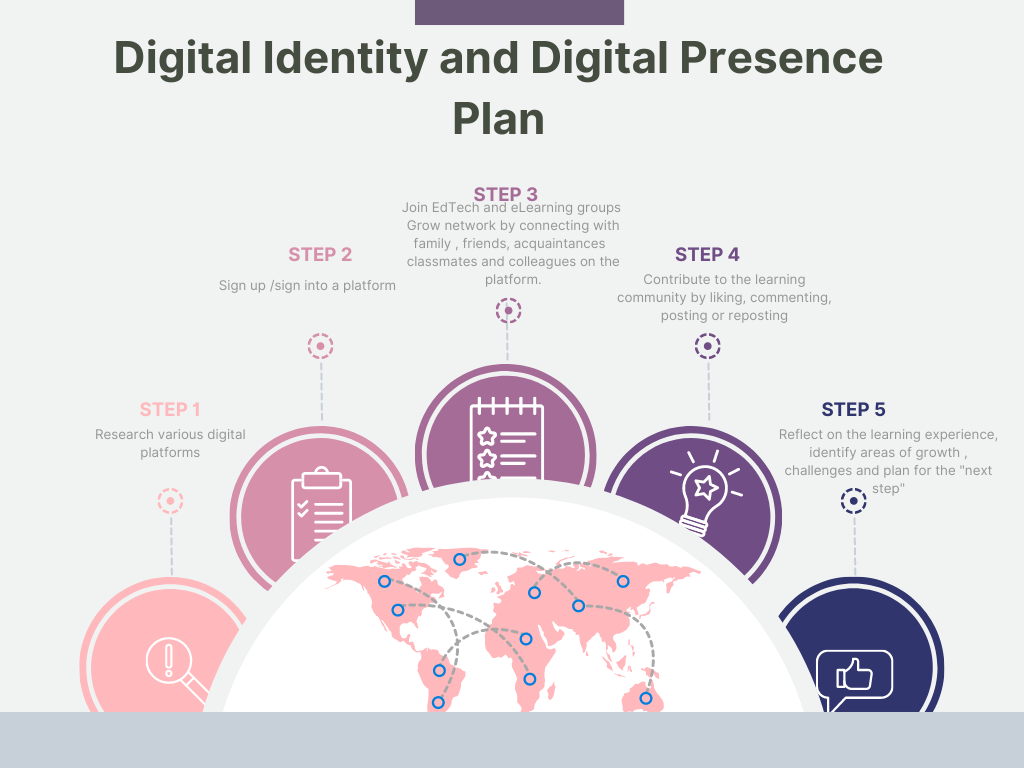
My goal for cultivating a digital presence and identity is to learn and contribute to a digital community. Digital communities consist of various engagement mediums, including text, pictures, video and audio. According to Garrison et al., text-based information can promote higher-order cognitive learning by allowing time for reflection (2000). By joining a digital platform and cultivating a digital presence, I can reflect, learn, engage and contribute to the community.
My approach is to first research different social platforms where I can be a contributor and learner. Finding a medium that I feel comfortable signing into will allow me to start forming connections. I plan to join Education, EdTech and E-learning groups and follow influencers in the field on my selected platform.
Naturally, I like connecting with people in person and socializing, but I am still learning to share online outside of my immediate circle of family and friends. I often ask myself what Cronin calls the “ Macro level question: Will I share openly” ( 2017). I am yet to learn how to share online while respecting my need for privacy. Connecting on a platform like LinkedIn will allow me to “connect with a world beyond my close friends and family” ( Boyd, 2011).
To address my need for privacy, I will start small by joining online Ed Tech communities and groups and surveying the land. According to Barab and Duffy (2000), communities “are part of something larger than the individuals participating in them.” Joining groups on a digital platform will allow me to connect and learn with some experts in the field and open the door to many possibilities.
Once I get comfortable in the online groups, I will comment on posts to show support and eventually post in these groups. To measure my success at the end, I will look at my activity within the platform and see how engaged and involved I have been. My likes/reposts will also serve as a library of things I found insightful within that learning community. My activity record will show me areas I need to improve, participate and be more engaged in.
I look forward to pushing myself out of my comfort zone, growing and engaging in rhizomatic learning ( Cromier, 2017).
Barab, Sasha A. and Thomas M. Duffy. ( 2000) .“From practice fields to communities of practice.” In Theoretical foundations of learning environments, edited by David H. Jonassen and Susan M. Land: pp. 25–55. Mahwah, NJ: Lawrence Erlbaum Associates.
Boyd, D. (2011). Social network sites as networked publics: Affordances, dynamics, and implications. In Z. Papacharissi (Ed.), A Networked Self (pp. 39–58). New York, NY: Rutledge.
Cronin, C. (2017, April 20). RRU Virtual Symposium: Choosing Open [Webinar]. Royal Roads University.
https://malat-coursesite.royalroads.ca/lrnt521/recordings/catherine-cronin-choosing-open/
Cormier, D. (2017, April 20). RRU Virtual Symposium: Intentional messiness of online communities [Webinar]. Royal Roads University.
Garrison, D. Randy., Anderson, T., & Archer, W. (2000). Critical Inquiry in a Text-Based Environment: Computer Conferencing in Higher Education. The Internet and Higher Education, 2(2-3), 87–105. https://auspace.athabascau.ca/bitstream/handle/2149/739/?sequence=1
A good start to your DIDP – and a really nice graphic!
I have also struggled somewhat with my desire for both an open online presence as an educator and a genuine concern for privacy. While I don’t have a perfect solution yet, my general approach has been to develop a professional persona that is genuine but perhaps not fully representative of everything about me. I do my best to share this persona openly in my chosen networks–but that does not mean that everything about me is openly shared.