

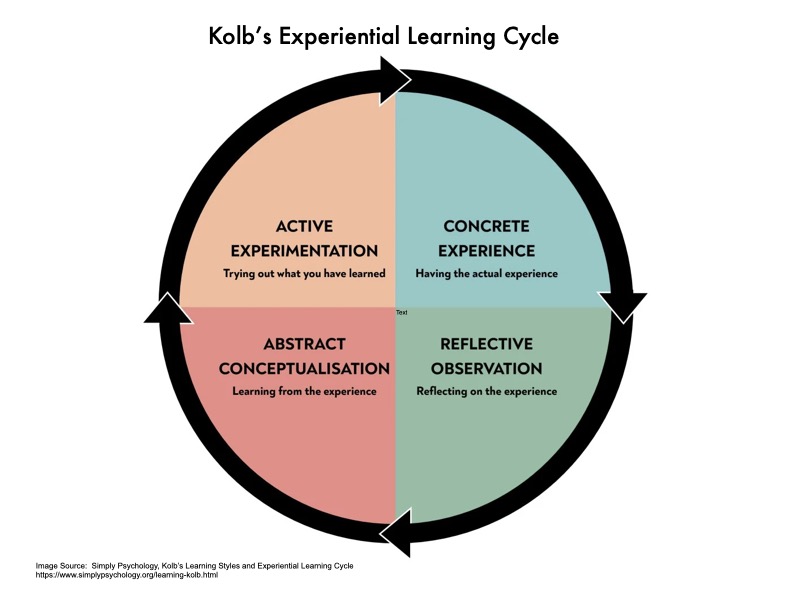
As an adult learner with learning differences, self-reflection has been essential in helping me identify strategies to adapt to different learning environments. I do my best thinking and creative problem-solving while moving, especially in nature. Walking in Fish Creek Park with my dog is both therapeutic and a powerful way to process ideas. Because I process information slowly, my learning tends to occur in short bursts, often through concise points and visuals. I enjoy using my whiteboard and dry-erase markers to create checklists, bullet points, and diagrams. Reflection is also a critical part of the clinical support my business provides to families and community agencies. What follows is a reflection on my course learning journey, framed within Kolb’s Experiential Learning Cycle (McLeod, 2025).
Concrete Experience – What Happened
Over the past several weeks, I developed the first draft of an online parenting course for my Psyched About Kids (PAK) child psychology clinic. This resource is designed to guide parents through a positive and successful potty training journey, offering practical tools, strategies, and science-backed insights to help them support their child with empathy, clarity, and fun.
Exploring the creation of a series of short, online courses has become part of my vision for PAK. These courses aim to equip parents with the knowledge, skills, and strategies to promote healthy family functioning and optimal child development. LRNT 527, Creating Digital Resources, provided the opportunity, foundational knowledge, and confidence to create my first online learning offering for clients.
I began the project by creating a project plan, course outline and storyboard with scripts to ensure clear learning objectives and identified Kajabi and Canva as my main production tools. Through feedback and course literature, I explored Vyond, InVideo, and Descript as other options for engaging course design and accessibility features. The course was published in Kajabi and incorporates a mix of text, videos, quizzes, additional resource links and downloadable activities.
From the beginning, I knew time, cost, technology, and my own capacity would influence what I could achieve in the first version. In line with Workman and Roux’s (2019) Build Something toolkit, I committed to creating a functional first draft, that will be supported by a “wish list” of future enhancements. Participant feedback will be an important guide in shaping the next iteration.
Reflective Observation – What I Noticed
Throughout development, I was reminded of my tendency to think big, far beyond my skills and available resources. As usual, I struggled to keep the project realistic while still leaning into my ambitions.
Relying heavily on Canva to produce the videos has resulted in some “old-school” PowerPoint format. While functional, it lacks some of the dynamic elements I had envisioned. To comply with accessibility standards, captions were added to videos using Descript, and combined with some text-heavy slides, I feel it makes them overwhelmingly busy.
Exploring new production platforms, such as InVideo and Vyond, lead to creative possibilities but also revealed the steep learning curve and high cost of mastering multimedia tools. Balancing accessibility, clarity, and engagement was a challenge that called for prioritization in the short term.
Another area I became aware of is my working knowledge of how to connect course design to measuring learning outcomes. The Toolkit is grounded in evidence-based content, but I would like to strengthen my skills in designing evaluation methods that clearly demonstrate whether the learning objectives are being met.
Abstract Conceptualization – What I Learned
This process advanced my understanding of the design thinking process, instructional design, and the realities of producing high-quality digital learning. I learned that:
- Starting with a strong framework makes it easier to adapt to challenges without losing direction.
- Balancing ambition, accessibility, engagement, and simplicity requires careful trade-offs.
- Cost, time, technology, and skill level must all be considered while planning.
- Continuous improvement has to be driven by participant feedback. It’s an essential part of learner centred design.
This learning journey also highlighted the importance of aligning all content with Psyched About Kids’ philosophy – leveraging the science behind child development to help children reach their potential. This means fostering healthy brain development through safe, supportive environments, trusting relationships, and enriching experiences. These shaped every decision in the Toolkit’s design.
4. Active Experimentation – How I’ll Apply This Going Forward
With this first draft published and accessible on Kajabi, my next steps are to:
- Collect feedback from three parent volunteers (one in the contemplation stage, one in preparation, and one with an older child experiencing regression) on content clarity, relevance, engagement, usefulness of activities and additional resources.
- Refine slide layouts to reduce cognitive load while maintaining accessibility – based on professional and parent feedback.
- Maintain a wish list of enhancements for future iterations, based on professional and parent feedback.
- Continue developing my technical skills to better integrate engaging, interactive elements. Along with my knowledge of outcome measurements.
Publishing my first course feels like a meaningful milestone, and I am proud of this starting point. I am grateful for the learning opportunity, which has expanded my skills and strengthened my motivation to continue evolving this resource. As usual, learning has opened new pathways forward, and I am excited to keep building, refining, and creating meaningful growth opportunities for parents and families.
Resources:
McLeod, S. (2025, March 19). Simply Psychology. Kolb’s Learning Styles And Experiential Learning Cycle. https://www.simplypsychology.org/learning-kolb.html
Worsham, D., & Roux, S. (2019). Design Process. Foundations in Learner-Centered Design. https://uclalibrary.github.io/foundations/modules/design-values/your-manifesto/