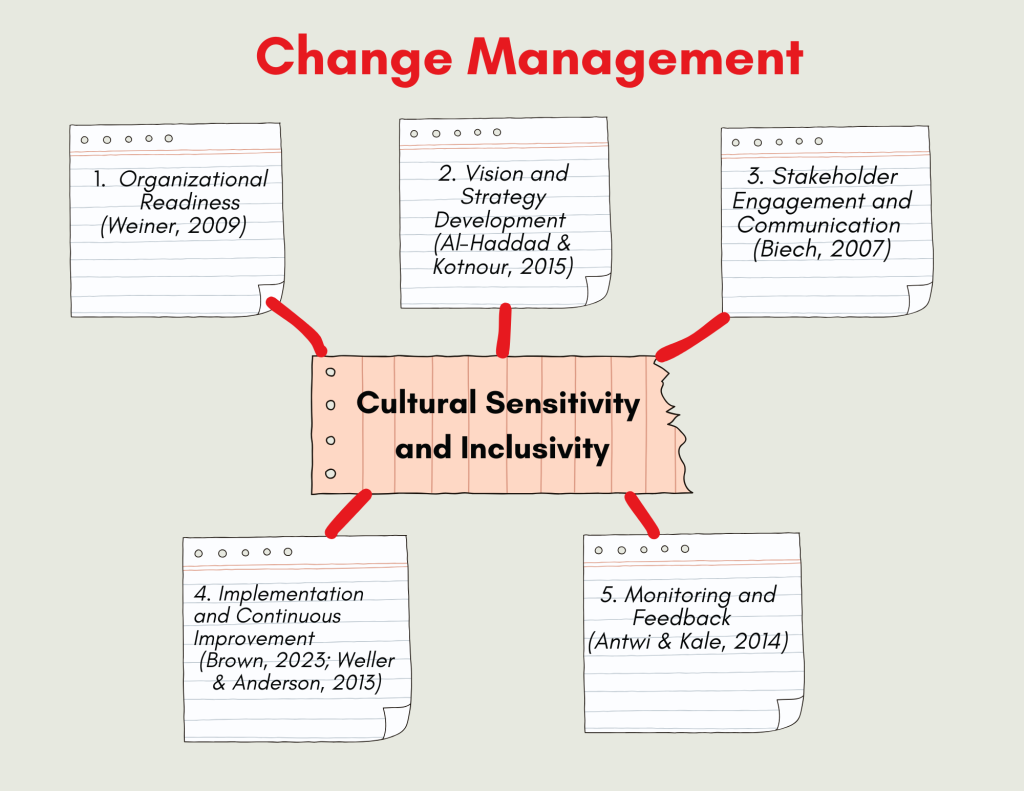
Leaders in digital learning environments must navigate continuous change while ensuring that organizational goals, stakeholder needs, and technological advancements are balanced. This model integrates key insights how successful change can be organized.
Organizational Readiness
Weiner’s (2009) theory of organizational readiness for change emphasizes the importance of shared commitment and influence in driving change efforts. Leaders must assess the current climate and readiness for adopting new technologies or pedagogies. My experience as the Aboriginal Education Coordinator highlights the value of initial readiness assessments to identify potential barriers or enablers for culturally relevant digital tools.
Vision and Strategy Development
Al-Haddad and Kotnour’s (2015) model underscore the importance of a clear vision and strategic planning in successful organizational change. Leaders must articulate a compelling vision and align it with institutional priorities. Developing strategies that respect and incorporate Indigenous knowledge is critical in my work with culturally responsive pedagogy.
Stakeholder Engagement and Communication
Biech (2007) identifies stakeholder engagement as a cornerstone of successful change. Open, transparent communication channels and inclusive decision-making help build trust. Consultation with colleagues and students ensures embracement of digital tools that meet diverse learning needs. Digital learning leaders must listen to and incorporate feedback from all stakeholders to stimulate engagement.
Implementation and Continuous Improvement
Brown (2023) emphasizes adaptive leadership in times of rapid change. Successful leaders are flexible and responsive, continuously refining strategies based on emerging challenges and feedback. Weller and Anderson (2013) introduce the concept of digital resilience, which involves adaptability in the face of technological disruptions. Leaders must implement constant improvements based on data-driven insights.
Monitoring and Feedback
Antwi and Kale (2014) advocate continuous monitoring and evaluation of change efforts to ensure goal alignment. This stage confirms that leaders remain accountable and transparent. Feedback creates opportunities for course correction and sustained change, which is critical for nurturing digital resilience in evolving learning environments.
Cultural Sensitivity and Inclusivity
Culturally responsive leadership plays a vital role across all stages, especially in Indigenous learning contexts. Udas (2008) emphasizes the need for open educational resources and distributed learning environments that respect cultural diversity. Integrating Indigenous knowledge systems and involving community voices ensures that change efforts are meaningful and effective.
Interview with Colleague
During my interview with the first-year Grade 5 teacher, our conversation highlighted the successful integration of First Voices, a digital platform for the Halq’eméylem language. This was successful due to inclusive planning, which involved input from Elders, language keepers, and committees to ensure cultural priorities were reflected. Professional development workshops helped teachers incorporate the platform into different subjects. The Grade 5 teacher agreed, noting that the workshops enabled them to integrate more language learning into their lessons and increased student confidence in using the app. We both celebrated the platform’s impact, particularly how it empowers students by preserving and celebrating their language in a modern format. The platform’s accessibility at home was also highlighted as a tool that extends learning beyond school walls. We ended the conversation by expressing excitement for future digital tools to strengthen Indigenous culture and language learning further.
Effective change leadership involves readiness assessments, clear visioning, stakeholder engagement, flexible implementation, and continuous feedback, all framed within culturally responsive practices. By aligning with these principles, leaders can drive sustainable, impactful change that supports diverse learning communities.
References
Al-Haddad, S., & Kotnour, T. (2015). Integrating the organizational change literature: A model for successful change. Journal of Organizational Change Management, 28(2), 234-262. doi.org/10.1108/JOCM-11-2013-0215
Antwi, M., & Kale, M. (2014). Change Management in Healthcare: Literature Review (January), 1–35.
Biech, E. (2007). Models for Change. In Thriving Through Change: A Leader’s Practical Guide to Change Mastery. Alexandria, VA: ASTD.
Brown, M. (2023). Leading in changing times. In O. Zawacki-Richter & I. Jung (Eds.), Handbook of Open, Distance and Digital Education (1st ed., pp. 199–220). Springer. 10.1007/978-981-19-2080-6_28
Feldstein, M. (2017, May 28). A flexible, interoperable digital learning platform: Are we there yet? [Blog post].
Udas, K. (2008, June 30). Distributed learning environments and OER: the change management challenge. [Blog post]. https://malat-webspace.royalroads.ca/rru0051/managing-change-for-learning-in-digital-environments/
Weiner, B. J. (2009). A theory of organizational readiness for change. Implementation Science, 4(67). 10.1186/1748-5908-4-67
Weller, M., & Anderson, T. (2013). Digital Resilience in Higher Education. European Journal of Open Distance and E-Learning, 16(1), 53-66.
Leave a Reply