
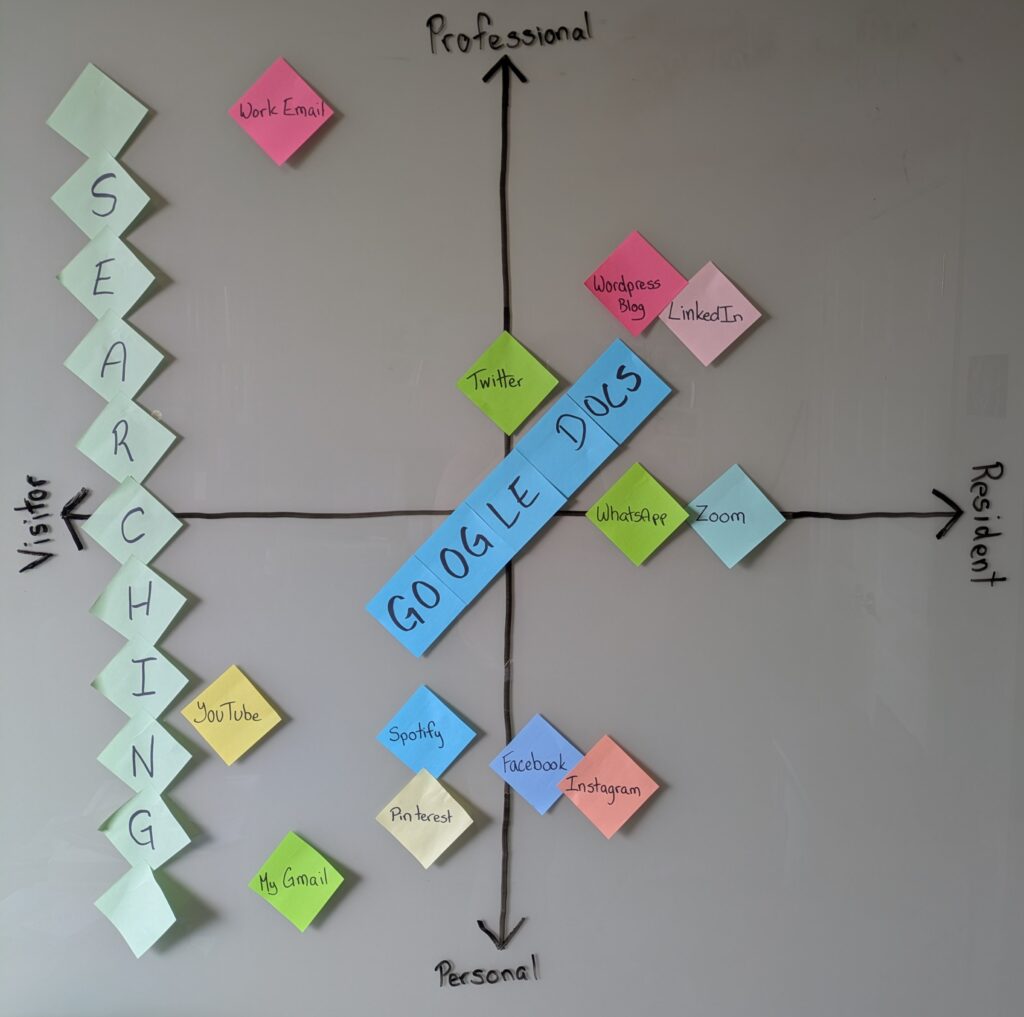
Resident-visitor typology
Mapping my technology use felt difficult as there were competing ideas in my head of what it has been, what it currently is, and what it could be. Looking at past, present, and future use, I have reflected behaviors of actively contributing and collaborating (resident behavior) vs. passively exploring (visitor behavior).
Past
My technology usage in my personal life has transitioned from active to passive in recent years, skewing my map towards the visitor end of the spectrum. When I first joined Facebook and Instagram, I posted regularly and interacted with others. While I haven’t posted on Instagram or Facebook regularly for a couple of years, my past interactions still live on through my profiles, projecting a persona of who I have been.
Present
In my professional life, I have been shifting further into the resident role. This is largely due to a certain level of expectation in my work of reposting content on LinkedIn, or leading workshops and presentations through Zoom. My professional digital presence has been crafted more intentionally to display a certain image, but it doesn’t always feel like a complete reflection of myself.
Future
As I look forward, I am curious about how I can get more comfortable writing blog posts. I find the permanency of the digital world quite overwhelming; I worry about being misunderstood and having judgements made about me. As social media has evolved, I have found it interesting the level of vulnerability that many content creators demonstrate, and I think about how I can use vulnerability in my own posts.
For me, this looks like being able to share a true representation of who I am and what I know, and how the two influence each other.
Alternative Tension Pair
The consideration of an alternative tension pair (Cormier, 2018) is an interesting way to explore these ideas further. As my map sits currently, it shows a limited view of how I interact, specifically in a digital context, it doesn’t recognize the analogue interactions that are had as well.
References
Cormier, D. (2018, March 31). Digital Practices Mapping – Intro activity for digital literacies course. Dave’s Educational Blog. davecormier.com/edblog/2018/03/31/digital-practices-mapping-intro-activity-for-digital-literacies-course/
White, D. S., & Le Cornu, A. (2011). Visitors and Residents: A new typology for online engagement. First Monday, 16(9). doi.org/10.5210/fm.v16i9.3171
Hi Gen,
I think you have identified an interesting contrast: While the activity in our digital lives fluctuates over time, the content we publish is often permanent. This leaves a public record of the person we were and the person we have become, but the viewer rarely sees the whole record in one place. As a result, anything we share online is likely to be viewed without context, and therefore open to misinterpretation.
Claire
Hi Gen,
As I was working on my map, I started thinking about how I use social media (Instagram, Facebook, Threads, etc.). At first, I thought about placing them on the “resident” side of the continuum, but then I realized I never actually post anything. And I don’t even have a profile picture. That made me reconsider, and I ended up seeing myself more as an observer, so placing them closer to the “visitor” side made more sense. I also feel like, even when I do engage, the persona I present isn’t always a true reflection of who I am.
I like that you used sticky notes. Great idea! 🙂
Hi Gen,
Your post resonates with me, especially regarding the transition over time from resident to visitor and I agree: it might be tightly related to another point you’re making : vulnerability (and the inherent fear of being judged tied to it). But why the change over time ? My guess would be because society judges content more critically nowadays.
Flo
Hi Gen,
I really appreciate your decision to reflect on your use of technology through the lenses of past, present, and future. It clearly highlights how we grow and evolve as individuals over time; whether those changes are intentional, socially influenced, or a combination of both is an interesting question to consider.
I can relate to what you shared about your engagement with social platforms. Over the years, my own use has shifted quite significantly from being more of an active resident to a more passive visitor. It wasn’t a deliberate change so much as a gradual decrease in my desire to maintain a strong personal presence online.
I also really enjoyed your creative approach to mapping your technology use on a whiteboard with post-it notes. It reinforces the idea that this kind of map isn’t fixed, it’s a living document that will continue to shift and evolve over time.
Celine
Hi Gen,
I really related to your shift between resident and visitor roles, especially how it differs p between personal and professional spaces. The idea of digital permanence and fear of being misunderstood really resonated.
I also loved that you created your map with your whiteboard and post-it notes. It feels like a great way to bring in that analogue side you mentioned.
Your point about vulnerability stood out too. It made me think about how sharing authentically doesn’t have to mean sharing everything, but finding a balance that feels right.
Something I am curious about. What would make you feel more comfortable starting to blog?
Kelly